Sunday, November 30, 2025

The rise of the autistic detective – why neurodivergent minds are at the heart of modern mysteries


There never seems to be a shortage of good crime shows on TV, and network television is teeming with detectives who think – and act – differently.

This fall, new seasons of “Elsbeth,” “High Potential,” “Patience” and “Watson” have aired, and they all feature leads who share similar characteristics: They’re outsiders, they’re socially awkward, they can be emotionally distant, and their minds operate in unconventional ways.

In fact, they all possess traits that align with what many people now associate with neurodivergence – what scholar Nick Walker defines as “a mind that functions in ways that diverge significantly from the dominant societal standards of ‘normal.’”

As a scholar of popular culture, I’ve long been fascinated by this recurring character type – detectives who might, today, be diagnosed as having autism spectrum disorder.

While researching my forthcoming book, “The Autistic Detective,” I’ve come to realize that most detectives in popular culture – yes, even Sherlock Holmes – exhibited neurodivergent characteristics, long before the term existed.

The thin line between genius and madness

In the late 19th century, when Sherlock Holmes was created, there was widespread scientific interest in the workings of the mind, particularly the thin line between genius and madness.

British psychologist James Sully described “men of genius” as exhibiting “intellectual or moral peculiarities which are distinctly symptomatic of mental disease,” naming Edgar Allan Poe as an example of the “tragic fatefulness of geniuses.” Italian criminologist Cesare Lombroso, meanwhile, proposed that madness, genius and criminality were all closely intertwined.

Such a fascination with exceptional minds – and the idea that madness and genius are two sides of the same coin – fed into the heart of detective fiction. And although later scholars have criticized the linking of neurodivergence to pathology, violence or genius, the trope remains common in popular culture, where it’s often used to signal the exceptional mind of a detective figure.

Now, however, many fans are able to connect these characteristics to specific diagnostic labels. According to CDC data from April 2025, autism diagnoses in U.S. children have risen sharply over the past two decades – from about 1 in 150 in 1998 to roughly 1 in 31 today. This reflects not only a broadened definition of the autism spectrum but also signals greater public awareness and acceptance of neurodivergence.

That growing understanding has led to renewed interest in Holmes. From online fan forums to The New York Times, people have debated whether Holmes might be autistic, wondered whether another label would be more appropriate, or highlighted the futility of trying to diagnose a fictional character.

Super intelligence and social dysfunction

That said, it’s hard not to see some neurodivergent traits in Sherlock Holmes and other fictional detectives.

Tunnel vision, pattern recognition and attention to detail are all traits that could be exhibited by autistic people.

Holmes was fixated on minute details: One story highlighted how he authored a study on the ashes of 140 different varieties of pipe, cigar and cigarette tobacco. He had an unmatched talent for noticing overlooked details and piecing together disparate clues. And he was obsessed with forensic science.

He could also come off as cold. As Holmes declared in “The Sign of the Four,” “Emotional qualities are antagonistic to clear reasoning.”

In Edgar Allan Poe’s 1841 short story “The Murders in the Rue Morgue,” which is widely considered the first detective fiction story, the protagonist, C. Auguste Dupin, also hyperfocuses on small details, reasons through “pure logic” and is socially reclusive – all qualities displayed by Holmes.

Even Dr. Watson, Holmes’ sidekick, noticed the resemblance.

“You remind me of Edgar Allen Poe’s Dupin,” he tells Holmes in “A Study in Scarlet.” “I had no idea that such individuals did exist outside of stories.”

When Sherlock Holmes creator Arthur Conan Doyle famously killed off the detective at Reichenbach Falls in his 1893 story “The Final Problem,” there was so much public outrage that the author was eventually forced to bring him back from the dead.

These 19th-century Sherlock enthusiasts were predecessors to today’s media fandoms. Their level of devotion, unlike anything previously seen for a fictional character, was a testament to the power of Doyle’s formula: an extraordinary investigator with savantlike cognitive abilities who upholds logic over emotion, thrives in solitude and yet still depends on his companion – in Holmes’ case, Dr. Watson, who serves as an emotional counterbalance.

In the 21st century, that formula has been revived in wildly popular TV shows such as “Bones,” “Criminal Minds” and “Sherlock.”

In 2016, “Sherlock” co-creator Steven Moffat told the BBC, “Doyle began the idea that super-intelligence comes at the price of some kind of social dysfunction, something that we’ve grasped as a narrative possibility ever since.”

In other words, the more eccentric – or socially dysfunctional – a detective is, the more ingenious the hero seems.

A new era for the detective

Detective fiction might have started as a way to explore the deviant, non-normative minds of detectives and the criminals they pursued. But it has since become a space for neurodivergent self-representation.

Today, scholars, fans, reviewers and scientists openly discuss diagnostic labels for fictional characters. This surge in interest coincides with a rise in research on portrayals of autism in the media and a growing number of autistic voices examining how those portrayals shape public understanding.

Disability scholars have long warned of disabled characters being used as mere plot devices and have criticized the lack of diversity in representations of detectives who appear to be autistic on screen.

Yet many of the new shows push back against some of the stereotypes of autistic people as cold, lonely and incapable of affection. Instead, they have friends. They have romantic partners. They’re empathetic.

The series “Elsbeth” and “High Potential” center on quirky, intelligent female investigative leads who appear to be on the autism spectrum. In HBO’s 2020 miniseries “The Outsider,” detective Holly Gibney appears as one of the first Black, autistic female detectives on television.

While most of these characters aren’t explicitly identified as autistic in their shows, “Extraordinary Attorney Woo” features a female attorney whose diagnosis is openly discussed by the show’s characters.

‘Extraordinary Attorney Woo’ is a Korean series centered on an autistic, early-career attorney.

The British-Belgian series “Patience,” meanwhile, is the first detective show to feature an explicitly autistic character played by a neurodivergent actress, Ella Maisy Purvis.

“It was really important to me that she wasn’t this kind of robotic, asexual drone,” Purvis told the Big Issue in 2025. “Patience is highly empathetic. She cares so much about her job and the people around her. It’s just expressed in a different way.”

These varied portrayals coincide with the rise of online fan communities where neurodivergent fans share what these stories mean to them. If the archetypal detective once tried to “make sense” of neurodivergent minds, today’s neurodivergent fans and creators are now having a hand in shaping them.

Perhaps most importantly, they no longer have to wonder whether they’re being represented on screen.The Conversation

Soohyun Cho, Assistant Professor at the Center for Integrative Studies in the Arts & Humanities, Michigan State University

This article is republished from The Conversation under a Creative Commons license. 

More than half of new articles on the internet are being written by AI – is human writing headed for extinction?


Preserving the value of real human voices will likely depend on how people adapt to artificial intelligence and collaborate with it. BlackJack3D/E+ via Getty Images

The line between human and machine authorship is blurring, particularly as it’s become increasingly difficult to tell whether something was written by a person or AI.

Now, in what may seem like a tipping point, the digital marketing firm Graphite recently published a study showing that more than 50% of articles on the web are being generated by artificial intelligence.

As a scholar who explores how AI is built, how people are using it in their everyday lives, and how it’s affecting culture, I’ve thought a lot about what this technology can do and where it falls short.

If you’re more likely to read something written by AI than by a human on the internet, is it only a matter of time before human writing becomes obsolete? Or is this simply another technological development that humans will adapt to? 


It isn’t all or nothing

Thinking about these questions reminded me of Umberto Eco’s essay “Apocalyptic and Integrated,” which was originally written in the early 1960s. Parts of it were later included in an anthology titled “Apocalypse Postponed,” which I first read as a college student in Italy.

In it, Eco draws a contrast between two attitudes toward mass media. There are the “apocalyptics” who fear cultural degradation and moral collapse. Then there are the “integrated” who champion new media technologies as a democratizing force for culture.

Back then, Eco was writing about the proliferation of TV and radio. Today, you’ll often see similar reactions to AI.

Yet Eco argued that both positions were too extreme. It isn’t helpful, he wrote, to see new media as either a dire threat or a miracle. Instead, he urged readers to look at how people and communities use these new tools, what risks and opportunities they create, and how they shape – and sometimes reinforce – power structures.

While I was teaching a course on deepfakes during the 2024 election, Eco’s lesson also came back to me. Those were days when some scholars and media outlets were regularly warning of an imminent “deepfake apocalypse.”

Would deepfakes be used to mimic major political figures and push targeted disinformation? What if, on the eve of an election, generative AI was used to mimic the voice of a candidate on a robocall telling voters to stay home?

Those fears weren’t groundless: Research shows that people aren’t especially good at identifying deepfakes. At the same time, they consistently overestimate their ability to do so.

In the end, though, the apocalypse was postponed. Post-election analyses found that deepfakes did seem to intensify some ongoing political trends, such as the erosion of trust and polarization, but there’s no evidence that they affected the final outcome of the election.

Listicles, news updates and how-to guides

Of course, the fears that AI raises for supporters of democracy are not the same as those it creates for writers and artists.

For them, the core concerns are about authorship: How can one person compete with a system trained on millions of voices that can produce text at hyper-speed? And if this becomes the norm, what will it do to creative work, both as an occupation and as a source of meaning?

It’s important to clarify what’s meant by “online content,” the phrase used in the Graphite study, which analyzed over 65,000 randomly selected articles of at least 100 words on the web. These can include anything from peer-reviewed research to promotional copy for miracle supplements.

A closer reading of the Graphite study shows that the AI-generated articles consist largely of general-interest writing: news updates, how-to guides, lifestyle posts, reviews and product explainers.

The primary economic purpose of this content is to persuade or inform, not to express originality or creativity. Put differently, AI appears to be most useful when the writing in question is low-stakes and formulaic: the weekend-in-Rome listicle, the standard cover letter, the text produced to market a business.

A whole industry of writers – mostly freelance, including many translators – has relied on precisely this kind of work, producing blog posts, how-to material, search engine optimization text and social media copy. The rapid adoption of large language models has already displaced many of the gigs that once sustained them.

Collaborating with AI

The dramatic loss of this work points toward another issue raised by the Graphite study: the question of authenticity, not only in identifying who or what produced a text, but also in understanding the value that humans attach to creative activity.

How can you distinguish a human-written article from a machine-generated one? And does that ability even matter?

Over time, that distinction is likely to grow less significant, particularly as more writing emerges from interactions between humans and AI. A writer might draft a few lines, let an AI expand them and then reshape that output into the final text.

This article is no exception. As a non-native English speaker, I often rely on AI to refine my language before sending drafts to an editor. At times the system attempts to reshape what I mean. But once its stylistic tendencies become familiar, it becomes possible to avoid them and maintain a personal tone.

Also, artificial intelligence is not entirely artificial, since it is trained on human-made material. It’s worth noting that even before AI, human writing has never been entirely human, either. Every technology, from parchment and stylus paper to the typewriter and now AI, has shaped how people write and how readers make sense of it.

Another important point: AI models are increasingly trained on datasets that include not only human writing but also AI-generated and human–AI co-produced text.

This has raised concerns about their ability to continue improving over time. Some commentators have already described a sense of disillusionment following the release of newer large models, with companies struggling to deliver on their promises.

Human voices may matter even more

But what happens when people become overly reliant on AI in their writing?

Some studies show that writers may feel more creative when they use artificial intelligence for brainstorming, yet the range of ideas often becomes narrower. This uniformity affects style as well: These systems tend to pull users toward similar patterns of wording, which reduces the differences that usually mark an individual voice. Researchers also note a shift toward Western – and especially English-speaking – norms in the writing of people from other cultures, raising concerns about a new form of AI colonialism.

In this context, texts that display originality, voice and stylistic intention are likely to become even more meaningful within the media landscape, and they may play a crucial role in training the next generations of models.

If you set aside the more apocalyptic scenarios and assume that AI will continue to advance – perhaps at a slower pace than in the recent past – it’s quite possible that thoughtful, original, human-generated writing will become even more valuable.

Put another way: The work of writers, journalists and intellectuals will not become superfluous simply because much of the web is no longer written by humans.The Conversation

Francesco Agnellini, Lecturer in Digital and Data Studies, Binghamton University, State University of New York

This article is republished from The Conversation under a Creative Commons license.

See you in the funny papers: How superhero comics tell the story of Jewish America


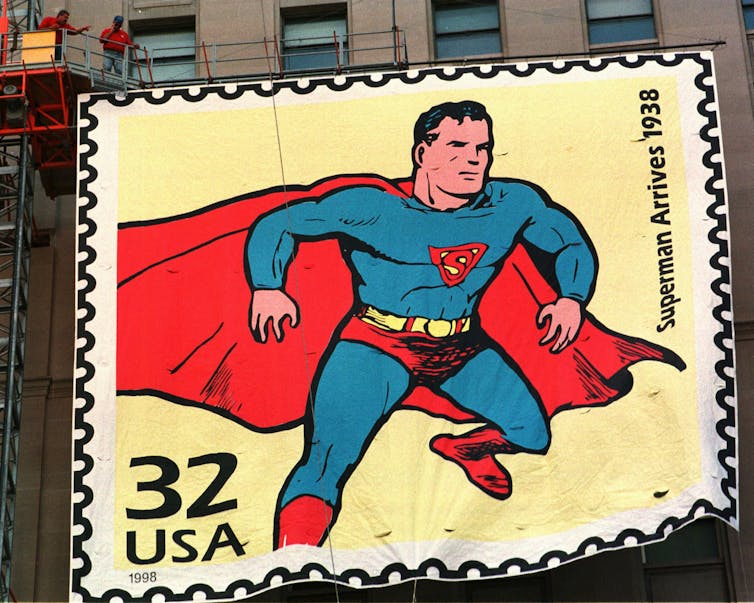
A five-story replica of a stamp of Superman in 1998 in Cleveland, home of the superhero’s creators, Jerry Siegel and Joe Shuster. AP Photo/Tony Dejak, File

Nearly a hundred years ago, a hastily crafted spaceship crash-landed in Smallville, Kansas. Inside was an infant – the sole survivor of a planet destroyed by old age. Discovering he possessed superhuman strength and abilities, the boy committed to channeling his power to benefit humankind and champion the oppressed.

This is the story of Superman: one of the most recognizable characters in history, who first reached audiences in the pages of Action Comics in 1938 – what many fans consider the most important single comic in history.

As a historian of American immigration and ethnicity – and a lifelong comics fan – I read this well-known bit of fiction as an allegory about immigration and the American dream. It is, at its core, the ultimate story of an immigrant in the early 20th century, when many people saw the United States as a land with open gates, providing such orphans of the world an opportunity to reach their fullest potential.

Taken in and raised by a rural family under the name Clark Kent, the baby was imbued with the best qualities of America. But, like all immigrant stories, Kent’s is a two-parter. There is also the emigrant story: the story of how Kal-El – Superman’s name at birth – was driven from his home on Planet Krypton to embrace a new land.

That origin story reflects the heritage of Superman’s creators: two of the many Jewish American writers and artists who ushered in the Golden Age of comic books.

Jewish history…

A faded colored card of people on two pieces of land separated by a thin strip of water, with a ship in the background.
A card from 1909, found in the Jewish Museum of New York, depicts Jewish Americans welcoming Jews emigrating from Russia. Heritage Images/Hulton Archive via Getty Images

The American comics industry was largely started by the children of Jewish immigrants. Like most publishing in the early 20th century, it was centered in New York City, home to the country’s largest Jewish population. Though they were still a very small minority, immigration had swelled the United States’ Jewish population more than a thousandfold: from roughly 3,000 in 1820 to roughly 3,500,000 in 1920.

Comic books had not yet been devised, but strip comics in newspapers were a regular feature. They began in the late 19th century with popular stories featuring recurring characters, such as Richard F. Outcault’s “Yellow Kid” and “the Little Bears” by Jimmy Swinnerton.

A few Jewish creators were able to break into the industry, such as Harry Hershfield and his comic “Abie the Agent.” Hershfield’s success was exceptional in three ways: He broke into mainstream newspaper comics, his titular character was also Jewish, and he never adopted an anglicized pen name – as many other Jewish creators felt they must.

Hulton Archive via Getty Images
Shoppers and vendors outside of haberdasheries on Hester Street in a Jewish neighborhood of New York’s Lower East Side around 1900. Photo by Hulton Archive/Getty Images

Generally, however, Jews were barred from the more prestigious jobs in newspaper cartooning. A more accessible alternative was the cheaper, second-tier business of reprinting previously published works.

In 1933, second-generation Jewish New Yorker Max Gaines – born Maxwell Ginzburg – began a new publication, “Funnies on Parade.” “Funnies” pulled together preexisting comic strips, reproducing them in saddle-stitched pamphlets that became the standard for the American comics industry. He went on to found All-American Comics and Educational Comics.

Another publisher, Malcolm Wheeler-Nicholson, founded National Allied Publications in 1934 and published the first comic book to feature entirely new material, rather than reprints of newspaper strips. He joined forces with two Jewish immigrants, Harry Donenfeld and Jack Leibowitz. At National, they created and distributed Detective and Action Comics – the precursors to DC, which would become one of the two largest comics distributors in history.

It was at Action Comics that Jerry Siegel and Joe Shuster, two second-generation immigrants from a Jewish neighborhood in Cleveland, found a home for Superman. It would also be where two Jewish kids from the Bronx, Bob Kane and Bill Finger – born Robert Kahn and Milton Finger – found a home for their character, Batman, in 1939.

A black and white photo of two men in suits looking at a large illustration of a superhero.
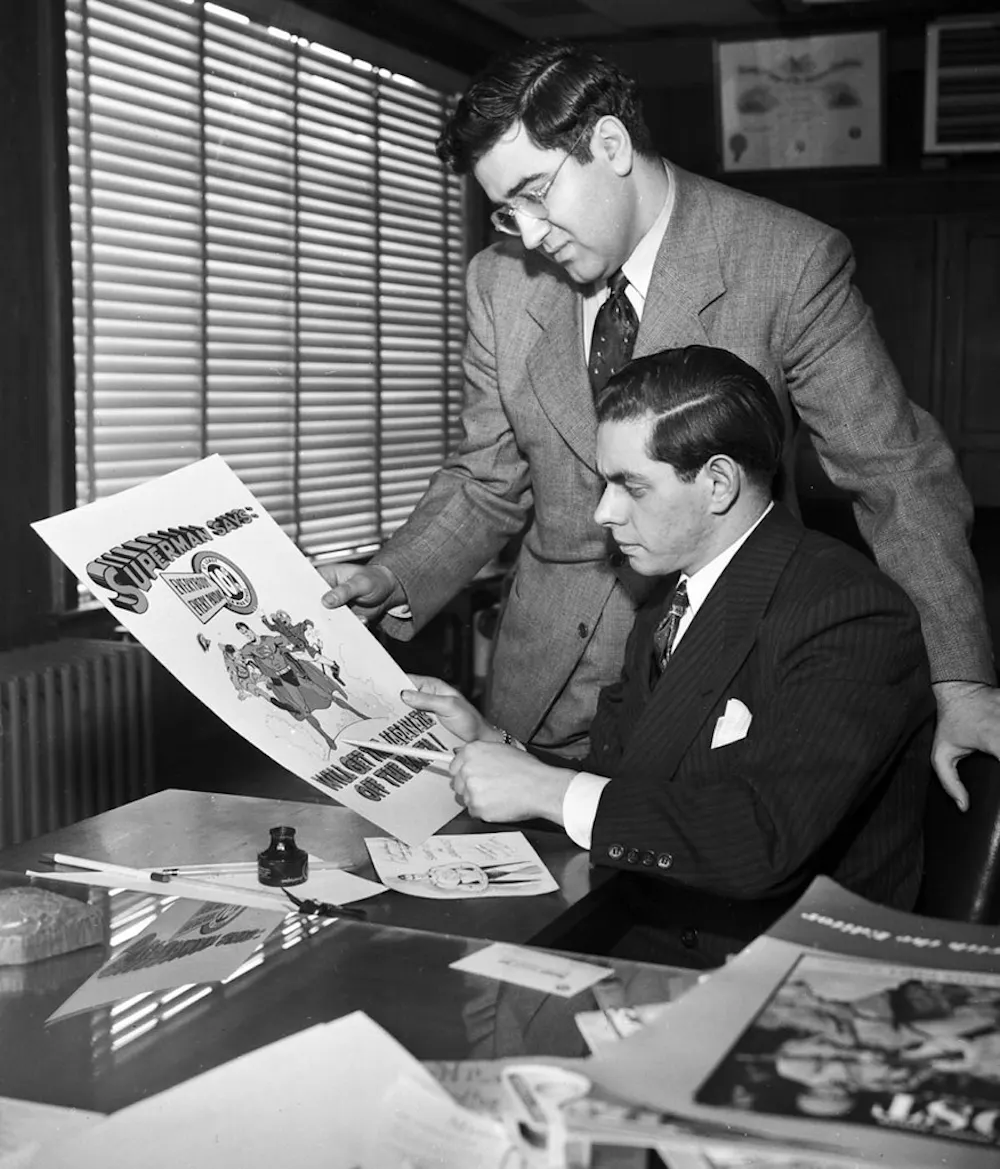
Jerry Siegel and Joe Shuster, creators of Superman, pictured in the 1940s. New Yorker/Wikimedia Commons

The success of these characters inspired another prominent second-generation Jewish New Yorker, pulp magazine publisher Moses “Martin” Goodman, to enter comics production with his line, “Timely Comics.” The 1939 debut featured what would become two of the early industry’s most well-known superheroes: the Sub-Mariner and the Human Torch. These characters would be mainstays of Goodman’s company, even when it became better known as Marvel Comics.

Thus were born the “big two,” Marvel and DC, from humble Jewish origins.

…and Jewish stories

The creation and popularization of superhero comics isn’t Jewish just because of its history. The content was, too, reflecting the values and priorities of Jewish America at the time: a community influenced by its origins and traditions, as well as the American mainstream.

Some of the most foundational early comics echo Jewish history and texts, such as Superman’s story, which parallels the Jewish hero Moses. The biblical prophet was born in Egypt, where the Israelites were enslaved, and soon after Pharaoh ordered the murder of all their newborn sons. Similarly, Superman’s people, the Kryptonians, faced an existential threat: the destruction of their planet.

Moses’ life is saved when his mother floats him down the Nile in a hastily constructed and tarred basket. Kal-El, too, is sent away to safety in a hastily constructed craft. Both boys are raised by strangers in a strange land and destined to become heroes to their people.

Comics also reflected the feelings and fears of Jews in a moment in time. For example, in the wake of Kristallnacht – the 1938 night of widespread organized attacks on German Jews and their property, which many historians see as a turning point toward the Holocaust – Finger and Kane debuted Batman’s Gotham City. The city is a dark contrast to Superman’s shining metropolis, a place where villains lurked around every corner and reflected the darkest sides of modern humanity.

Some comic artists and writers used their platform to make political statements. Jack Kirby – born Kurtzberg – and Hymie “Joe” Simon, creators of Captain America, explained that they “knew what was going on over in Europe. World events gave us the perfect comic-book villain, Adolf Hitler, with his ranting, goose-stepping and ridiculous moustache. So we decided to create the perfect hero who would be his foil.” The comic debut of Captain America in 1941 featured a brightly colored cover with the brand-new hero punching Adolf Hitler in the face.

In later generations, characters penned by Jewish authors continued to grapple with issues of outsider status, hiding aspects of their identity, and maintaining their determination to better the world in spite of rejection from it. Think of Spider-Man, the Fantastic Four and X-Men. All of these were created by Stan Lee – another Jewish creator, born Stanley Martin Lieber – who was hired into Timely Comics at just 17 years old.

With so many of the most popular comics written by New York Jews, and centered in the city, much of New York’s Yiddish-tinged, recognizably Jewish language made its way onto the pages. Lee’s Spider-Man, for example, frequently exclaims “oy!” or calls bad guys “putz” or “shmuck.”

In later years, Jewish authors such as Chris Claremont and Brian Michael Bendis introduced or took over mainstream characters who were overtly Jewish – reflecting an emerging comfort with a more public Jewish ethnic identity in America. In X-Men, for example, Kitty Pryde recounts her encounters with contemporary antisemitism. Magneto, who is at times friend but often foe of the X-Men, developed a backstory as a Holocaust survivor.

History is never solely about retelling; it’s about gaining a better understanding of complex narratives. Trends in comics history, particularly in the superhero genre, offer insight into the ways that Jewish American anxieties, ambitions, patriotism and sense of place in the U.S. continually changed over the 20th century. To me, this understanding makes the retelling of these classic stories even more meaningful and entertaining.The Conversation

Miriam Eve Mora, Managing Director of the Raoul Wallenberg Institute, University of Michigan

This article is republished from The Conversation under a Creative Commons license. 
Saturday, November 29, 2025

🌱 Theme: Resilience ✨ The Call to Quiet Action


If you are currently navigating a difficult season, remember that you don't need a public performance of strength. You don't need to post a triumphant caption or make a grand announcement about your comeback.

Your strength is yours alone, a silent contract between your spirit and your will. It is the act of gently straightening your shoulders when they want to slump, and consistently choosing hope over despair, one quiet morning at a time.

Embrace the whisper. Listen to the gentle, persistent voice within you that promises: "I will rise again."

It is in this quiet resolve that you will find your most enduring power.


🔹 Micro-Sparks Collection

Carrying Light Forward
When you find a spark, don’t keep it hidden. Pass it on, and watch the world brighten.


🌱 What does quiet strength look like for you? Share your thoughts in the comments below!