Thursday, February 23, 2017

Happiness mapped: why work is the place we feel the worst

Are you happy while you work? The answer to that question may depend on when you’re being asked it. Significant amounts of research suggest that people are – overall – happy with their jobs and get a sense of purpose from work. But our research suggests it’s not so simple.

The way that our study differs from many others is in the way we carried it out. Most research on happiness relies on surveys that ask people to reflect back on and evaluate their experiences “these days” or “nowadays”. In doing so, respondents usually attach weight to events that are related to their overall sense of well-being or satisfaction with their lives.

These studies find consistent evidence that paid work plays an important role in people’s happiness and overall life satisfaction. The research also finds that becoming unemployed results in a precipitous decline in well-being from which – unlike most other changes in personal circumstances – people do not fully recover.

Paid work is a central part of most people’s lives, so it should not be surprising to find that it is critical to the way we feel about ourselves and our sense of well-being. Perhaps it is because work generates a feeling of being worthwhile, leading to a sense of meaning or purpose in life.

To find out how people feel when they are at work – in the moment – one of us (George) designed an app called Mappiness, which allows people to record their well-being on-the-go via a smartphone. This enabled us to capture and analyse people’s feelings at the time they are doing an activity, rather than on reflection afterwards.

Real-time responses

With Mappiness, we were able to collect more than a million observations on tens of thousands of individuals in the UK, from August 2010. People who downloaded the app received randomly timed “dings” on their phone to request that they complete a very short survey. They were asked to rate how happy they felt and how relaxed they were; whether they were alone and, if not, who they were with; whether they were indoors, outdoors or in a vehicle; and whether they were at home, at work or elsewhere. Finally, they were asked what they were doing “just now”.

This way we got a spectrum of responses – including their feelings at work, at home or elsewhere. Together with the responses to the survey, the app transmits the location of the individual (via satellite positioning) and the precise time at which the survey was completed. It also records the time elapsed between the random “ding” and the response, thus making it possible to distinguish between immediate, random responses and delayed ones.


Mappiness captured real-time responses. shutterstock.com

Although there are drawbacks to this method of data collection (such as the non-random sampling of participants) it has considerable advantages over more traditional research methods where individuals are asked to reconstruct their activities and experiences of the preceding day. These surveys may be subject to recall bias and retrospective distortion. In contrast, Mappiness obtains instantaneous responses so that people report their feelings at the time they are undertaking the activity.

Anywhere but work?

Strikingly, our analysis of all these data found that paid work is ranked lower than any of the other 39 activities people engage in, with the exception of being sick in bed. The effect is equivalent to a 7-8% reduction in happiness relative to circumstances in which someone is not working. Time spent in paid work has a similarly bad (in fact, slightly larger) effect on how relaxed people feel.

Precisely how unhappy or anxious someone is while working depends on the circumstances. Well-being at work varies significantly with where you work (at home, at work or elsewhere); whether you are combining work with other activities; whether you are alone or with others; and the time of day or night at which you are working. Many of these circumstances can be shaped by public policies to facilitate “happier” working conditions – which can also improve productivity.

But why does work appear to have such an adverse effect on people’s momentary well-being? We know that part of the answer is related to anxiety at work. Even though people are positive about paid work when reflecting on the meaning and value of their lives, actually engaging in paid work comes at some personal cost in terms of the pressures and stress they face while working.

But this is not the whole story. Working continues to be negatively correlated with happiness, even when it is combined with other activities that are pleasurable such as chatting with friends. Plus, even when we account for how relaxed people felt, working continues to be negatively associated with momentary well-being.

Instead, it appears that we would just rather be doing other things than working. This is why economists have long theorised that work is dependent on getting paid to do it – and why people typically put in more hours and more effort when the pay is higher.

The Conversation
Alex Bryson, Professor of Quantitative Social Science, UCL and George MacKerron, Lecturer in Economics, University of Sussex

This article was originally published on The Conversation.

20 years after Dolly: Everything you always wanted to know about the cloned sheep and what came next

It’s been 20 years since scientists in Scotland told the world about Dolly the sheep, the first mammal successfully cloned from an adult body cell. What was special about Dolly is that her “parents” were actually a single cell originating from mammary tissue of an adult ewe. Dolly was an exact genetic copy of that sheep – a clone.

Dolly captured people’s imaginations, but those of us in the field had seen her coming through previous research. I’ve been working with mammalian embryos for over 40 years, with some work in my lab specifically focusing on various methods of cloning cattle and other livestock species. In fact, one of the coauthors of the paper announcing Dolly worked in our laboratory for three years prior to going to Scotland to help create the famous clone.

Dolly was an important milestone, inspiring scientists to continue improving cloning technology as well as to pursue new concepts in stem cell research. The endgame was never meant to be armies of genetically identical livestock: Rather, researchers continue to refine the techniques and combine them with other methods to turbocharge traditional animal breeding methods as well as gain insights into aging and disease.

Not the usual sperm + egg

Dolly was a perfectly normal sheep who became the mother of numerous normal lambs. She lived to six and a half years, when she was eventually put down after a contagious disease spread through her flock, infecting cloned and normally reproduced sheep alike. Her life wasn’t unusual; it’s her origin that made her unique.

Before the decades of experiments that led to Dolly, it was thought that normal animals could be produced only by fertilization of an egg by a sperm. That’s how things naturally work. These germ cells are the only ones in the body that have their genetic material all jumbled up and in half the quantity of every other kind of cell. That way when these so-called haploid cells come together at fertilization, they produce one cell with the full complement of DNA. Joined together, the cell is termed diploid, for twice, or double. Two halves make a whole.

From that moment forward, nearly all cells in that body have the same genetic makeup. When the one-cell embryo duplicates its genetic material, both cells of the now two-cell embryo are genetically identical. When they in turn duplicate their genetic material, each cell at the four-cell stage is genetically identical. This pattern goes on so that each of the trillions of cells in an adult is genetically exactly the same – whether it’s in a lung or a bone or the blood.


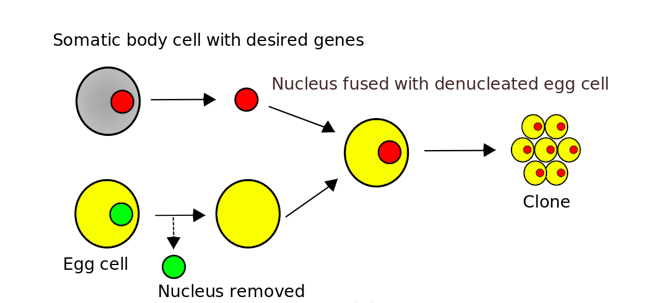
In somatic cell nuclear transfer, all the DNA comes from a single adult cell. Belkorin, CC BY-SA

In contrast, Dolly was produced by what’s called somatic cell nuclear transfer. In this process, researchers remove the genetic material from an egg and replace it with the nucleus of some other body cell. The resulting egg becomes a factory to produce an embryo that develops into an offspring. No sperm is in the picture; instead of half the genetic material coming from a sperm and half from an egg, it all comes from a single cell. It’s diploid from the start.

Long research path led to Dolly

Dolly was the culmination of hundreds of cloning experiments that, for example, showed diploid embryonic and fetal cells could be parents of offspring. But there was no way to easily know all the characteristics of the animal that would result from a cloned embryo or fetus. Researchers could freeze a few of the cells of a 16-cell embryo, while going on to produce clones from the other cells; if a desirable animal was produced, they could thaw the frozen cells and make more copies. But this was impractical because of low success rates.

Dolly demonstrated that adult somatic cells also could be used as parents. Thus, one could know the characteristics of the animal being cloned.

By my calculations, Dolly was the single success from 277 tries at somatic cell nuclear transfer. Sometimes the process of cloning by somatic cell nuclear transfer still produces abnormal embryos, most of which die. But the process has greatly improved so success rates now are more like 10 percent; it’s highly variable, though, depending on the cell type used and the species.
More than 10 different cell types have been used successfully as “parents” for cloning. These days most cloning is done using cells obtained by biopsying skin.

More than genes can affect a clone

Genetics is only part of the story. Even while clones are genetically identical, their phenotypes – the characteristics they express – will be different. It’s like naturally occurring identical twins: They share all their genes but they’re not really exactly alike, especially if reared in different settings.
Environment plays a huge role for some characteristics. Food availability can influence weight. Diseases can stunt growth. These kinds of lifestyle, nutrition or disease effects can influence which genes are turned on or off in an individual; these are called epigenetic effects. Even though all the genetic material may be the same in two identical clones, they might not be expressing all the same genes.


Cloning a winner doesn’t guarantee success for the next generation. AP Photo/Darron Cummings

Consider the practice of cloning winning racehorses. Clones of winners sometimes also will be winners – but most of the time they’re not. This is because winners are outliers; they need to have the right genetics, but also the right epigenetics and the right environment to reach that winning potential. For example, one can never exactly duplicate the uterine conditions a winning racehorse experienced when it was a developing fetus. Thus, cloning champions usually leads to disappointment. On the other hand, cloning a stallion that sires a high proportion of race-winning horses will result very reliably in a clone that similarly sires winners. This is a genetic rather than a phenotypic situation.
Even though the genetics are reliable, there are aspects of the cloning procedure that mean the epigenetics and environment are suboptimal. For example, sperm have elegant ways of activating the eggs they fertilize, which will die unless activated properly; with cloning, activation usually is accomplished by a strong electric shock. Many of the steps of cloning and subsequent embryonic development are done in test tubes in incubators. These conditions are not perfect substitutes for the female reproductive tract where fertilization and early embryonic development normally occur.

Sometimes abnormal fetuses develop to term, resulting in abnormalities at birth. The most striking abnormal phenotype of some clones is termed “large offspring syndrome,” in which calves or lambs are 30 or 40 percent larger than normal, resulting in difficult birth. The problems stem from an abnormal placenta. At birth, these clones are genetically normal, but are overly large, and tend to be hyperinsulinemic and hypoglycemic. (The conditions normalize over time once the offspring is no longer influenced by the abnormal placenta.)
Recent improvements in cloning procedures have greatly reduced these abnormalities, which also occur with natural reproduction, but at a much lower incidence.


Removing genetic material from the nucleus of a cell. AP Photo/Thomas Terry

Continuing onward with cloning

Many thousands of cloned mammals have been produced in nearly two dozen species. Very few of these concern practical applications, such as cloning a famous Angus bull named Final Answer (who recently died at an old age) in order to produce more high-quality cattle via his clone’s sperm.

But the cloning research landscape is changing fast. The driving force for producing Dolly was not to produce genetically identical animals. Rather researchers want to combine cloning techniques with other methods in order to efficiently change animals genetically – much quicker than traditional animal breeding methods that take decades to make changes in populations of species such as cattle.

One recent example is introducing the polled (no horns) gene into dairy cattle, thus eliminating the need for the painful process of dehorning. An even more striking application has been to produce a strain of pigs that is incapable of being infected by the very contagious and debilitating PRRS virus. Researchers have even made cattle that cannot develop Mad Cow Disease. For each of these procedures, somatic cell nuclear transplantation is an essential part of the process.

To date, the most valuable contribution of these somatic cell nuclear transplantation experiments has been the scientific information and insights gained. They’ve enhanced our understanding of normal and abnormal embryonic development, including aspects of aging, and more. This information is already helping reduce birth defects, improve methods of circumventing infertility, develop tools to fight certain cancers and even decrease some of the negative consequences of aging – in livestock and even in people. Two decades since Dolly, important applications are still evolving.
The Conversation
George Seidel, Professor of Biomedical Sciences, Colorado State University

This article was originally published on The Conversation. Read the original article.

Big Men


We all need protection from “Big Men”.  Big Men plot and plan evil, and do not care who they hurt by asserting themselves. “Big Men” pride themselves on being ruthless, cruel, greedy and destructive.  They are even proud of the number of people who hate them.
I posted the above message on my Facebook page, because I want people to know that these horrible evil people who think they are BIG can manipulate and destroy the lives of ordinary people. Sometimes, we all need protection from "Big Men". I know I do, they are all around and prey on the weak. It is nothing new, we have had Big Men roaming around for centuries.  If we look at Psalm 52, we can begin to understand that these wicked evil people tormented even King David.  Well one day, they will be banished from the earth.
We have all learned that there is something bigger, better  and more enduring than the boasts of Big Evil Men and the trouble they instigate, and that is the grace and mercy of God.
*-*-*-*-*-*-*-*-*-*-*-*-*-*-*-*-*-*-*-*-*
Why do you boast of evil, you mighty hero?
    Why do you boast all day long,
    you who are a disgrace in the eyes of God?
You who practice deceit,
    your tongue plots destruction;
    it is like a sharpened razor.
You love evil rather than good,
    falsehood rather than speaking the truth.[c]
You love every harmful word,
    you deceitful tongue!
Surely God will bring you down to everlasting ruin:
    He will snatch you up and pluck you from your tent;
    he will uproot you from the land of the living.
The righteous will see and fear;
    they will laugh at you, saying,
“Here now is the man
    who did not make God his stronghold
but trusted in his great wealth
    and grew strong by destroying others!”
But I am like an olive tree
    flourishing in the house of God;
I trust in God’s unfailing love
    for ever and ever.
For what you have done I will always praise you
    in the presence of your faithful people.
And I will hope in your name,
    for your name is good.
*-*-*-*-*-*-*-*-*-*-*-*-*-*-*-*-*-*-*-*-*-*-*-*-*-*

Let us all pray, that these arrogant, greedy, corrupt and ruthless people be banished from the planet.


Combatting stereotypes: How to talk to your children

How can modern parents raise the next generation to be free from corrosive gender and racial stereotypes? By the time children start elementary school, gender and race shape their lives in many ways that parents might want to prevent. As early as first grade, girls are less likely than boys to think members of their own gender are “really, really smart.” And by just age three, white children in the United States implicitly endorse stereotypes that African-American faces are angrier than white faces.
These stereotypes go deeper than children’s beliefs – they can also shape a child’s behavior. By age six, girls are less likely than boys to choose activities that seem to require them to be really smart, which could contribute to the development of long-term gender differences in science and math achievement.

Why do stereotypes develop in such young children? As a professor of early cognitive and social development, I have seen my research reveal how surprisingly subtle features of language contribute to a child’s tendency to view the world through the lens of social stereotypes.

The problem of generalization

Many parents try to prevent the development of stereotypes in children by avoiding saying things like, “boys are good at math,” or “girls cannot be leaders.” Instead, parents might take care to say things that are positive, like “girls can be anything they want.”

But our research has found that, to the developing mind, even these positive statements can have negative consequences.

For young children, how we speak is often more important than what we say. Generalizations, even if they say only things that are positive or neutral, such as “Girls can be anything they want,” “Hispanics live in the Bronx” or “Muslims eat different foods,” communicate that we can tell what someone is like just by knowing her gender, ethnicity or religion.

In our research, published in Child Development, we found that hearing generalizations led children as young as two years old to assume that groups mark stable and important differences between individual people.

In this study, children were introduced to a new, made-up way of categorizing people: “Zarpies.” If they only heard statements about specific individuals, (e.g., “These Zarpies whisper when they talk”), children continued to treat the people as individuals, even though they were all marked by the same label and wore similar clothes. But if they heard the same information as a generalization (e.g., “Zarpies whisper when they talk”), they started to think that “Zarpies” are very different from everyone else. Hearing generalizations led children to think that being a member of the group determined what the members would be like.

In another recent study, we found that hearing these types of generalizations – even if none of them was negative – led five-year-old children to share fewer resources (in this case, colorful stickers) with members outside their own social group.

These findings show that hearing generalizations, even positive or neutral ones, contributes to the tendency to view the world through the lens of social stereotypes. It is the form of the sentence, not exactly what it says, that matters to young children.

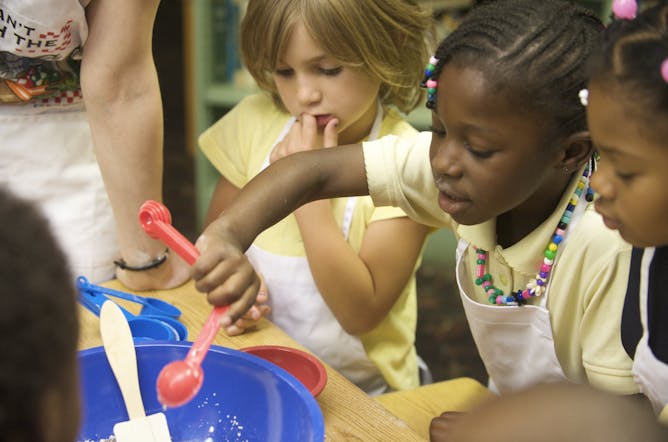
Studies show that repeatedly hearing generalizing language can negatively impact children’s behavior toward different social groups. Department of Education, CC BY

From groups to individuals

Our research means that generalizations are problematic even if children do not understand them.
If a young child overhears, “Muslims are terrorists,” the child might not know what it means to be a Muslim or a terrorist. But the child can still learn something problematic – that Muslims, whoever they are, are a distinct kind of person. That it is possible to make assumptions about what someone is like just by knowing if they are Muslim or not.

Language that uses specifics – instead of making general claims – avoids these problems. Sentences like, “Her family is Hispanic and lives in the Bronx,” “This Muslim family eats different foods,” “Those girls are great at math,” “You can be anything you want,” all avoid making general claims about groups.

Using specific language can also teach children to challenge their own and others’ generalizations. My three-year-old recently announced that “Boys play guitar,” despite knowing many female guitar players. This troubled me, not because it matters very much what he thinks about guitar playing, but because this way of talking means that he is starting to think that gender determines what a person can do.

But there is a very easy and natural way to respond to statements like these, which our research suggests reduces stereotyping. Simply say, “Oh? Who are you thinking of? Who did you see play the guitar?” Children usually have someone in mind. “Yes, that man at the restaurant played the guitar tonight. And yes, so does Grandpa.” This response guides children to think in terms of individuals, instead of groups.

This approach works for more sensitive generalizations too – things a child might say, like “Big boys are mean,” or “Muslims wear funny clothes.” Parents can ask children who they are thinking of and discuss whatever specific incident they have in mind. Sometimes children speak this way because they are testing out whether drawing a generalization is sensible. By bringing them back to the specific incident, we communicate to them that it is not.

Teachers and parents both influence the way children think about groups and individuals. Department of Education, CC BY

Every interaction counts

How much can this small change in language really matter? Parents, teachers and other caring adults cannot control everything that children hear, and exposure to explicitly racist, sexist or xenophobic ideas can also influence a child’s view of societal norms and values.

But children develop their sense of the world through minute-by-minute conversations with important adults in their lives. These adults have powerful platforms with their children. As parents and caregivers, we can use our language carefully to help children learn to view themselves and others as individuals, free to choose their own paths. With our language, we can help children develop habits of mind that challenge, rather than endorse, stereotyped views of the people around us.

The Conversation
Marjorie Rhodes, Associate Professor of Psychology, New York University
This article was originally published on The Conversation.