Sunday, April 7, 2019

What your pet's microchip has to do with the Mark of the Beast


An almost invisible electronic device used all over the world – best known to much of the public for helping reunite lost pets and their owners, but also found in subway cards, electronic tolling, luggage tags, passports and warehouse inventory systems – has alarmed some evangelical Christian communities, who see in this technology the work of the Antichrist.

In a section of “A Billion Little Pieces,” my recent book about Radio Frequency Identification chips, also known as RFID chips, I investigate why these tiny items have, in some religious circles, become closely linked with the apocalypse depicted in the biblical Book of Revelation. The reasons are more connected with modern concerns than you might expect.

What is RFID?


RFID chips can be small and flexible. Maschinenjunge/Wikimedia Commons, CC BY-SA

For starters, RFID technology is a method of wirelessly, digitally identifying objects – like luggage, cars or subway passes – that often does not require any internal power source. A small chip is inserted into or attached to an item to be identified – like a duffel bag or a toll pass transponder. It does nothing until it passes near an RFID reader, which can be a few inches away for passports, or several feet away as in highway toll barriers. The reader emits a specific radio frequency that activates the chip, which then transmits its digital identification code.

The chips, also called tags, are just about everywhere. About 10 billion tags were used around the world in 2018 alone. Retailers – especially clothing stores – are a potentially huge market that has begun to adopt RFID systems to monitor inventory and to prevent theft.

Many domestic pets are microchipped with RFID, encoding information that helps them reunite with their owners if they get lost. Some humans have also chosen to microchip themselves so their bodies can wirelessly communicate with identification systems – and that’s where the evangelicals get upset.

The people at the right of the illumination are receiving the Mark of the Beast. Getty Center/Google Cultural Institute/Wikimedia Commons

The Mark of the Beast

What does a chip implant have to do with the Bible? Believers see echoes of RFID chips in a short passage in the Book of Revelation:
“[The beast] causes all, both small and great, rich and poor, free and slave, to receive a mark on their right hand or on their foreheads, and that no one may buy or sell except one who has the mark or the name of the beast, or the number of his name.”
This passage is the origin of beliefs around what would eventually become known as the “Mark of the Beast,” a way to identify those who worship the Antichrist. More than 15 years ago, some evangelicals began linking RFID to the mark.

A doctor implants an RFID chip in a patient’s hand. Paul Hughes/Wikimedia Commons, CC BY-SA

My research has found that they made the connection for two main reasons. First, when biohackers chip themselves, they typically put the RFID chip into the palm of one hand because it’s easy to wave that at sensors to open doors or process payments, and the scripture specifically mentions the mark on a person’s hand. In addition, some people have injected RFID chips containing credit card payment information, which calls to mind to the payment methods mentioned in the Bible.

These links spread in some evangelical communities throughout the 2000s, with many articles published on religious sites about RFID. The authors of a best-selling book about RFID and surveillance – “Spychips” – published an alternative version targeted at evangelical Christians that included added passages about the Book of Revelation. The main RFID industry publication even published a refutation of those claims.

In the years since, the connection between RFID and the mark has remained prominent. In 2017, a Wisconsin company offered to pay for its employees to get RFID implants – if they voluntarily chose to. The company’s Google business listing was flooded with more than 100 one-star reviews, many of which said it was a sin to use RFID as a form of identification or payment. Some of them were specific about what was wrong, saying the company was “doing the dirty work for Satan himself” and urging employees to “read your Bible. This is the first sign of the mark of the beast.”

Does it really matter?

It’s more than just a curiosity that evangelical Christians have linked RFID to the apocalypse. Evangelicals are a major force in American culture and politics, and their views on technology are often underreported.

Readers mounted above the highway track RFID chips in cars passing beneath them, charging drivers for tolls. BrandonKleinVideo/Shutterstock.com

In addition, they’re expressing concern about an increasingly ubiquitous technology, similar to objections raised by privacy advocates that have actually changed corporate policies in the past.
Most people probably don’t agree that RFID represents the Mark of the Beast. But the roots of that concern do raise interesting questions about the merging of human bodies and computing. The religious fear that every person might need to be physically tagged to pay for things and move freely shares a lot with the concerns expressed by more mainstream privacy advocates.

Finally, there’s something poetic about linking a tiny technology used to identify rescue dogs in a shelter to the Mark of the Beast. After all, there’s likely no more consequential type of identification than the differentiation of the damned from the redeemed.


Jordan Frith is the author of:

A Billion Little Pieces: RFID and Infrastructures of IdentificationThe Conversation

MIT Press provides funding as a member of The Conversation US.

Jordan Frith, Associate Professor of Technical Communication, University of North Texas
This article is republished from The Conversation under a Creative Commons license.

Wednesday, April 3, 2019

How humans derailed the Earth's climate in just 160 years


File 20190321 93051 vim6mh.jpg?ixlib=rb 1.1
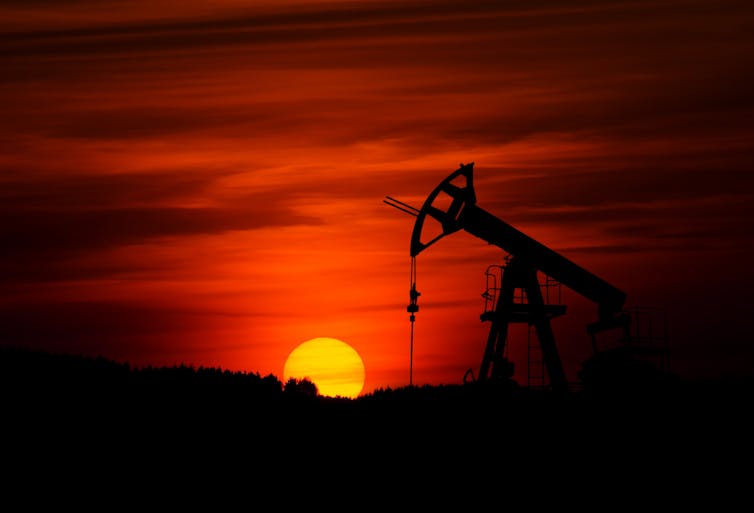
The exploitation of fossil fuels emits CO₂, the main cause of global warming. Zbynek Burival/Unsplash, CC BY

Climate change might be the most urgent issue of our day, both politically and in terms of life on Earth. There is mounting awareness that the global climate is a matter for public action.

For 11,500 years, atmospheric carbon dioxide (CO2) concentrations hovered around 280 ppm (the preindustrial “normal”), with an average surface temperature around 15°C. Since the Industrial Revolution, this level has been rising continuously, reaching 410 ppm in 2018. The geosciences, with their focus on timescales up to billions of years, are uniquely equipped to make extremely clear how abruptly industrial societies have changed and are changing the Earth’s climate.

Climate, greenhouse gases and CO2

The main engine of Earth’s climate is the sun. Our star delivers an average surface power of 342 W/m2 per year (roughly that of a hairdryer for each square meter of the planet). Earth absorbs about 70% of this and reflects the rest. If this were the only climate mechanism, the average temperature would be -15°C (below the freezing point of water, 0°C). Life would likely be impossible.

Fortunately, some of the absorbed energy is re-emitted as infrared radiation, which, unlike visible light, interacts with the greenhouse gases (GHGs) present in the atmosphere to radiate heat back toward Earth’s surface. This greenhouse effect currently maintains our average temperature around 15°C.

The primary GHGs are water vapour and the much-debated CO2. Carbon dioxide contributes up to 30% of the total greenhouse effect, water vapour provides about 70%. CO2, though, has overall warming power that water vapour doesn’t. Water vapour in the atmosphere has a very short residence time (from hours to days) and its concentration can increase only if temperature increases. CO2 lingers in the atmosphere for 100 years and its concentration is not solely controlled by temperature.

CO2 is thus able to trigger warming: if CO2 concentration increases, the average temperature, regardless of its own trend, will increase.

Carbon sinks

It is thus crucial to understand how atmospheric CO2 is regulated. Over geologic timescales (100,000+ years), volcanic gasses are the primary source of CO2, averaging 0.4 billion of tons of CO2 per year (0.4 GtCO2/y). But CO2 doesn’t just endlessly accumulate in the atmosphere. It fluxes in and out thanks to other environmental processes, and is stored in reservoirs known as carbon sinks.

The ocean, for one, contains 50 times more carbon than the atmosphere. However, CO2 dissolved in the ocean can easily be released toward the atmosphere, while only geological sinks keep CO2 away from the atmosphere on geological timescales.

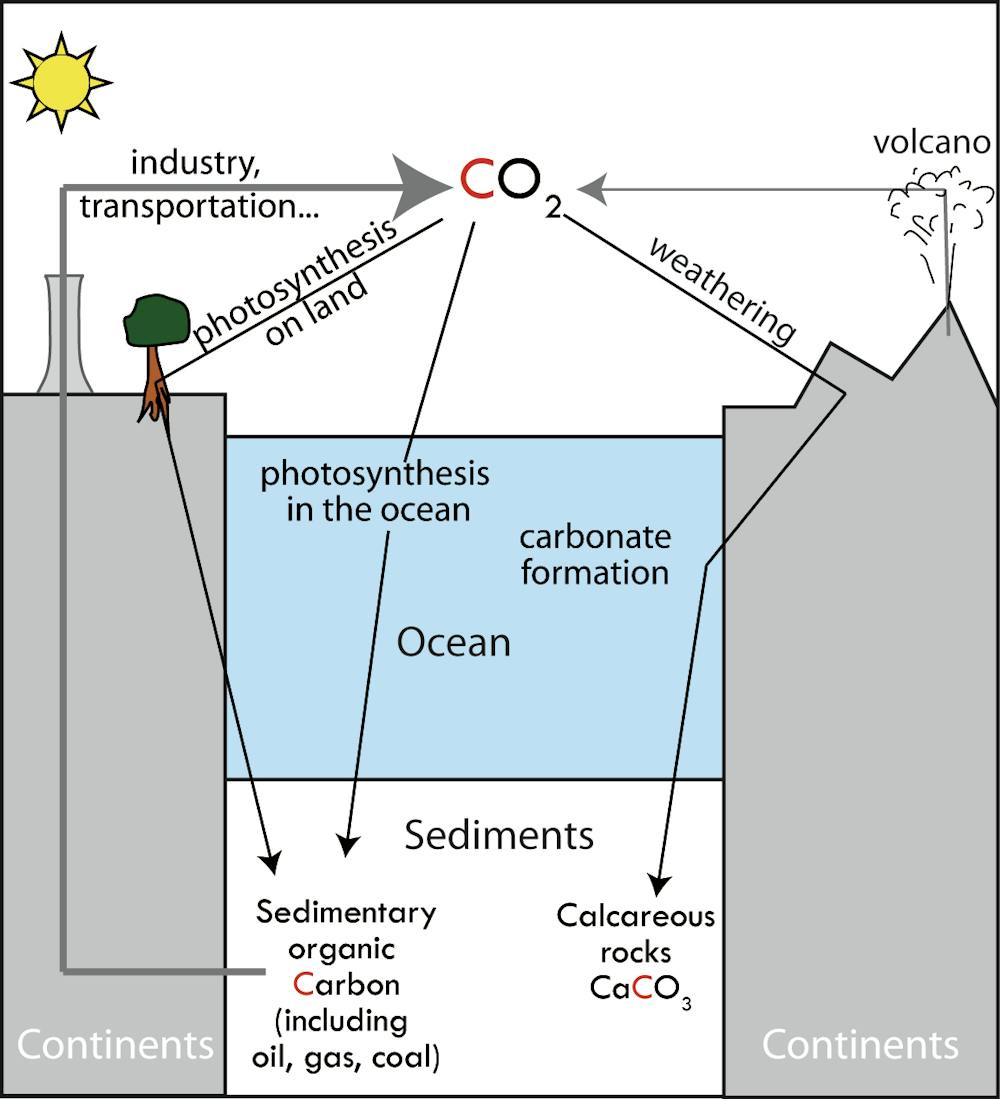
Simplified geological carbon cycle. The sinks (black) show the sedimentation of organic matter and the alteration-synthesis coupling of carbonate. They oppose (grey) sources: volcanoes for more than 4 billion years and thermo-industrial human activities for 150 years. G. Paris

The first geological sink is sedimentary organic matter. Living organisms contain organic carbon built from atmospheric CO2 through photosynthesis, and dead organisms are often sent to the bottom of the ocean, lakes, and swamps. Immense amounts of organic carbon thus accumulate over time in marine and continental sediments, some of which are eventually transformed into fossil fuels (oil, gas and coal).

Calcareous rocks are the second geological carbon sink. Rocks such as granites or basalts are weathered by surface waters, washing calcium and bicarbonate ions away to the ocean. Marine organisms use these to build hard parts made of calcium carbonate. When deposited at the bottom of the ocean, calcium carbonate is eventually sequestered as limestone.

Depending on the estimates, these two sinks combined contain 50,000 to 100,000 times more carbon than the present atmosphere.

The Earth’s atmosphere over time

The amount of CO2 in the Earth’s atmosphere has varied widely. Decades of research allow us to draw the main lines of the history beginning after the Earth was fully formed 4.4 billion years ago.
Earth’s early atmosphere was extremely rich in CO2 (up to 10,000 times modern levels), while oxygen (O2) was scarce. During the Archean (3.8 to 2.5 billion years ago), life first flourished, the first continents built up. Weathering started pulling CO2 out of the atmosphere. The development of photosynthesis contributed to decrease atmospheric CO2, while elevating O2 levels during the Great Oxygenation Event, about 2.3 billion years ago. CO2 concentration fell to “only” 20 to 100 times the preindustrial level, never to return to the concentration of Earth’s earliest eons.

Two billion years later, the carbon cycle changed. Toward the late Devonian-early Carboniferous (approximately 350 million years ago), CO2 concentration was around 1,000 ppm. Mammals didn’t exist. Vascular plants able to synthesise lignin appeared during the Devonian and spread. Lignin is a molecule resistant to microbial degradation that allowed massive organic carbon stocks to build up as coal over millions of years. Combined with the weathering of the Hercynian range (the vestiges of which can be found in France’s Massif Central or the Appalachians in the United States), organic carbon burial pulled atmospheric CO2 down to levels similar to (or lower than) today’s and generated a major glacial era between 320 and 280 million years ago.

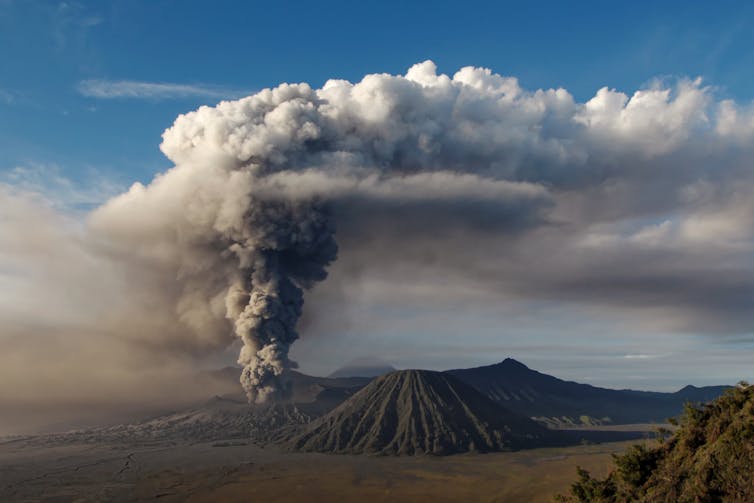
Eruption of Bromo volcano on the island of Java (2011). On a geological time scale, volcanoes play a role in the CO₂ cycle. Marc Szeglat/Unsplash

By the end of the Jurassic (145 million years ago), however, the pendulum had swung. Dinosaurs ruled the Earth, mammals evolved, tectonic activity increased and Pangea (the last super-continent) ripped apart. CO2 increased, to 500 to 2,000 ppm, and remained at high levels, maintaining a warm greenhouse climate for 100 million years.

From 55 million years, Earth cooled as CO2 decreased, notably following the Himalayan uplift and a subsequent increase in weathering and organic carbon sedimentation. Evolution continues with Hominids appearing 7 million years ago. At 2.6 million years, Earth entered a new state characterised by an alternation of glacial and interglacial periods at a regular pace led by Earth’s orbital parameters and amplified by the shorter-term carbon cycle. CO2 reached its preindustrial level 11,500 years ago as Earth entered the latest interglacial stage.

A new story: the Industrial Revolution

Until the 19th century, the story of atmospheric carbon and Earth’s climate was a story of geology, biology and evolution. That story changed sharply following the Industrial Revolution, when modern humans (Homo sapiens), who probably appeared 300,000 years ago, began extracting and burning fossil fuels on a massive scale.

By 1950, the addition of CO2 to the atmosphere through fossil-fuel combustion was already proven, via the carbon isotopic signature of CO2 molecules (known as the “Suess” effect). By the late 1970’s, climate scientists observed a rapid drift toward warmer overall temperatures. The IPCC, created in 1988, showed in 2012 that the average temperature had increased by 0.9°C since 1901. That change might seem modest compared to the last deglaciation, when average temperature increased by about 6°C in 7,000 years, but it’s at least 10 times faster.

The average temperature continues to climb, and natural parameters such as solar activity or volcanism can’t explain such a fast warming. The cause is unambiguously human addition of GHGs to the atmosphere, and high-income countries emit the most CO2 per inhabitant.

How will our story end?

Industrial societies burnt about 25% of Earth’s fossil fuels within 160 years and abruptly inverted a natural flux storing carbon away from the atmosphere. This new human-generated flux is instead adding 28 Gt of CO₂ per year, 50 times more than volcanoes. Natural geological sequestration cannot compensate and atmospheric CO2 keeps rising.

The consequences are imminent, numerous and dire: extreme weather events, sea-level rise, glacier retreat, ocean acidification, ecosystem disruptions and extinctions. Earth itself has survived other catastrophes. Although current warming will outpace many species’ ability to adapt, life will continue. It is not the planet that is at stake. Instead, it is the future of human societies and the preservation of current ecosystems.

While the Earth sciences cannot provide solutions to think about the necessary changes in our behaviour and consumption of fossil fuels, they can and must contribute to knowledge and collective awareness of the current global warming.

We thank Morgan Fahey for her invaluable help with the English text.The Conversation
Guillaume Paris, Géochimiste, chargé de recherche CNRS au Centre de recherches pétrographiques et géochimiques de Nancy, Université de Lorraine and Pierre-Henri Blard, Géochronologue et paléoclimatologue, chargé de recherches CNRS - Centre de recherches pétrographiques et géochimiques (Nancy) et Laboratoire de glaciologie (Bruxelles), Université de Lorraine
This article is republished from The Conversation under a Creative Commons license.
Sunday, March 24, 2019

Teens have less face time with their friends – and are lonelier than ever


File 20190319 60956 6picsy.jpg?ixlib=rb 1.1
Teens aren’t necessarily less social, but the contours of their social lives have changed. pxhere
Jean Twenge, San Diego State University
Ask a teen today how she communicates with her friends, and she’ll probably hold up her smartphone. Not that she actually calls her friends; it’s more likely that she texts them or messages them on social media.

Today’s teens – the generation I call “iGen” that’s also called Gen Z – are constantly connected with their friends via digital media, spending as much as nine hours a day on average with screens.


Some studies have found that people who spend more time on social media actually have more face time with friends.

But studies like this are only looking at people already operating in a world suffused with smartphones. They can’t tell us how teens spent their time before and after digital media use surged.

What if we zoomed out and compared how often previous generations of teens spent time with their friends to how often today’s teens are doing so? And what if we also saw how feelings of loneliness differed across the generations?

To do this, my co-authors and I examined trends in how 8.2 million U.S. teens spent time with their friends since the 1970s. It turns out that today’s teens are socializing with friends in fundamentally different ways – and also happen to be the loneliest generation on record.

Less work, but fewer hangs?

After studying two large, nationally representative surveys, we found that although the amount of time teens spent with their friends face to face has declined since the 1970s, the drop accelerated after 2010 – just as smartphones use started to grow.

Compared with teenagers in previous decades, iGen teens are less likely to get together with their friends. They’re also less likely to go to parties, go out with friends, date, ride in cars for fun, go to shopping malls or go to the movies.

It’s not because they are spending more time on work, homework or extracurricular activities. Today’s teens hold fewer paid jobs, homework time is either unchanged or down since the 1990s, and time spent on extracurricular activities is about the same.

Yet they’re spending less time with their friends in person – and by large margins. In the late 1970s, 52 percent of 12th-graders got together with their friends almost every day. By 2017, only 28 percent did. The drop was especially pronounced after 2010.


Today’s 10th-graders go to about 17 fewer parties a year than 10th-graders in the 1980s did. Overall, 12th-graders now spend an hour less on in-person social interaction on an average day than their Gen X predecessors did.

We wondered if these trends would have implications for feelings of loneliness, which are also measured in one of the surveys. Sure enough, just as the drop in face-to-face time accelerated after 2010, teens’ feelings of loneliness shot upward.

Among 12th graders, 39 percent said they often felt lonely in 2017, up from 26 percent in 2012. Thirty-eight percent said they often felt left out in 2017, up from 30 percent in 2012. In both cases, the 2017 numbers were all-time highs since the questions were first asked in 1977, with loneliness declining among teens before suddenly increasing.


A new cultural norm

As previous studies have shown, we did find that those teens who spent more time on social media also spent more time with their friends in person.

So why have in-person social interactions been going down, overall, as digital media use has increased?

It has to do with the group versus the individual.

Imagine a group of friends that doesn’t use social media. This group regularly gets together, but the more outgoing members are willing to hang out more than others, who might stay home once in a while. Then they all sign up for Instagram. The social teens are still more likely to meet up in person, and they’re also more active on their accounts.

However, the total number of in-person hangs for everyone in the group drops as social media replaces some face-to-face time.

So the decline in face-to-face interaction among teens isn’t just an individual issue; it’s a generational one. Even teens who eschew social media are affected: Who will hang out with them when most of their peers are alone in their bedrooms scrolling through Instagram?

Higher levels of loneliness are just the tip of the iceberg. Rates of depression and unhappiness also skyrocketed among teens after 2012, perhaps because spending more time with screens and less time with friends isn’t the best formula for mental health.

Some have argued that teens are simply choosing to communicate with their friends in a different way, so the shift toward electronic communication isn’t concerning.

That argument assumes that electronic communication is just as good for assuaging loneliness and depression as face-to-face interaction. It seems clear that this isn’t the case. There’s something about being around another person – about touch, about eye contact, about laughter – that can’t be replaced by digital communication.

The result is a generation of teens who are lonelier than ever before.


The Conversation

Jean Twenge, Professor of Psychology, San Diego State University
This article is republished from The Conversation under a Creative Commons license.
Monday, February 25, 2019

Shutting down the internet doesn't work -- but governments keep doing it


File 20190212 174894 7u9vts.jpg?ixlib=rb 1.1
The Zimbabwean government recently shutdown the internet by ordering mobile companies to withhold mobile data. EPA-EFE/STF

As the internet continues to gain considerable power and agency around the world, many governments have moved to regulate it. And where regulation fails, some states resort to internet shutdowns or deliberate disruptions.

The statistics are staggering. In India alone, there were 154 internet shutdowns between January 2016 and May 2018. This is the most of any country in the world.

But similar shutdowns are becoming common on the African continent. Already in 2019 there have been shutdowns in Cameroon, the Democratic Republic of Congo, Republic of Congo, Chad, Sudan and Zimbabwe. Last year there were 21 such shutdowns on the continent. This was the case in Togo, Sierra Leone, Sudan and Ethiopia, among others.

The justifications for such shutdowns are usually relatively predictable. Governments often claim that internet access is blocked in the interest of public security and order. In some instances, however, their reasoning borders on the curious if not downright absurd, like the case of Ethiopia in 2017 and Algeria in 2018 when the internet was shut down apparently to curb cheating in national
examinations.

Whatever their reasons, governments have three general approaches to controlling citzens’ access to the web.

How they do it

Internet shutdowns or disruptions usually take three forms. The first and probably the most serious is where the state completely blocks access to the internet on all platforms. It’s arguably the most punitive, with significant social, economic and political costs.

The financial costs can run into millions of dollars for each day the internet is blocked. A Deloitte report on the issue estimates that a country with average connectivity could lose at least 1.9% of its daily GDP for each day all internet services are shut down.

For countries with average to medium level connectivity the loss is 1% of daily GDP, and for countries with average to low connectivity it’s 0.4%. It’s estimated that Ethiopia, for example, could lose up to US$500,000 a day whenever there is a shutdown. These shutdowns, then, damage businesses, discourage investments, and hinder economic growth.

The second way that governments restrict internet access is by applying content blocking techniques. They restrict access to particular sites or applications. This is the most common strategy and it’s usually targeted at social media platforms. The idea is to stop or limit conversations on these platforms.

Online spaces have become the platform for various forms of political expression that many states especially those with authoritarian leanings consider subversive. Governments argue, for example, that social media platforms encourage the spread of rumours which can trigger public unrest.

This was the case in 2016 in Uganda during the country’s presidential elections. The government restricted access to social media, describing the shutdown as a “security measure to avert lies … intended to incite violence and illegal declaration of election results”.

In Zimbabwe, the government blocked social media following demonstrations over an increase in fuel prices. It argued that the January 2019 ban was because the platforms were being “used to coordinate the violence”.

The third strategy, done almost by stealth, is the use of what is generally known as “bandwidth throttling”. In this case telecom operators or internet service providers are forced to lower the quality of their cell signals or internet speed. This makes the internet too slow to use. “Throttling” can also target particular online destinations such as social media sites.

What drives governments

In most cases the desire to control the internet is rooted in governments’ determination to control the political narrative. Many see the internet as an existential threat that must be contained, no matter what consequences it will have on other sectors.

The internet is seen as a threat because it disrupts older forms of government political control, particularly the control of information. The stranglehold on the production and dissemination of information has always been an invaluable political tool for many African governments.

The loss of this control, at a time when the media has brought politics closer to the people, presents governments with a distinctly unsettling reality. Social media, for example, inherently encourages political indiscipline and engenders the production and circulation of alternative political narratives.

In addition, because it is a networked platform, users are simultaneously and instantaneously local and international and are engaged in an information carnival that is difficult to police. Quite often the narratives therein are at variance with the self-preserving and carefully constructed ideologies of the state.

The shutdown trend

The irony, however, is that as these shutdowns continue, even proliferate, there is scant evidence they actually work. Instead, they seem to animate dissent and encourage precisely the kind of responses considered subversive by many governments This has been the case in Burkina Faso and Uganda, for example, where such bans have simply increased the profile of the causes being agitated.

Internet shutdowns don’t stop demonstrations. Nor do they hinder the production and circulation of rumours: they encourage them instead. Many people are also circumventing the shutdowns through the use of virtual private networks (VPNs). These are networks that redirect internet activity to a computer in a different geographical location thus enabling access to sites blocked in one’s own country. VPNS are now par for the course in countries like Zimbabwe.

The future of unfettered internet access in Africa looks precarious should governments continue on this trajectory. The absence in many African countries of enforceable constitutional guarantees that protect the public’s right to information means there are few opportunities for legal redress. This makes the development of legislative regimes that recognise and protect access to the internet both urgent and necessary.


The Conversation

George Ogola, Reader in Journalism, University of Central Lancashire
This article is republished from The Conversation under a Creative Commons license.