Sunday, June 16, 2019

What Orwell's '1984' tells us about today's world, 70 years after it was published


The dominant reading of George Orwell’s dystopian novel, “1984” has been that it was a dire prediction of what could be. Denis Hamel Côté, CC BY-SA

Seventy years ago, Eric Blair, writing under a pseudonym George Orwell, published “1984,” now generally considered a classic of dystopian fiction.

The novel tells the story of Winston Smith, a hapless middle-aged bureaucrat who lives in Oceania, where he is governed by constant surveillance. Even though there are no laws, there is a police force, the “Thought Police,” and the constant reminders, on posters, that “Big Brother Is Watching You.”

Smith works at the Ministry of Truth, and his job is to rewrite the reports in newspapers of the past to conform with the present reality. Smith lives in a constant state of uncertainty; he is not sure the year is in fact 1984.

Although the official account is that Oceania has always been at war with Eurasia, Smith is quite sure he remembers that just a few years ago they had been at war with Eastasia, who has now been proclaimed their constant and loyal ally. The society portrayed in “1984” is one in which social control is exercised through disinformation and surveillance.

As a scholar of television and screen culture, I argue that the techniques and technologies described in the novel are very much present in today’s world.

‘1984’ as history

One of the key technologies of surveillance in the novel is the “telescreen,” a device very much like our own television.

The telescreen displays a single channel of news, propaganda and wellness programming. It differs from our own television in two crucial respects: It is impossible to turn off and the screen also watches its viewers.

The telescreen is television and surveillance camera in one. In the novel, the character Smith is never sure if he is being actively monitored through the telescreen.
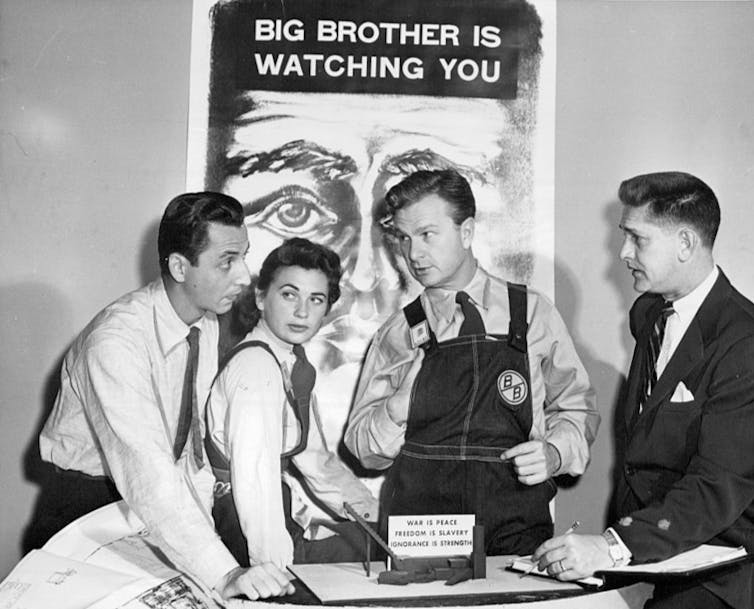
A publicity photo on the set of the CBS anthology television series ‘Studio One’ depicts a presentation of George Orwell’s ‘1984.’ CBS Television

Orwell’s telescreen was based in the technologies of television pioneered prior to World War II and could hardly be seen as science fiction. In the 1930s Germany had a working videophone system in place, and television programs were already being broadcast in parts of the United States, Great Britain and France.

Past, present and future

The dominant reading of “1984” has been that it was a dire prediction of what could be. In the words of Italian essayist Umberto Eco, “at least three-quarters of what Orwell narrates is not negative utopia, but history.”

Additionally, scholars have also remarked how clearly “1984” describes the present.

In 1949, when the novel was written, Americans watched on average four and a half hours of television a day; in 2009, almost twice that. In 2017, television watching was slightly down, to eight hours, more time than we spent asleep.

In the U.S. the information transmitted over television screens came to constitute a dominant portion of people’s social and psychological lives.

‘1984’ as present day

In the year 1984, however, there was much self-congratulatory coverage in the U.S. that the dystopia of the novel had not been realized. But media studies scholar Mark Miller argued how the famous slogan from the book, “Big Brother Is Watching You” had been turned to “Big Brother is you, watching” television.

Miller argued that television in the United States teaches a different kind of conformity than that portrayed in the novel. In the novel, the telescreen is used to produce conformity to the Party. In Miller’s argument, television produces conformity to a system of rapacious consumption – through advertising as well as a focus on the rich and famous. It also promotes endless productivity, through messages regarding the meaning of success and the virtues of hard work.
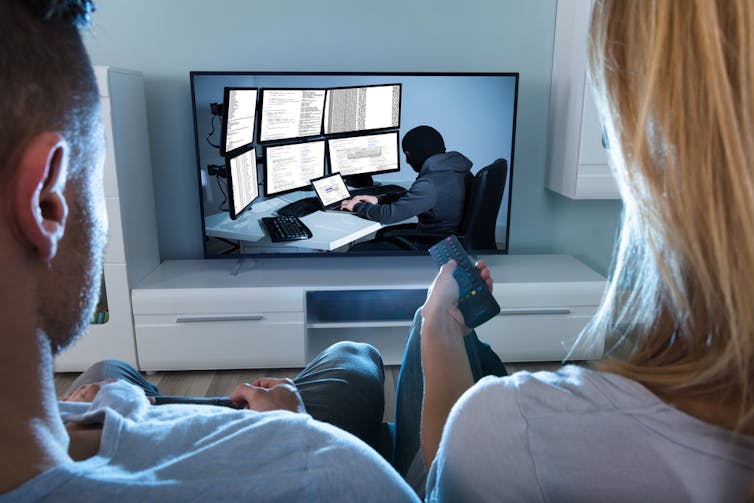
Television has a profound effect on its viewers. Andrey_Popov

Many viewers conform by measuring themselves against what they see on television, such as dress, relationships and conduct. In Miller’s words, television has “set the standard of habitual self-scrutiny.”

The kind of paranoid worry possessed by Smith in the novel – that any false move or false thought will bring the thought police – instead manifests in television viewers that Miller describes as an “inert watchfulness.” In other words, viewers watch themselves to make sure they conform to those others they see on the screen.

This inert watchfulness can exist because television allows viewers to watch strangers without being seen. Scholar Joshua Meyrowitz has shown that the kinds of programming which dominate U.S television – news, sitcoms, dramas – have normalized looking into the private lives of others.

Controlling behavior

Alongside the steady rise of “reality TV,” beginning in the ‘60s with “Candid Camera,” “An American Family,” “Real People,” “Cops” and “The Real World,” television has also contributed to the acceptance of a kind of video surveillance.

For example, it might seem just clever marketing that one of the longest-running and most popular reality television shows in the world is entitled “Big Brother.” The show’s nod to the novel invokes the kind of benevolent surveillance that “Big Brother” was meant to signify: “We are watching you and we will take care of you.”

But Big Brother, as a reality show, is also an experiment in controlling and modifying behavior. By asking participants to put their private lives on display, shows such as “Big Brother” encourage self-scrutiny and behaving according to perceived social norms or roles that challenge those perceived norms.

The stress of performing 24/7 on “Big Brother” has led the show to employ a team of psychologists.
Television scholar Anna McCarthy and others have shown that the origins of reality television can be traced back to social psychology and behavioral experiments in the aftermath of World War II, which were designed to better control people.

Yale University psychologist Stanley Milgram, for example, was influenced by “Candid Camera.”
In the “Candid Camera” show, cameras were concealed in places where they could film people in unusual situations. Milgram was fascinated with “Candid Camera,” and he used a similar model for his experiments – his participants were not aware that they were being watched or that it was part of an experiment.

Like many others in the aftermath of World War II, Milgram was interested in what could compel large numbers of people to “follow orders” and participate in genocidal acts. His “obedience experiments” found that a high proportion of participants obeyed instructions from an established authority figure to harm another person, even if reluctantly.

While contemporary reality TV shows do not order participants to directly harm each other, they are often set up as a small-scale social experiment that often involves intense competition or even cruelty.

Surveillance in daily life

And, just like in the novel, ubiquitous video surveillance is already here.

Closed-circuit television exist in virtually every area of American life, from transportation hubs and networks, to schools, supermarkets, hospitals and public sidewalks, not to mention law enforcement officers and their vehicles.

Video surveillance is part of our modern-day lives. Africa Studio

Surveillance footage from these cameras is repurposed as the raw material of television, mostly in the news but also in shows like “America’s Most Wanted,” “Right This Minute” and others. Many viewers unquestioningly accept this practice as legitimate.

The friendly face of surveillance

Reality television is the friendly face of surveillance. It helps viewers think that surveillance happens only to those who choose it or to those who are criminals. In fact, it is part of a culture of widespread television use, which has brought about what Norwegian criminologist Thomas Mathiesen called the “viewer society” – in which the many watch the few.

For Mathiesen, the viewer society is merely the other side of the surveillance society – described so aptly in Orwell’s novel – where a few watch the many.

[ Expertise in your inbox. Sign up for The Conversation’s newsletter and get a digest of academic takes on today’s news, every day. ]The Conversation
Stephen Groening, Assistant Professor of Cinema and Media Studies, University of Washington
This article is republished from The Conversation under a Creative Commons license.

Sunday, June 9, 2019

Are brain games mostly BS?


You might just be getting better at the game you’re practicing. Malcolm Lightbody/Unsplash, CC BY

You’ve probably seen ads for apps promising to make you smarter in just a few minutes a day.

 Hundreds of so-called “brain training” programs can be purchased for download. These simple games are designed to challenge mental abilities, with the ultimate goal of improving the performance of important everyday tasks.

But can just clicking away at animations of swimming fish or flashed streets signs on your phone really help you improve the way your brain functions?

Two large groups of scientists and mental health practitioners published consensus statements, months apart in 2014, on the effectiveness of these kinds of brain games. Both included people with years of research experience and expertise in cognition, learning, skill acquisition, neuroscience and dementia. Both groups carefully considered the same body of evidence available at the time.

Yet, they issued exactly opposite statements.

One concluded that “there is little evidence that playing brain games improves underlying broad cognitive abilities, or that it enables one to better navigate a complex realm of everyday life.”

The other argued that “a substantial and growing body of evidence shows that certain cognitive training regimens can significantly improve cognitive function, including in ways that generalize to everyday life.”

These two competing contradictory statements highlight a deep disagreement among experts, and a fundamental dispute over what counts as convincing evidence for something to be true.

Then, in 2016, the U.S. Federal Trade Commission entered into the fray with a series of rulings, including a US$50 million judgment (later reduced to $2 million) against one of the most heavily advertised brain training packages on the market. The FTC concluded that Lumos Labs’ advertisements – touting the ability of its Lumosity brain training program to improve consumers’ cognition, boost their performance at school and work, protect them against Alzheimer’s disease and help treat symptoms of ADHD – were not grounded in evidence.

What does clicking away on a laptop really improve? Akkalak Aiempradit/Shutterstock.com

In light of conflicting claims and scientific statements, advertisements and government rulings, what are consumers supposed to believe? Is it worth your time and money to invest in brain training? What types of benefits, if any, can you expect? Or would your time be better spent doing something else?

I’m a cognitive scientist and member of Florida State University’s Institute for Successful Longevity. I have studied cognition, human performance and the effects of different types of training for nearly two decades. I’ve conducted laboratory studies that have directly put to the test the ideas that are the foundation of the claims made by brain training companies.

Based on these experiences, my optimistic answer to the question of whether brain training is worth it would be “we just don’t know.” But the actual answer may very well be “no.”

How well does research measure improvements?

My colleagues and I have argued that most of the pertinent studies fall far short of being able to provide definitive evidence either way.

Some of these problems are statistical in nature.

Brain training studies often look at its effect on multiple cognitive tests – of attention, memory, reasoning ability and so on – over time. This strategy makes sense in order to uncover the breadth of potential gains.

But, for every test administered, there’s a chance that scores will improve just by chance alone. The more tests administered, the greater the chance that researchers will see at least one false alarm.

Brain training studies that include many tests and then report only one or two significant results cannot be trusted unless they control for the number of tests being administered. Unfortunately, many studies do not, calling their findings into question.

Picking the one task that she improved on out of many casts doubt on the study’s validity. De Visu/Shutterstock.com

Another design problem has to do with inadequate control groups. To claim that a treatment had an effect, the group receiving the treatment needs to be compared to a group that does not. It’s possible, for example, that people receiving brain training improve on an assessment test just because they’ve already taken it – before and then again after training. Since the control group also takes the test twice, cognitive improvements based on practice effects can be ruled out.

Many studies that have been used to support the effectiveness of brain training have compared the effect of brain training to a control group that did nothing. The problem is any difference observed between the training group and the control group in these cases could easily be explained by a placebo effect.

Placebo effects are improvements that are not the direct result of a treatment, but due to participants expecting to feel or perform better as a result of having received a treatment. This is an important concern in any intervention study, whether aimed at understanding the effect of a new drug or a new brain training product.

Researchers now realize that doing something generates a greater expectation of improvement than doing nothing. Recognition of the likelihood for a placebo effect is shifting standards for testing the effectiveness of brain games. Now studies are much more likely to use an active control group made up of participants who perform some alternative non-brain training activity, rather than doing nothing.

Still, these active controls don’t go far enough to control for expectations. For instance, it’s unlikely that a participant in a control condition that features computerized crossword puzzles or educational videos will expect improvement as much as a participant assigned to try fast-paced and adaptive commercial brain training products – products specifically touted as being able to improve cognition.

Yet, studies with these inadequate designs continue to claim to provide evidence that commercial brain training works. It remains rare for studies to measure expectations in order to help understand and counteract potential placebo effects.

Participants in our studies do develop expectations based on their training condition, and are especially optimistic regarding the effects of brain training. Unmatched expectations between groups are a serious concern, because there is growing evidence suggesting cognitive tests are susceptible to placebo effects, including tests of memory, intelligence and attention.

Is there a likely mechanism for improvement?

There’s another important question that needs to be addressed: Should brain training work? That is, given what scientists know about how people learn and acquire new skills, should we expect training on one task to improve the performance of another, untrained task? This is the fundamental claim being made by brain training companies – that engaging in games on a computer or mobile device will improve your performance on all sorts of tasks that are not the game you’re playing.

Brain training programs ‘gamify’ the process to keep people practicing. Gustavo da Cunha Pimenta/Flickr, CC BY-SA

As one example, “speed of processing training” has been incorporated into commercial brain training products. The goal here is to improve the detection of objects in the periphery, which can be useful in avoiding an automobile crash. A brain game may take the form of nature scenes with birds presented in the periphery; players must locate specific birds, even though the image is presented only briefly. But can finding birds on a screen help you detect and avoid, for example, a pedestrian stepping off the curb while you’re driving?

This is a crucial question. Few people care much about improving their score on an abstract computerized brain training exercise. What is important is improving their ability to perform everyday tasks that relate to their safety, well-being, independence and success in life. But over a century of research suggests that learning and training gains tend to be extremely specific. Transferring gains from one task to another can be a challenge.

Consider the individual known as SF, who was able, with extended practice, to improve his memory for numbers from seven to 79 digits. After training, he was able to hear a list of 79 randomly generated digits and immediately repeat this list of numbers back, perfectly, without delay. But he could still remember and repeat back only about six letters of the alphabet.

This is just one of many examples in which individuals can vastly improve their performance on a task, but demonstrate no training gains at all when presented with an even slightly different challenge. If the benefits of training on remembering digits do not transfer to remembering letters, why would training on virtual bird-spotting transfer to driving, academic performance or everyday memory?

There are other proven ingredients for healthy aging. Val Vesa/Unsplash, CC BY

Staying mentally spry

Brain training programs are an appealing shortcut, a “get smart quick” scheme. But improving or maintaining cognition is likely not going to be quick and easy. Instead, it may require a lifetime – or at least an extended period – of cognitive challenge and learning.

If you’re worried about your cognition, what should you do?

First, if you do engage in brain games, and you enjoy them, please continue to play. But keep your expectations realistic. If you’re playing solely to obtain cognitive benefits, instead consider other activities that might be as cognitively stimulating, or at least more fulfilling – like learning a new language, for instance, or learning to play an instrument.

Some evidence suggests that physical exercise can potentially help maintain cognition. Even if exercise had no effect on cognition at all, it has clear benefits to physical health – so why not move your body a bit?

The most important lesson from the literature on training is this: If you want to improve your performance on a task that’s important to you, practice that task. Playing brain games may only make you better at playing brain games.

The Conversation
Walter Boot, Professor of Cognitive Psychology, Florida State University
This article is republished from The Conversation under a Creative Commons license.

How dogs help keep multiracial neighborhoods socially segregated


Dogs can connect neighbors, but in multicultural areas they can also reinforce racial barriers. Shutterstock

Cities in the United States are getting less segregated and, according to a recent national survey, most Americans value the country’s racial diversity.

But the demographic integration of a neighborhood doesn’t necessarily mean that neighbors of different races are socializing together.

Diverse urban areas remain socially segregated in part because white gentrifiers and long-time residents have differing economic interests. And the racial hierarchies of the United States are simply not erased when black and white people share the same space.

White residents of multicultural areas tend to overlook inequality in their neighborhoods, studies show. That further reinforces racial barriers.

My sociological research in one such multicultural neighborhood identifies a more surprising vehicle of racial segregation: dogs.

‘A very doggie neighborhood’

I spent 18 months studying Creekridge Park, a diverse and mixed-income area of Durham, North Carolina, to understand how black, white and Latino residents interacted with each other. Between 2009 and 2011, I interviewed 63 residents, attended neighborhood events and conducted a household survey.

I learned that white, black and Latino residents led rather separate social lives in Creekridge Park. Eighty-six percent of white people said their closest friends were white, and 70% of black residents surveyed reported that their best friends were black.

One black resident lamented that neighbors weren’t as “friendly as I had hoped and thought that they would be – or at least, this image I had in my head of what ‘friendly’ would be like.”

White, black and Latino people in Creekridge Park even had different experiences with something as seemingly innocuous as pet ownership.

Many white residents described friendships growing as a result of walking their dogs around the neighborhood, with chance encounters on the sidewalk turning into baseball games, dinners and even vacations together.

“It’s the dogs that are our connectors,” said Tammy, a white homeowner in her fifties. “That’s how a lot of us have gotten to know each other.”

Such positive interactions did not necessarily happen across racial boundaries. More often, I found, dogs reinforced boundaries.

When Jerry, a black homeowner in his sixties, stopped to chat with some dog-owning customers, who were white, in the outdoor seating area of a neighborhood bakery, the staff asked him to leave.

“I owned some dogs like that at one particular time. And I was just speaking to them. All of a sudden, I’m a panhandler,” Jerry said, incredulous and hurt.

Jerry is a black disabled veteran who was wearing his old army uniform that day. He figures they thought he was begging for money.

The dogs didn’t create the interracial boundaries at the bakery, which caters to a primarily white, middle-class clientele. In fact, the dogs presented an avenue to connect black and white neighbors.

But they gave bakery staff a reason to intervene, to maintain interracial boundaries.

Neighborhood watch

The treatment of dogs in Creekridge Park also divided neighbors of different races.

Tammy, the same resident who said dogs served as “connectors” in the neighborhood, disliked that her Latino neighbors wouldn’t let their dog into the house, leaving her tied up in the backyard.

Tethering dogs is a common practice in Durham, NC. Shutterstock

One day, when she heard her neighbor’s dog barking, she decided to monitor their backyard with binoculars, to make sure the dog was OK. When the father spotted her doing her surveillance, Tammy lied. She said she was looking at a different dog.

Tammy was not, however, embarrassed when recounting this story. She felt she was justified in considering the dog’s well-being. She offered the family a bigger dog house and began to take the dog on hour-long walks twice a day. Eventually, she adopted the dog as her own.

Tammy said that she always intervened whenever she saw dogs mistreated in the neighborhood. However, the only examples she shared during our interview involved Latino families.

Latino families are not the only Creekridge Park residents who tied up their dogs. The practice is common enough across Durham that a local group was formed in 2007 to build free dog fences.

Police come ‘almost immediately’

Several white residents of Creekridge Park have even reported their neighbors to the police for suspected animal abuse.

Emma, a white homeowner in her thirties, called the police when she thought her neighbors were involved in dog fighting.

They “came almost immediately,” she said.

Generally, Emma told me, if she knows her neighbors, she will confront them directly about problems she perceives. Otherwise, she prefers to call the police.

Given how segregated friendship networks are in Creekridge Park, this seemingly non-racial distinction between “known” and “unknown” neighbors means that in practice Emma involved police in conflicts only with black and Latino neighbors.

Dogs can connect neighbors – but they can also divide them. Shutterstock

How white people enforce their rules

This white willingness to report non-white neighbors for “unruly” behavior recalls numerous recent incidents nationwide in which white people have called the police on black people for perfectly legal activities.

In July 2018 a white woman in San Francisco threatened an 8-year-old black girl for “illegally selling water without a permit.” A few months before, a white woman dubbed by internet users as “BBQ Becky” called the cops on a black family barbecuing in an Oakland park for using an “unauthorized” charcoal grill.

Other examples of white people using police to enforce their unspoken social norms have occurred at Starbucks, a Yale University dorm and a Texas swimming pool.

In U.S. neighborhoods, middle- and upper-class white residents enjoy a privileged social position by virtue of their race and class. They understand that police, local businesses and government agencies exist to serve them – the same social institutions that often underserve or even target racial minorities.

By drawing arbitrary lines between right and wrong, insider and outsider – even good pet owner and bad – white people like Tammy and BBQ Becky use that power to try to shape diverse neighborhoods into their preferred mold.

As a result of white residents’ focus on their own comfort in diverse places, racial inequality can pervade everyday life – even, my research shows, when walking the dog.

The Conversation
Sarah Mayorga-Gallo, Assistant Professor of Sociology, University of Massachusetts Boston
This article is republished from The Conversation under a Creative Commons license.

Man's stressed friend: how your mental health can affect your dog


Don’t worry the puppy. Shutterstock/The Vine Studios

If you think your dog looks stressed out, it might be your own stress levels that are affecting your pet pooch.

A study published on Thursday in Nature’s Scientific Reports shows pet dogs may synchronise their stress levels with those of their owners.

More than just being “man’s best friend”, it appears our pet dogs may be mirroring our mental state too, and that can be bad for their health.

It’s all in the hair

Swedish researchers studied 58 dogs – 33 Shetland Sheepdogs and 25 Border Collies – as well as their owners. The dogs selected were balanced for sex, breed and activity level.

Read more: Vets can do more to reduce the suffering of flat-faced dog breeds

Both dog and owner personality was assessed through standardised personality questionnaires, with owners filling out the Dog Personality Questionnaire on behalf of their pet.

Border collies were used as part of the study. Flickr/Tamsin Cooper, CC BY-SA

The researchers also measured the hormone cortisol in the hair of dogs and their owners over a year-long period.

Cortisol is a measure of physiological stress, which can be raised during mental distress. But it’s also elevated for short periods such as during exercise and illness.

Hair cortisol is a good way of measuring long-term trends in stress levels, as hair grows slowly (about 1cm per month) and absorbs circulating substances from the blood.

Impact on dogs

The results showed a significant correlation between human and dog cortisol levels across the year. In 57 of the dogs in summer and 55 in winter, cortisol levels matched those of their owners. This means that for these dogs, their cortisol levels rose and fell in unison with their owner’s.

This correlation was not influenced by dog activity levels or dog personality. It was, however, influenced by owner personality. Owners with higher stress levels tended to have dogs with higher stress levels too.

Female dogs had a stronger connection with their owner’s stress levels compared with male dogs. Previous studies have shown that female dogs (as well as rats and chimpanzees) are more emotionally responsive than males.

There’s also evidence that increased oxytocin (the love and bonding hormone) in female dogs results in increased interactions with their owner, causing a corresponding increase in the owner’s oxytocin levels. This effect wasn’t seen in male dogs.

A limiting factor to the new study was that it did not identify any causes of elevated stress in the dog owners. But what it does show is that regardless of the cause of the stress, our reaction to it impacts our dogs.

Our relationship with dogs

Researchers have long discussed the concept of what is called the “human-dog dyad”, a close bond between humans and dogs. This relationship, developed over 15,000 years, is unique in the animal world.

Our relationship with dogs goes back many years. Flickr/Dboybaker, CC BY-NC

There is evidence to suggest dogs evolved alongside us and consequently are in tune with our emotions and bond with us through eye contact.

Although many aspects of this inter-species relationship are positive (particularly for us), it’s likely there are some drawbacks to this close relationship with dogs.

Like many animals, we can share diseases with our dogs such as the superbug MRSA and Q Fever. What’s more, dog bites are an issue of increasing importance to society.

We know that failing to providing basic care like food and shelter is cruel, but we often overlook how disregarding the mental lives of our pets can also negatively impact their welfare.

Helping our dogs cope

Dogs are sentient animals. This means they can experience both positive and negative emotions, such as pleasure, comfort, fear, and anxiety.

A poor mental state, where a dog is regularly experiencing negative emotions such as anxiety, can lead to poor animal welfare. If owners have an impact on the stress levels of their dogs, it means we also play a role in protecting their welfare.

The impact we have on our dog’s stress levels goes both ways - positive and negative. If we reduce our own stress levels, it’s likely we will also reduce our dog’s stress levels.

Read more: Why a walk in the woods really does help your body and your soul

We know chronic stress is bad for both humans and dogs, increasing the likelihood we will get sick as well as decreasing our quality of life.

If you don’t work on decreasing your stress levels for your own sake, perhaps you will do it for your dog. There are great resources available for decreasing stress levels, and the good news is that some of them, such as getting out in nature, can be done with your dog right by your side.The Conversation

A great way to reduce your stress: walking the dogs. Flickr/Ed Dunens

Bronwyn Orr, Veterinarian and PhD scholar, University of Sydney
This article is republished from The Conversation under a Creative Commons license.