Saturday, March 6, 2021

As death approaches, our dreams offer comfort, reconciliation


As death approaches, relationships can be resurrected, love revived and forgiveness achieved. DeAgostini/Getty Images

One of the most devastating elements of the coronavirus pandemic has been the inability to personally care for loved ones who have fallen ill.

Again and again, grieving relatives have testified to how much more devastating their loved one’s death was because they were unable to hold their family member’s hand – to provide a familiar and comforting presence in their final days and hours.

Some had to say their final goodbyes through smartphone screens held by a medical provider. Others resorted to using walkie-talkies or waving through windows.

How does one come to terms with the overwhelming grief and guilt over the thought of a loved one dying alone?

I don’t have an answer to this question. But the work of a hospice doctor named Christopher Kerr – with whom I co-authored the book “Death Is But a Dream: Finding Hope and Meaning at Life’s End” – might offer some consolation.

Unexpected visitors

At the start of his career, Dr. Kerr was tasked – like any and all physicians – with attending to the physical care of his patients. But he soon noticed a phenomenon that seasoned nurses were already accustomed to. As patients approached death, many had dreams and visions of deceased loved ones who came back to comfort them in their final days.

Doctors are typically trained to interpret these occurrences as drug-induced or delusional hallucinations that might warrant more medication or downright sedation.

But after seeing the peace and comfort these end-of-life experiences seemed to bring his patients, Dr. Kerr decided to pause and listen. One day, in 2005, a dying patient named Mary had one such vision: She began moving her arms as if rocking a baby, cooing at her child who had died in infancy decades prior.

To Dr. Kerr, this didn’t seem like cognitive decline. What if, he wondered, patients’ own perceptions at life’s end mattered to their well-being in ways that should not concern just nurses, chaplains and social workers?

What would medical care look like if all physicians stopped and listened, too?

The project begins

So at the sight of dying patients reaching and calling out to their loved ones – many of whom they had not seen, touched or heard for decades – he began collecting and recording testimonies given directly by those who were dying. Over the course of 10 years, he and his research team recorded the end-of-life experiences of 1,400 patients and families.

What he discovered astounded him. Over 80% of his patients – no matter what walk of life, background or age group they came from – had end-of-life experiences that seemed to entail more than just strange dreams. These were vivid, meaningful and transformative. And they always increased in frequency near death.

They included visions of long-lost mothers, fathers and relatives, as well as dead pets come back to comfort their former owners. They were about relationships resurrected, love revived and forgiveness achieved. They often brought reassurance and support, peace and acceptance.

Becoming a dream weaver

I first heard of Dr. Kerr’s research in a barn.

I was busy mucking my horse’s stall. The stables were on Dr. Kerr’s property, so we often discussed his work on the dreams and visions of his dying patients. He told me about his TEDx Talk on the topic, as well as the book project he was working on.

I couldn’t help but be moved by the work of this doctor and scientist. When he disclosed that he was not getting far with the writing, I offered to help. He hesitated at first. I was an English professor who was an expert in taking apart the stories others wrote, not in writing them myself. His agent was concerned that I wouldn’t be able to write in ways that were accessible to the public – something academics are not exactly known for. I persisted, and the rest is history.

It was this collaboration that turned me into a writer.

I was tasked with instilling more humanity into the remarkable medical intervention this scientific research represented, to put a human face on the statistical data that had already been published in medical journals.

The moving stories of Dr. Kerr’s encounters with his patients and their families confirmed how, in the words of the French Renaissance writer Michel de Montaigne, “he who should teach men to die would at the same time teach them to live.”

I learned about Robert, who was losing Barbara, his wife of 60 years, and was assailed by conflicting feelings of guilt, despair and faith. One day, he inexplicably saw her reaching for the baby son they had lost decades ago, in a brief span of lucid dreaming that echoed Mary’s experience years earlier. Robert was struck by his wife’s calm demeanor and blissful smile. It was a moment of pure wholeness, one that transformed their experience of the dying process. Barbara was living her passing as a time of love regained, and seeing her comforted brought Robert some peace in the midst of his irredeemable loss.

For the elderly couples Dr. Kerr cared for, being separated by death after decades of togetherness was simply unfathomable. Joan’s recurring dreams and visions helped mend the deep wound left by her husband’s passing months earlier. She would call out to him at night and point to his presence during the day, including in moments of full and articulate lucidity. For her daughter Lisa, these occurrences grounded her in the knowledge that her parents’ bond was unbreakable. Her mother’s pre-death dreams and visions assisted Lisa in her own journey toward acceptance – a key element of processing loss.

When children are dying, it is often their beloved, deceased pets that make appearances. Thirteen-year-old Jessica, dying of a malignant form of bone-based cancer, started having visions of her former dog, Shadow. His presence reassured her. “I will be fine,” she told Dr. Kerr on one of his last visits.

A young girl's hand clasps a dog's paw.
For many kids, their only experience with death is with family pets, and the return of deceased animals can be comforting. Carol Yepes/Getty Images

For Jessica’s mom, Kristen, these visions – and Jessica’s resulting tranquility – helped initiate the process she had been resisting: that of letting go.

Isolated but not alone

The health care system is difficult to change. Nevertheless, Dr. Kerr still hopes to help patients and their loved ones reclaim the dying process from a clinical approach to one that is appreciated as a rich and unique human experience.

[Deep knowledge, daily. Sign up for The Conversation’s newsletter.]

Pre-death dreams and visions help fill the void that may otherwise be created by the doubt and fear that death evokes. They help the dying reunite with those they have loved and lost, those who secured them, affirmed them and brought them peace. They heal old wounds, restore dignity, and reclaim love. Knowing about this paradoxical reality helps the bereaved cope with grief as well.

As hospitals and nursing homes continue to remain closed to visitors because of the coronavirus pandemic, it may help to know that the dying rarely speak of being alone. They speak of being loved and put back together.

There is no substitute for being able to hold our loved ones in their last moments, but there may be solace in knowing that they were being held.The Conversation

Carine Mardorossian, Professor of English, University at Buffalo

This article is republished from The Conversation under a Creative Commons license.

What the Bible's approach to history can teach us about America's glory and shame


Trumpeting the past? The Bible has conflicting narratives over the conquest of Canaan. Wikimedia Commons

At a time when Americans are seemingly as polarized as ever over the present, the country’s past also appears to be up for debate.

The killing of George Floyd and the anti-racism protests it sparked and The New York Times’ 1619 Project, which placed slavery central to the American narrative, have reminded people of the oppressive, exploitative and painful parts of the making of the United States. Meanwhile, former President Donald Trump’s 1776 Commission was created to counter what the administration described as a “radicalized” view of America history. Its report, released in the last days of the Trump administration, suggested that all Americans are “united by the glory of our history.”

But history is messy. It doesn’t fit easily within binary thinking.

As a Bible scholar, I am struck by the ways the Bible tells both the good and bad of ancient Israel’s history – even when the narratives conflict. Instead of only celebrating moments of glory or tragedy, the Bible recounts both together. This approach to history – treating narratives as one rather than cherry-picking the bits that fit a certain point of view – offers an example of how we can reframe the debate about how the U.S. tells its own history.

‘City on a hill’

The Bible regularly has been mined for ideas, themes and metaphors to tell America’s story.

In 1630, shortly after the first slave ship arrived in Virginia, John Winthrop, a Puritan minister and later Massachusetts Bay Colony governor, delivered a sermon calling for the Massachusetts Bay Colony to become a “city upon a hill” – a reference to a passage in the Book of Matthew in which Jesus calls on his followers to be models of behavior for the world to follow. This image became popular again in the 20th century when both Presidents John F. Kennedy and Ronald W. Reagan invoked it to describe American exceptionalism – the idea that the U.S. is by design, inherently different.

Meanwhile, the U.S. as a promised land given to the settlers by their God, a widely held belief in the 19th century, motivated the idea of Manifest Destiny, the doctrine under which American settlers embarked on a westward movement. This movement, with its forced displacement of Native Americans and others, implicitly reenacted another part of the biblical narratives: Canaan as the land God gave ancient Israel. It was another way the U.S. could become Winthrop’s “city upon a hill.”

Written by the victors

Beginning in ancient times, historical narratives commonly celebrate purported victories and downplay or omit whatever detracts from them.

Take for example Egypt’s Pharaoh Ramesses II who, in the 13th century B.C., fought a battle with the Hittite king Muwatalli II at Kadesh, in what is now Syria. Ramesses portrayed the event as an Egyptian victory. But Hittite accounts of the battle, discovered by archaeologists, suggest the battle was a draw. The outcome of the battle depends on who tells the story.

Different narratives

The biblical writers also provide accounts of victories. But they also acknowledge defeats and failures. They even preserve conflicting accounts of Israel’s past, providing multiple interpretations of the same event as part of one overall history – take, for example, the conquest of Canaan.

The Book of Joshua recounts a story of a sweeping military campaign to capture Canaan. Yet in the very next chapter, Joshua 13, readers learn things are not quite what they seem. Israel did not conquer all of Canaan. The first chapter of the next book, Judges 1, provides a different account of Israel’s life in Canaan.

Rather than a great military conquest, Israel takes possession of Canaan gradually and with setbacks. Israelites live among the inhabitants of Canaan, occasionally fighting limited battles to take particular cities or regions. The process took time.

Elsewhere in the Bible, there is the figure of King David. He is remembered as the one who unifies the people, makes Jerusalem the capital and has God’s favor. But he also impregnates another man’s wife and sends Uriah to his death in battle before marrying his wife Bathsheba.

He is also driven from Jerusalem when his own son, Absalom, leads a rebellion against him.

[Deep knowledge, daily. Sign up for The Conversation’s newsletter.]

Replacing binary history

The point is, be it portraying a key figure as both heroic and flawed, or a campaign as triumphant victory and slow conquest, the biblical writers often told more than one side of history.

They recount the good and bad of ancient Israel’s history, without resolution of the tension, discrepancies and unseemliness of past actions.

As such, it could offer a model for how to tell U.S. history. Both the 1619 Project and President Trump’s 1776 Commission can tell the histories of the U.S. without denying or excluding the other.

As the Bible shows, coming to terms with different historical narratives is possible.

Iliff School of Theology is a member of the Association of Theological Schools.The Conversation

The ATS is a funding partner of The Conversation US.

Mark K. George, Professor of Bible and Ancient Systems of Thought, Iliff School of Theology

This article is republished from The Conversation under a Creative Commons license.

Friday, February 5, 2021

Conflating morality and the law does South Africa's governing party no good


Supporters of Ace Magashule, the secretary general of the ANC, protest outside the court where he appeared on corruption charges. EFE-EPA/Conrad Bornman

Since the African National Congress (ANC) came to power in South Africa in 1994, it has been dogged by corruption and abuse of power.

These “sins of incumbency” – the seduction of politicians and public officials by power and their abuse of it for their own ends – became endemic during former president Jacob Zuma’s term (May 2009 to February 2018).

The details coming out of the Zondo commission of inquiry into state capture have shown how deeply this has taken root. Can the governing party dig it out?

The ANC passed a resolution on how to deal with dishonesty in its ranks at its 54th national conference in December 2017.

It resolved that any of its cadres “accused of, or reported to be involved in, corrupt practices are to account to the Integrity Committee immediately or face disciplinary processes”.

It added that those

who fail to give an acceptable explanation or to voluntarily step down while they face disciplinary, investigative or prosecutorial procedures were to be summarily suspended.

The party’s integrity commission was established in 2013 to be the custodian of this moral stance, after a series of scandals that damaged its public image.

On a path to political morality?

This, followed by the adoption of the anti-corruption resolution and election of Cyril Ramaphosa as president of the ANC, and of the country, created optimism that, finally, the party was set to mend its ways.

That was easier said than done.

Three years later, the resolution is embroiled in controversies, pitting the ANC’s factions against each other. The biggest test came last November, when the party’s secretary general, Ace Magashule, was charged with corruption and appeared in court.

He defied the integrity commission’s call on him to step aside, insisting that only the party’s branches could make that demand.

His loyalists pushed back against the resolution while those aligned to Ramaphosa supported it. The matter became embroiled in legalistic arguments about whether his stepping aside would be just and in keeping with the ANC’s constitution, and that of the country, or not.

But this misses the point in that it conflates morality and the law. It will scupper the resolution, robbing the ANC of a chance to clean up its act. If the distinction between morality and legality is blurred, the resolution could be mired in misconceptions.

Morality versus the law

Morality shapes people’s lives, including their thoughts and actions, on the basis of what society generally accepts as right and wrong. It is used to check people’s “self-interested, emotional, or sentimental reactions to serious questions of human conduct”. This is what enables people to coexist.

Morality depends on one’s conscience to freely comply with societal expectations.

The law, which the legal scholar Arthur Scheller Jr defines as “an ordination of reason for the common good”, is a system of rules that prescribe behaviour and is enforceable.

Various formations in society, such as political parties, may have their own laws or rules to regulate the conduct of their members. But such rules should not contradict the supreme law of the land - the constitution - especially in a constitutional democracy founded on the principles of the rule of law.

Morals and laws are not binaries. They complement each other. When the law enhances moral conscience and morality promotes legal consciousness, people can live together harmoniously and ethically.

The confluence of morality and law is what makes for a good society. This is what the ANC fails to grasp. It uses the law to stymie its own resolution, which is basically about the party reclaiming its political morality.

Instead of those who run foul of the resolution stepping aside, contrasting legal opinions are sought. They don’t provide clarity; they cloud a resolution that has all along been clear.

As the American sociologist Robert MacIver once said,

to turn all moral obligations into legal obligations would be to destroy morality.

Innocent till proven guilty

Subjecting the ANC’s “step-aside” resolution to legal interpretation ignores the context that gave rise to it, and its aim of restoring morality within the party. That is imperative if the ANC is to regain trust in society and win votes.

Sticking to the legal principle that one is innocent until proven guilty, just to keep those who flout the resolution in office, misses the point.

The guilt or innocence of a person is a function of a juridical process or law. That they should step aside is a moral stance. It is also for this reason that the party established its integrity commission, whose mandate is to

protect the image of the organisation and enhance its standing in society by ensuring, among others, that urgent action is taken to deal with public officials, leaders and members of the ANC who face damaging allegations of improper conduct.

The commission cannot pronounce on the guilt or blamelessness of a person, but on political morality – a function of moral conscience and consciousness. Unfortunately, it is becoming difficult for some in the ANC to appreciate this. Indeed, as the American political activist Upton Sinclair once said:

it is difficult to get a man to understand something when his salary depends upon his not understanding it.

Way forward

The conflation of morality with legality has obfuscated a resolution that led many corruption-weary South Africans to believe that the ANC, which fancies itself “the leader of society”, was set on a new path of moral political rectitude.

Building organisational integrity requires that party leaders be guided by their moral conscience. These should shape the party’s moral disposition in line with its values and principles to achieve its purpose, which has always been about the common good.

Changing the party’s rules to make the integrity commission’s recommendations binding is not going to make party leaders and members internalise morality. What the ANC needs is genuine commitment to institutionalise ethical leadership among all in its ranks.The Conversation

Mashupye Herbert Maserumule, Professor of Public Affairs, Tshwane University of Technology

This article is republished from The Conversation under a Creative Commons license.

Why ocean pollution is a clear danger to human health


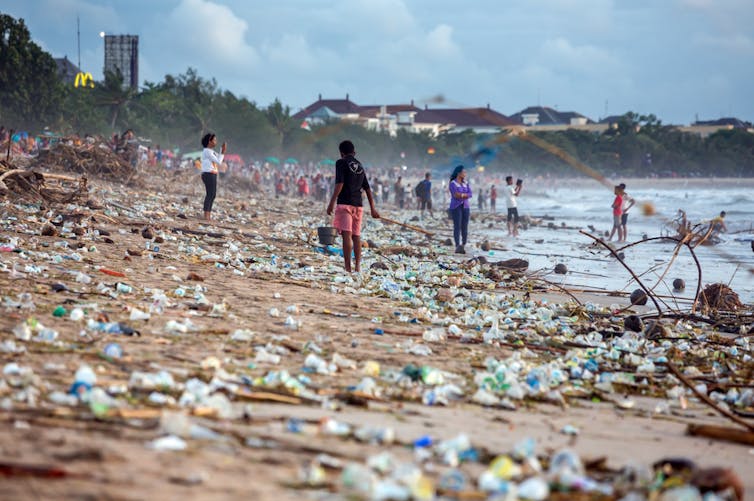
Plastic waste is the most visible component of ocean pollution. Maxim Blinkov/Shutterstock

Ocean pollution is widespread, worsening, and poses a clear and present danger to human health and wellbeing. But the extent of this danger has not been widely comprehended – until now. Our recent study provides the first comprehensive assessment of the impacts of ocean pollution on human health.

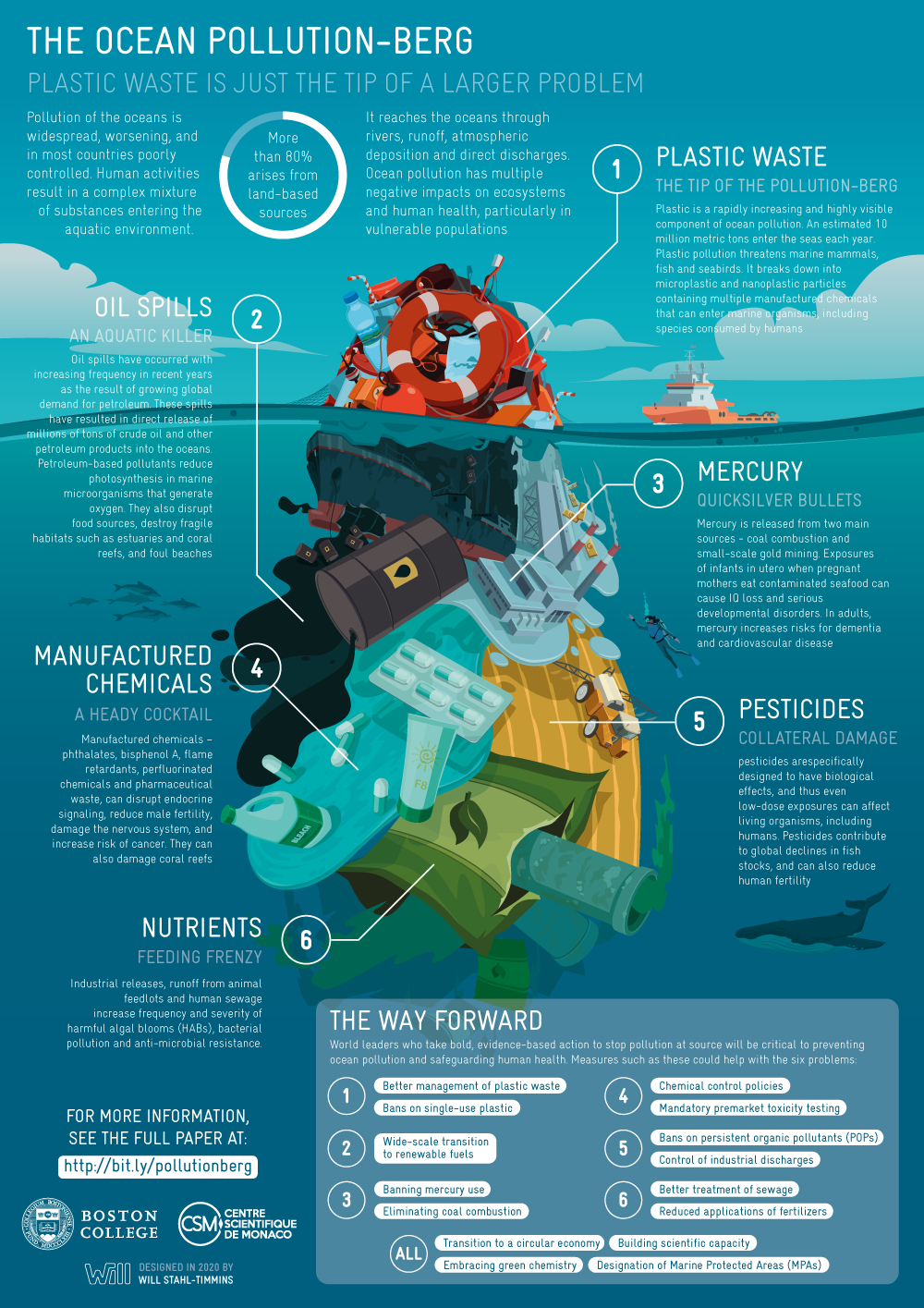
Ocean pollution is a complex mixture of toxic metals, plastics, manufactured chemicals, petroleum, urban and industrial wastes, pesticides, fertilisers, pharmaceutical chemicals, agricultural runoff, and sewage. More than 80% arises from land-based sources and it reaches the oceans through rivers, runoff, deposition from the atmosphere – where airborne pollutants are washed into the ocean by rain and snow – and direct dumping, such as pollution from waste water treatment plants and discarded waste. Ocean pollution is heaviest near the coasts and most highly concentrated along the coastlines of low-income and middle-income countries.

Infographic showing how sources of ocean pollution
The ‘pollution-berg’. Will Stahl-Timmins/Boston College/Centre Scientifique de Monaco, Author provided

Ocean pollution can also be found far beyond national jurisdictions in the open oceans, the deepest oceanic trenches, and on the shores of remote islands. Ocean pollution knows no borders.

The most hazardous ocean pollution

Plastic waste is the most visible component of ocean pollution. More than ten million tonnes of plastic enter the seas every year. The majority of this breaks down into microplastic particles and accumulates in coastal and deep-sea sediments.

Some large pieces float in the water for decades ending up as massive concentrations where currents converge and circulate. The Pacific Ocean’s so called “garbage patch” is a well-known example.


Read more: It might be the world's biggest ocean, but the mighty Pacific is in peril


Microplastics contain multiple toxic chemicals that are added to plastics to make them flexible, colourful, waterproof or flame-resistant. These include carcinogens, neurotoxins, and endocrine disruptors – chemicals that interfere with hormones, and can cause cancer, birth defects, and reduced fertility.

These chemical-laden particles enter the food chain and accumulate in fish and shellfish. When humans eat seafood contaminated with these materials, we ingest millions of microplastic particles and the many chemicals they carry. Though there is still debate on the harm to humans from microplastics, exposure to these chemicals increases the risk of all the diseases that they cause. Virtually all of us have microplastics in our bodies today.

Mercury is widespread in the oceans, and the major culprit is coal burning in homes and industry. All coal contains mercury, and when it burns, mercury vaporises, enters the atmosphere, and eventually washes into the sea. Gold mining is another source, as mercury is used to dissolve gold from the ore.

Mercury can accumulate to high levels in predatory fish such as tuna and swordfish, which are in turn eaten by us. Contaminated fish can be especially dangerous if eaten by expectant mothers. Exposure of mercury to infants in the womb can damage developing brains, reducing IQ and increasing risks for autism, ADHD, and other learning disorders. Adult mercury exposure increases risks for heart disease and dementia.

Petroleum pollutants from oil spills threaten the marine microorganisms that produce much of the Earth’s oxygen by reducing their capacity for photosynthesis. These beneficial microorganisms use solar energy to convert atmospheric CO₂ into oxygen and are also affected by organic pollutants and other chemicals. When there is a major oil spill, the impact can be huge.

Coastal pollution from industrial waste, agricultural runoff, pesticides, and sewage increases the frequency of harmful algal blooms, known as red tides, brown tides, and green tides. These blooms produce powerful toxins like ciguatera and domoic acid that accumulate in fish and shellfish. When ingested, these toxins can cause dementia, amnesia, paralysis, and even rapid death. When inhaled, they can cause asthma.

Dangerous microorganisms result from a combination of coastal pollution and warming seas, which encourages their spread. Harmful bacteria such as the vibrio species – found in warmer waters and responsible for vibriosis, a potentially fatal illness – are now appearing further north and causing life-threatening infections. There’s a high risk that cholera, caused by vibrio cholerae, could spread to new, previously unaffected areas.

And the health impacts of ocean pollution fall disproportionately on indigenous peoples, coastal communities and vulnerable populations in the Global South, underlining the planetary scale of this environmental injustice.

Political will and scientific evidence

While the findings in this report are alarming, the good news is that ocean pollution, as with all forms of pollution, can be controlled and prevented. Bans on single-use plastics and better waste sorting can curb pollution at its source, especially plastic waste, both on land and at sea.

Wise governments have curbed other forms of pollution by deploying control strategies based on law, policy, technology, and targeted enforcement. The US, for example, has reduced air pollution by 70% since the passage of the Clean Air Act in 1970. They have saved thousands of lives. They have proven highly cost-effective.

Countries around the world are now applying these same tools to control ocean pollution. Boston Harbour in Massachusetts and Victoria Harbour in Hong Kong have been cleaned. Estuaries from Chesapeake Bay in the US to the Seto Inland Sea in Japan have been rejuvenated. Some coral reefs have been restored, such as those in American Samoa, where vigilance, protection and quick response have happened in relation to various pollution threats.

These successes have boosted economies, increased tourism, restored fisheries, and improved health. They demonstrate that broad control of ocean pollution is feasible and their benefits will last for centuries. Our study offers some clear recommendations for preventing and controlling ocean pollution, including transitioning to cleaner energy, developing affordable alternatives to fossil fuel-based plastics, reducing human, agricultural and industrial discharges, and expanding Marine Protected Areas.

Protecting the planet is a global concern and our collective responsibility. Leaders who recognise the gravity of ocean pollution, acknowledge its growing dangers, engage civil society, and take bold, evidence-based action to stop pollution at source will be essential for preventing ocean pollution and safeguarding our own health.The Conversation

Jacqueline McGlade, Professor of Natural Prosperity, Sustainable Development and Knowledge Systems, UCL and Philip Landrigan, Professor and Director, Global Public Health Program and Global Pollution Observatory, Schiller Institute for Integrated Science and Society, Boston College

This article is republished from The Conversation under a Creative Commons license.