Friday, April 23, 2021

Christian nationalism is a barrier to mass vaccination against COVID-19


Some evangelical leaders are trying to counter Christian nationalist misinformation over vaccines. Win McNamee/Getty Images

While the majority of Americans either intend to get the COVID-19 vaccine or have already received their shots, getting white evangelicals to vaccination sites may prove more of a challenge – especially those who identify as Christian nationalists.

A Pew Research Center survey conducted in February found white evangelicals to be the religious group least likely to say they’d be vaccinated against the coronavirus. Nearly half (45%) said they would not get the COVID-19 shot, compared with 30% of the general population.

Some evangelicals have even linked coronavirus vaccinations to the “mark of the beast” – a symbol of submission to the Antichrist found in biblical prophecies, Revelation 13:18.

As a scholar of religion and society, I know that this skepticism among evangelicals has a background. Suspicion from religious conservatives regarding the COVID-19 vaccine is built on the back of their growing distrust of science, medicine and the global elite.

‘Anti-mask, anti-social distance, anti-vaccine’

Vaccine hesitancy is not restricted to immunization over COVID-19. In 2017, the Pew Research Center found that more than 20% of white evangelicals – more than any other group – believed that “parents should be able to decide not to vaccinate their children, even if that may create health risks for other children and adults.”

Meanwhile, there are concerns that many white evangelicals are becoming more radical. Faith is not in itself an indication of extremism, but the attack on the Capitol on Jan. 6 showed that there is a problem when it comes to some evangelicals also holding extreme beliefs. White evangelicalism, in particular, has been susceptible to Christian nationalism – the belief that the U.S. is a Christian nation that should serve the interests of white Americans.

Those who identify as Christian nationalists believe they are God’s chosen people and will be protected from any illness or disease.

This proves problematic when it comes to vaccinations. A study earlier this year found Christian nationalists were far more likely to abstain from taking the COVID-19 vaccine. It builds on research that found Christian nationalism was a leading predictor of ignoring precautionary behaviors regarding coronavirus.

Christian nationalists tend to place vaccinations within a worldview that generally distrusts science and scientists as a threat to the moral order. This was seen in the response of many on the religious right to guidance on masks and social distancing as well as, now, vaccines.

And in some cases it was driven by church leaders in the wider conservative evangelical community. For example, Tony Spell, a minister at the Life Tabernacle Church in Baton Rouge, Louisiana, defied authorities in holding mass church gatherings even after the state deemed them illegal. He has also rejected warnings that the pandemic is dangerous, stating, “We’re anti-mask, anti-social distancing, and anti-vaccine.”

He believes the vaccine is politically motivated and has used his pulpit to discourage church members from taking the vaccine.

This anti-vaccine attitude fits with the anti-government libertarianism that predominates among Christian nationalists. Many within the movement place this belief in freedom from government action within a traditional religious framework.

They feel that COVID-19 is God’s divinely ordained message telling the world to change. If the government tells them to go against that idea and vaccinate, many of them they feel they are either going against God’s will or that the government is violating their religious freedom.

Such a view was also seen before the vaccination rollout. White evangelicals were the least likely religious group to support mandated closures of businesses, for example.

Countering misinformation

The problem isn’t just that Christian nationalist beliefs will be a considerable barrier to herd immunity. To dispel myths about the COVID-19 vaccination among conservative religious communities, church leaders need to be enlisted to communicate facts about the vaccine to their parishioners – who may trust church leaders more than scientists and the government.

For vaccination rates to be increased, messages must come from trusted people in the community. The opinion of a government official will in many instances matter far less to a Christian nationalist than advice from a church leader.

As such, I argue, faith leaders can guide their followers and use their pulpits to encourage parishioners that the vaccine is safe and in line with religious doctrines.

To enable this, church leaders need to both understand and communicate to parishioners the origins of the vaccine. Many evangelicals are under the mistaken impression that vaccines were developed using fresh fetal tissue and are immensely troubled by that fact.
In reality, none of the vaccinations for COVID-19 available in the U.S. was manufactured using new fetal stem cells, but the Johnson & Johnson one was developed using lab-created stem cell lines derived from a decades-old aborted fetus. Many evangelical churches have determined that it is ethical for anti-abortion Christians to take the other vaccines when there are no other options for the preservation of life.

Some within the wider evangelical movement have begun sounding the alarm over the influence of radicalized Christian nationalism.

After the Jan. 6, 2021, attack on the Capitol, a coalition of evangelical leaders published an open letter warning: “We recognize that evangelicalism, and white evangelicalism in particular, has been susceptible to the heresy of Christian nationalism because of a long history of faith leaders accommodating white supremacy.”
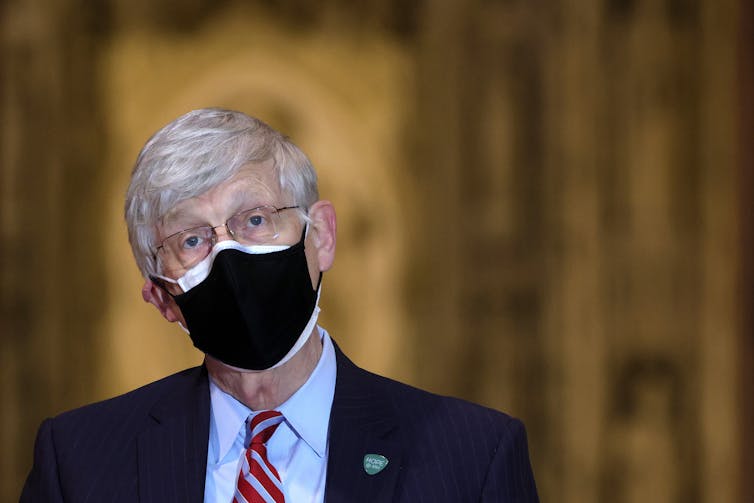
National Institutes of Health director Dr. Francis Collins addresses faith leaders at an event in Washington, D.C.
NIH director Dr. Francis Collins, a devout Christian, has urged faith leaders to get behind the vaccine program. Alex Wong/Getty Images

And many high-profile evangelical leaders acknowledge that they can maintain their personal and biblical integrity while also supporting scientific breakthroughs by connecting what they see as the wonders of God’s universe to science.

For example, Francis Collins, head of the National Institutes of Health and a devoted evangelical Christian, has said: “The church, in this time of confusion, ought to be a beacon, a light on the hill, an entity that believes in truth.”

“This is a great moment for the church to say, no matter how well intentioned someone’s opinions may be, if they’re not based upon the fact, the church should not endorse them.”

Monique Deal Barlow, Doctoral Student of Political Science, Georgia State University

This article is republished from The Conversation under a Creative Commons license.

Lab–grown embryos and human–monkey hybrids: Medical marvels or ethical missteps?


Researchers have grown mammal embryos later into development than ever before in an artificial womb. Vitalii Kyryk/WikimediaCommons, CC BY-SA

In Aldous Huxley’s 1932 novel “Brave New World,” people aren’t born from a mother’s womb. Instead, embryos are grown in artificial wombs until they are brought into the world, a process called ectogenesis. In the novel, technicians in charge of the hatcheries manipulate the nutrients they give the fetuses to make the newborns fit the desires of society. Two recent scientific developments suggest that Huxley’s imagined world of functionally manufactured people is no longer far-fetched.

On March 17, 2021, an Israeli team announced that it had grown mouse embryos for 11 days – about half of the gestation period – in artificial wombs that were essentially bottles. Until this experiment, no one had grown a mammal embryo outside a womb this far into pregnancy. Then, on April 15, 2021, a U.S. and Chinese team announced that it had successfully grown, for the first time, embryos that included both human and monkey cells in plates to a stage where organs began to form.

As both a philosopher and a biologist I cannot help but ask how far researchers should take this work. While creating chimeras – the name for creatures that are a mix of organisms – might seem like the more ethically fraught of these two advances, ethicists think the medical benefits far outweigh the ethical risks. However, ectogenesis could have far-reaching impacts on individuals and society, and the prospect of babies grown in a lab has not been put under nearly the same scrutiny as chimeras.

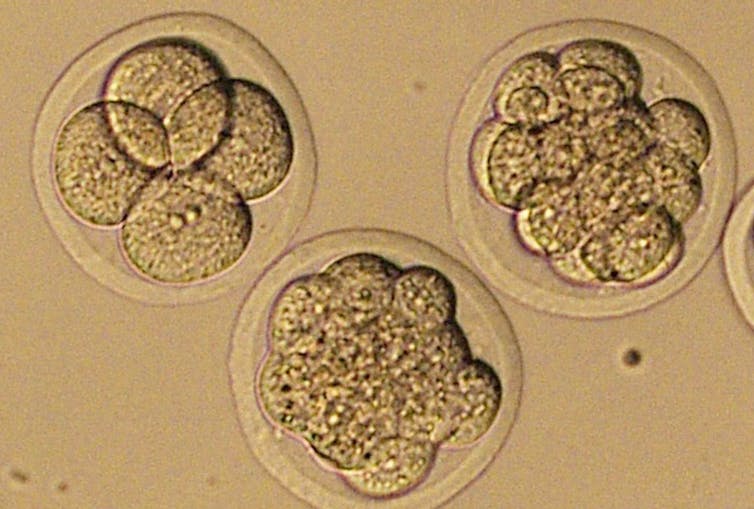
Mouse embryos were grown in an artificial womb for 11 days, and organs had begun to develop.

Growing in an artificial womb

When in vitro fertilization first emerged in the late 1970s, the press called IVF embryos “test-tube babies,” though they are nothing of the sort. These embryos are implanted into the uterus within a day or two after doctors fertilize an egg in a petri dish.

Before the Israeli experiment, researchers had not been able to grow mouse embryos outside the womb for more than four days – providing the embryos with enough oxygen had been too hard. The team spent seven years creating a system of slowly spinning glass bottles and controlled atmospheric pressure that simulates the placenta and provides oxygen.

This development is a major step toward ectogenesis, and scientists expect that it will be possible to extend mouse development further, possibly to full term outside the womb. This will likely require new techniques, but at this point it is a problem of scale – being able to accommodate a larger fetus. This appears to be a simpler challenge to overcome than figuring out something totally new like supporting organ formation.

The Israeli team plans to deploy its techniques on human embryos. Since mice and humans have similar developmental processes, it is likely that the team will succeed in growing human embryos in artificial wombs.

To do so, though, members of the team need permission from their ethics board.

CRISPR – a technology that can cut and paste genes – already allows scientists to manipulate an embryo’s genes after fertilization. Once fetuses can be grown outside the womb, as in Huxley’s world, researchers will also be able to modify their growing environments to further influence what physical and behavioral qualities these parentless babies exhibit. Science still has a way to go before fetus development and births outside of a uterus become a reality, but researchers are getting closer. The question now is how far humanity should go down this path.

A drawing of a half–eagle, half–horse griffin.
Chimeras evoke images of mythological creatures of multiple species – like this 15th-century drawing of a griffin – but the medical reality is much more sober. Martin Schongauer/WikimediaCommons

Human-monkey hybrids

Human–monkey hybrids might seem to be a much scarier prospect than babies born from artificial wombs. But in fact, the recent research is more a step toward an important medical development than an ethical minefield.

If scientists can grow human cells in monkeys or other animals, it should be possible to grow human organs too. This would solve the problem of organ shortages around the world for people needing transplants.

But keeping human cells alive in the embryos of other animals for any length of time has proved to be extremely difficult. In the human-monkey chimera experiment, a team of researchers implanted 25 human stem cells into embryos of crab-eating macaques – a type of monkey. The researchers then grew these embryos for 20 days in petri dishes.

After 15 days, the human stem cells had disappeared from most of the embryos. But at the end of the 20-day experiment, three embryos still contained human cells that had grown as part of the region of the embryo where they were embedded. For scientists, the challenge now is to figure out how to maintain human cells in chimeric embryos for longer.

A drawing of test tubes with embryos inside.
The ability to grow true test–tube babies raises many ethical questions. Carol Yepes/Moment via Getty Images

Regulating these technologies

Some ethicists have begun to worry that researchers are rushing into a future of chimeras without adequate preparation. Their main concern is the ethical status of chimeras that contain human and nonhuman cells – especially if the human cells integrate into sensitive regions such as a monkey’s brain. What rights would such creatures have?

However, there seems to be an emerging consensus that the potential medical benefits justify a step-by-step extension of this research. Many ethicists are urging public discussion of appropriate regulation to determine how close to viability these embryos should be grown. One proposed solution is to limit growth of these embryos to the first trimester of pregnancy. Given that researchers don’t plan to grow these embryos beyond the stage when they can harvest rudimentary organs, I don’t believe chimeras are ethically problematic compared with the true test–tube babies of Huxley’s world.

Few ethicists have broached the problems posed by the ability to use ectogenesis to engineer human beings to fit societal desires. Researchers have yet to conduct experiments on human ectogenesis, and for now, scientists lack the techniques to bring the embryos to full term. However, without regulation, I believe researchers are likely to try these techniques on human embryos – just as the now-infamous He Jiankui used CRISPR to edit human babies without properly assessing safety and desirability. Technologically, it is a matter of time before mammal embryos can be brought to term outside the body.

[Over 100,000 readers rely on The Conversation’s newsletter to understand the world. Sign up today.]

While people may be uncomfortable with ectogenesis today, this discomfort could pass into familiarity as happened with IVF. But scientists and regulators would do well to reflect on the wisdom of permitting a process that could allow someone to engineer human beings without parents. As critics have warned in the context of CRISPR-based genetic enhancement, pressure to change future generations to meet societal desires will be unavoidable and dangerous, regardless of whether that pressure comes from an authoritative state or cultural expectations. In Huxley’s imagination, hatcheries run by the state grew a large numbers of identical individuals as needed. That would be a very different world from today.The Conversation

Sahotra Sarkar, Professor of Philosophy and Integrative Biology, The University of Texas at Austin College of Liberal Arts

This article is republished from The Conversation under a Creative Commons license.

Saturday, March 6, 2021

As death approaches, our dreams offer comfort, reconciliation


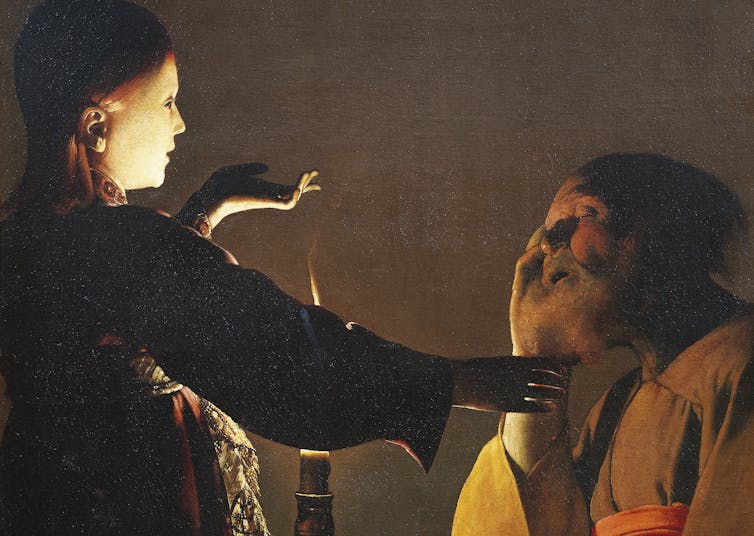
As death approaches, relationships can be resurrected, love revived and forgiveness achieved. DeAgostini/Getty Images

One of the most devastating elements of the coronavirus pandemic has been the inability to personally care for loved ones who have fallen ill.

Again and again, grieving relatives have testified to how much more devastating their loved one’s death was because they were unable to hold their family member’s hand – to provide a familiar and comforting presence in their final days and hours.

Some had to say their final goodbyes through smartphone screens held by a medical provider. Others resorted to using walkie-talkies or waving through windows.

How does one come to terms with the overwhelming grief and guilt over the thought of a loved one dying alone?

I don’t have an answer to this question. But the work of a hospice doctor named Christopher Kerr – with whom I co-authored the book “Death Is But a Dream: Finding Hope and Meaning at Life’s End” – might offer some consolation.

Unexpected visitors

At the start of his career, Dr. Kerr was tasked – like any and all physicians – with attending to the physical care of his patients. But he soon noticed a phenomenon that seasoned nurses were already accustomed to. As patients approached death, many had dreams and visions of deceased loved ones who came back to comfort them in their final days.

Doctors are typically trained to interpret these occurrences as drug-induced or delusional hallucinations that might warrant more medication or downright sedation.

But after seeing the peace and comfort these end-of-life experiences seemed to bring his patients, Dr. Kerr decided to pause and listen. One day, in 2005, a dying patient named Mary had one such vision: She began moving her arms as if rocking a baby, cooing at her child who had died in infancy decades prior.

To Dr. Kerr, this didn’t seem like cognitive decline. What if, he wondered, patients’ own perceptions at life’s end mattered to their well-being in ways that should not concern just nurses, chaplains and social workers?

What would medical care look like if all physicians stopped and listened, too?

The project begins

So at the sight of dying patients reaching and calling out to their loved ones – many of whom they had not seen, touched or heard for decades – he began collecting and recording testimonies given directly by those who were dying. Over the course of 10 years, he and his research team recorded the end-of-life experiences of 1,400 patients and families.

What he discovered astounded him. Over 80% of his patients – no matter what walk of life, background or age group they came from – had end-of-life experiences that seemed to entail more than just strange dreams. These were vivid, meaningful and transformative. And they always increased in frequency near death.

They included visions of long-lost mothers, fathers and relatives, as well as dead pets come back to comfort their former owners. They were about relationships resurrected, love revived and forgiveness achieved. They often brought reassurance and support, peace and acceptance.

Becoming a dream weaver

I first heard of Dr. Kerr’s research in a barn.

I was busy mucking my horse’s stall. The stables were on Dr. Kerr’s property, so we often discussed his work on the dreams and visions of his dying patients. He told me about his TEDx Talk on the topic, as well as the book project he was working on.

I couldn’t help but be moved by the work of this doctor and scientist. When he disclosed that he was not getting far with the writing, I offered to help. He hesitated at first. I was an English professor who was an expert in taking apart the stories others wrote, not in writing them myself. His agent was concerned that I wouldn’t be able to write in ways that were accessible to the public – something academics are not exactly known for. I persisted, and the rest is history.

It was this collaboration that turned me into a writer.

I was tasked with instilling more humanity into the remarkable medical intervention this scientific research represented, to put a human face on the statistical data that had already been published in medical journals.

The moving stories of Dr. Kerr’s encounters with his patients and their families confirmed how, in the words of the French Renaissance writer Michel de Montaigne, “he who should teach men to die would at the same time teach them to live.”

I learned about Robert, who was losing Barbara, his wife of 60 years, and was assailed by conflicting feelings of guilt, despair and faith. One day, he inexplicably saw her reaching for the baby son they had lost decades ago, in a brief span of lucid dreaming that echoed Mary’s experience years earlier. Robert was struck by his wife’s calm demeanor and blissful smile. It was a moment of pure wholeness, one that transformed their experience of the dying process. Barbara was living her passing as a time of love regained, and seeing her comforted brought Robert some peace in the midst of his irredeemable loss.

For the elderly couples Dr. Kerr cared for, being separated by death after decades of togetherness was simply unfathomable. Joan’s recurring dreams and visions helped mend the deep wound left by her husband’s passing months earlier. She would call out to him at night and point to his presence during the day, including in moments of full and articulate lucidity. For her daughter Lisa, these occurrences grounded her in the knowledge that her parents’ bond was unbreakable. Her mother’s pre-death dreams and visions assisted Lisa in her own journey toward acceptance – a key element of processing loss.

When children are dying, it is often their beloved, deceased pets that make appearances. Thirteen-year-old Jessica, dying of a malignant form of bone-based cancer, started having visions of her former dog, Shadow. His presence reassured her. “I will be fine,” she told Dr. Kerr on one of his last visits.

A young girl's hand clasps a dog's paw.
For many kids, their only experience with death is with family pets, and the return of deceased animals can be comforting. Carol Yepes/Getty Images

For Jessica’s mom, Kristen, these visions – and Jessica’s resulting tranquility – helped initiate the process she had been resisting: that of letting go.

Isolated but not alone

The health care system is difficult to change. Nevertheless, Dr. Kerr still hopes to help patients and their loved ones reclaim the dying process from a clinical approach to one that is appreciated as a rich and unique human experience.

[Deep knowledge, daily. Sign up for The Conversation’s newsletter.]

Pre-death dreams and visions help fill the void that may otherwise be created by the doubt and fear that death evokes. They help the dying reunite with those they have loved and lost, those who secured them, affirmed them and brought them peace. They heal old wounds, restore dignity, and reclaim love. Knowing about this paradoxical reality helps the bereaved cope with grief as well.

As hospitals and nursing homes continue to remain closed to visitors because of the coronavirus pandemic, it may help to know that the dying rarely speak of being alone. They speak of being loved and put back together.

There is no substitute for being able to hold our loved ones in their last moments, but there may be solace in knowing that they were being held.The Conversation

Carine Mardorossian, Professor of English, University at Buffalo

This article is republished from The Conversation under a Creative Commons license.
What the Bible's approach to history can teach us about America's glory and shame


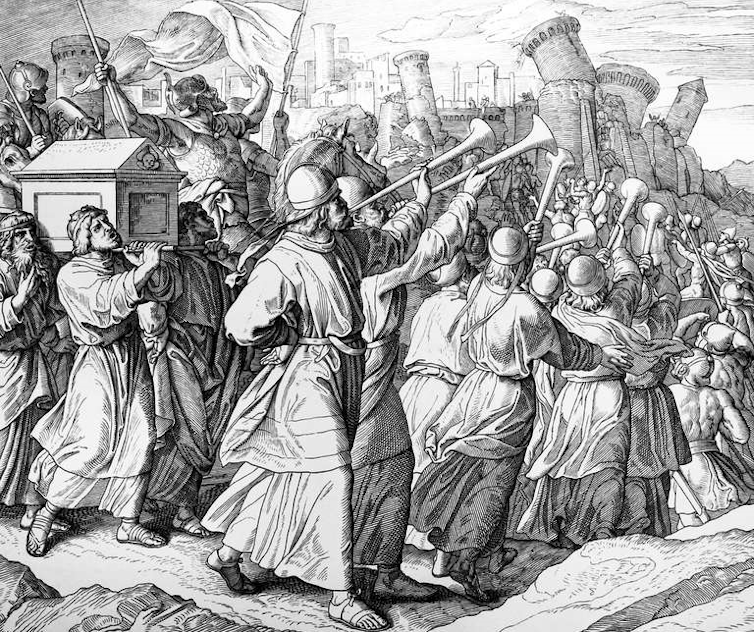
Trumpeting the past? The Bible has conflicting narratives over the conquest of Canaan. Wikimedia Commons

At a time when Americans are seemingly as polarized as ever over the present, the country’s past also appears to be up for debate.

The killing of George Floyd and the anti-racism protests it sparked and The New York Times’ 1619 Project, which placed slavery central to the American narrative, have reminded people of the oppressive, exploitative and painful parts of the making of the United States. Meanwhile, former President Donald Trump’s 1776 Commission was created to counter what the administration described as a “radicalized” view of America history. Its report, released in the last days of the Trump administration, suggested that all Americans are “united by the glory of our history.”

But history is messy. It doesn’t fit easily within binary thinking.

As a Bible scholar, I am struck by the ways the Bible tells both the good and bad of ancient Israel’s history – even when the narratives conflict. Instead of only celebrating moments of glory or tragedy, the Bible recounts both together. This approach to history – treating narratives as one rather than cherry-picking the bits that fit a certain point of view – offers an example of how we can reframe the debate about how the U.S. tells its own history.

‘City on a hill’

The Bible regularly has been mined for ideas, themes and metaphors to tell America’s story.

In 1630, shortly after the first slave ship arrived in Virginia, John Winthrop, a Puritan minister and later Massachusetts Bay Colony governor, delivered a sermon calling for the Massachusetts Bay Colony to become a “city upon a hill” – a reference to a passage in the Book of Matthew in which Jesus calls on his followers to be models of behavior for the world to follow. This image became popular again in the 20th century when both Presidents John F. Kennedy and Ronald W. Reagan invoked it to describe American exceptionalism – the idea that the U.S. is by design, inherently different.

Meanwhile, the U.S. as a promised land given to the settlers by their God, a widely held belief in the 19th century, motivated the idea of Manifest Destiny, the doctrine under which American settlers embarked on a westward movement. This movement, with its forced displacement of Native Americans and others, implicitly reenacted another part of the biblical narratives: Canaan as the land God gave ancient Israel. It was another way the U.S. could become Winthrop’s “city upon a hill.”

Written by the victors

Beginning in ancient times, historical narratives commonly celebrate purported victories and downplay or omit whatever detracts from them.

Take for example Egypt’s Pharaoh Ramesses II who, in the 13th century B.C., fought a battle with the Hittite king Muwatalli II at Kadesh, in what is now Syria. Ramesses portrayed the event as an Egyptian victory. But Hittite accounts of the battle, discovered by archaeologists, suggest the battle was a draw. The outcome of the battle depends on who tells the story.

Different narratives

The biblical writers also provide accounts of victories. But they also acknowledge defeats and failures. They even preserve conflicting accounts of Israel’s past, providing multiple interpretations of the same event as part of one overall history – take, for example, the conquest of Canaan.

The Book of Joshua recounts a story of a sweeping military campaign to capture Canaan. Yet in the very next chapter, Joshua 13, readers learn things are not quite what they seem. Israel did not conquer all of Canaan. The first chapter of the next book, Judges 1, provides a different account of Israel’s life in Canaan.

Rather than a great military conquest, Israel takes possession of Canaan gradually and with setbacks. Israelites live among the inhabitants of Canaan, occasionally fighting limited battles to take particular cities or regions. The process took time.

Elsewhere in the Bible, there is the figure of King David. He is remembered as the one who unifies the people, makes Jerusalem the capital and has God’s favor. But he also impregnates another man’s wife and sends Uriah to his death in battle before marrying his wife Bathsheba.

He is also driven from Jerusalem when his own son, Absalom, leads a rebellion against him.

[Deep knowledge, daily. Sign up for The Conversation’s newsletter.]

Replacing binary history

The point is, be it portraying a key figure as both heroic and flawed, or a campaign as triumphant victory and slow conquest, the biblical writers often told more than one side of history.

They recount the good and bad of ancient Israel’s history, without resolution of the tension, discrepancies and unseemliness of past actions.

As such, it could offer a model for how to tell U.S. history. Both the 1619 Project and President Trump’s 1776 Commission can tell the histories of the U.S. without denying or excluding the other.

As the Bible shows, coming to terms with different historical narratives is possible.

Iliff School of Theology is a member of the Association of Theological Schools.The Conversation

The ATS is a funding partner of The Conversation US.

Mark K. George, Professor of Bible and Ancient Systems of Thought, Iliff School of Theology

This article is republished from The Conversation under a Creative Commons license.