Monday, April 18, 2022

How a coffee company and a marketing maven brewed up a Passover tradition: A brief history of the Maxwell House Haggadah


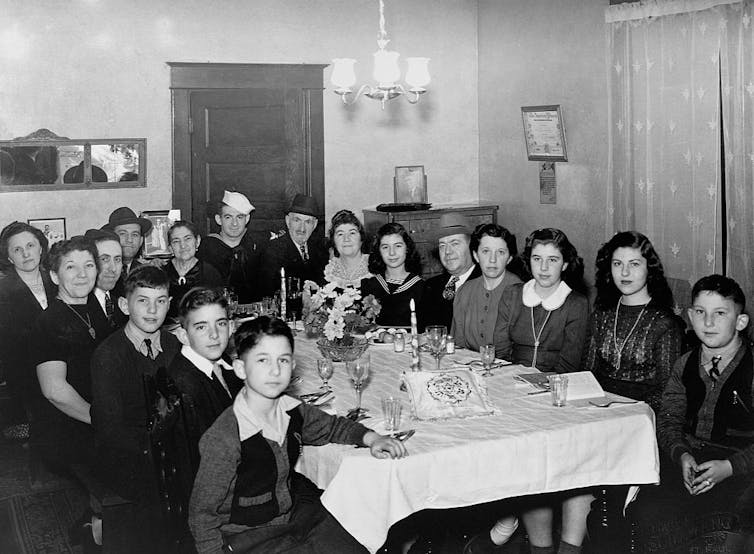
A Jewish family welcomes home their Navy man and gathers for a Passover Seder at their home in St. Paul, Minnesota in 1943. Minnesota Historical Society/CORBIS/Corbis Historical via Getty Images

For more than a millennium, the haggadah has been the centerpiece of the Jewish holiday of Passover. The book sets out the ceremony for the Seder meal, when families tell the biblical Exodus story of God delivering the ancient Israelites from slavery in Egypt.

Today, thousands of different haggadahs exist, with prayers, rituals and readings tailored to every type of Seder – from LGBTQ+-affirming to climate-conscious. But for decades, one of the most popular and influential haggadahs in the United States has been a simple version with an unlikely source: the Maxwell House Haggadah, dreamed up in 1932 by the coffee corporation and a Jewish advertising executive.

The cover page of the Maxwell House Haggadah, in English and Hebrew.
The Maxwell House Haggadah, first published in 1932. Joseph Jacobs Advertising

Its history reflects how Jews modernized and adapted to their new country, while also upholding traditions. But coffee has no ritual ties to Passover. So what explains the Maxwell House Haggadah’s sustained popularity?

Coffee competition

One explanation is advertising: a field so pervasive and powerful in people’s lives that it becomes almost invisible. As a scholar of American Jewish visual culture and communication, I have researched how marketing can influence Americans’ religious and cultural identities.

The story of the Maxwell House Haggadah begins with the meeting of two marketing masterminds. The first, Joseph Jacobs, grew up on the Lower East Side in New York at the turn of the 20th century, amid a wave of Jewish immigration from Eastern Europe. He went on to establish his advertising company in 1919. The second was Joel Owsley Cheek of the Cheek-Neal Coffee Company, who hailed from the South. Cheek-Neal was then the parent company of Maxwell House coffee, with its famous slogan “good to the last drop.”

Jacobs’ quest to familiarize companies with the buying power of the growing population of Jewish Americans led him to talk with Cheek in 1922 about placing ads for Maxwell House coffee in Jewish journals. There was only one problem: American Jews of Eastern European descent believed that coffee beans, like other legumes, were forbidden for Passover, when certain foods must be avoided, so they drank tea during the weeklong holiday.

Consulting a rabbi from the Lower East Side, who declared that technically coffee beans were like berries and therefore kosher for Passover, Jacobs secured a rabbinical stamp of approval for Maxwell coffee in 1923.

During the Great Depression of the 1930s, when a major grocery chain discounted their own brand of coffee, Maxwell House turned to Jacobs’ firm to help them stay competitive. The Maxwell House Haggadah was born when he suggested distributing a book for free with each purchased can of coffee.

Beyond its appeal as a giveaway, however, the content of the haggadah needed to earn Jewish customers’ trust. The front cover relied upon a classical design of centered text in Hebrew, but also English. Inside, pen and ink illustrations of biblical stories continued the sense of tradition. The pages of the haggadah turned from right to left, as is typical of Hebrew texts.

It worked. According to a market report commissioned by the Joseph Jacobs Organization to guide its marketing efforts, Maxwell House became the coffee of choice for Jewish households around New York City.

Modernizing the haggadah

The Maxwell House Haggadah remained largely the same through the 1940s and ‘50s, and soon achieved the status of a Passover classic. Yet the 1965 version marked a definitive break with the past. As 1960s culture introduced more minimalist, graphic art, raging against the classicism of the past, the haggadah’s images changed to reflect the times. And though the written text remained largely the same, the addition of English transliterations of blessings and prayers hinted at Americanizing Jews’ loss of Hebrew reading skills.
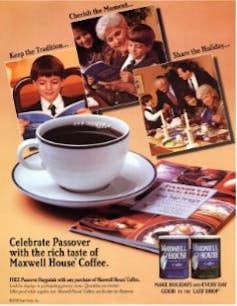
An advertisement for Maxwell House Coffee.
An ad for Maxwell House coffee, themed for Passover. Joseph Jacobs Advertising

For the next 30 years, very little changed in the haggadah. But in 2000, it finally received a visual makeover, as seen in an advertisement that year. Stark graphics, popular since the mid-‘60s, were replaced with nostalgic photos depicting an intergenerational family at a Seder. This tender imagery invoked tradition at a time when many Americans had grown more distant from their Jewish communities, prompting concern from Jewish leaders.

In 2009, the haggadah achieved worldwide fame when President Barack Obama used it to conduct his first White House Seder. Shortly after, it underwent a complete overhaul for the 21st century. Maxwell House’s version was now less illustrated and included more written text, like the haggadahs used by more religious Jews. By eliminating antiquated words like “thee” and “thine,” along with gender-specific pronouns for God, the new version felt more relevant for a younger and more secular Jewish population.
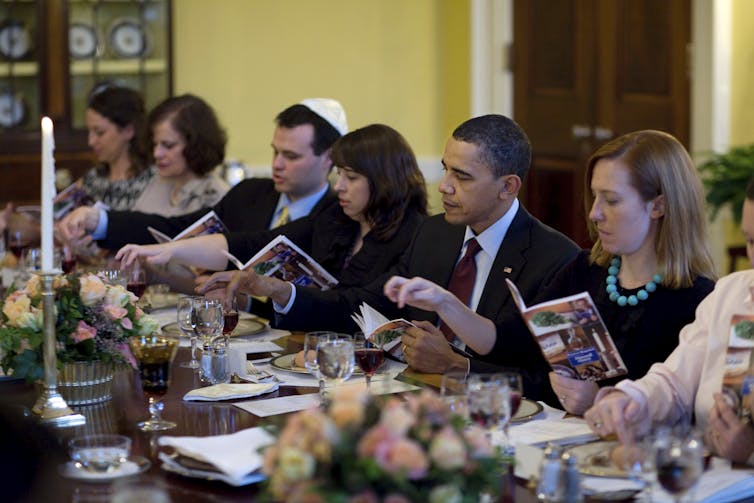
President Obama and guests sit around a dinner table at the White House.
In this image released by the White House, President Barack Obama and the first family mark the Jewish holiday of Passover with a Seder at the White House in 2010. AP Photo/The White House, Pete Souza

And in 2019, when “The Marvelous Mrs. Maisel,” the television show about a mid-century Jewish housewife-turned-comedian, was at its height of popularity, Maxwell House published a special Mrs. Maisel edition of its haggadah. A throwback to the haggadah’s heyday in the late ‘50s, this television tie-in represented yet another marketing effort to retain American Jews’ affection for Maxwell House coffee in a crowded market.

The pink cover of the
Maxwell House/Amazon

In a sea of thousands of haggadahs, it is Maxwell House’s that has become the de facto representative of American Jewish life. The story of its place within U.S. households points to marketing’s key role in shaping a yearly tradition.The Conversation

Kerri Steinberg, Department Chair of Liberal Arts and Sciences, Otis College of Art and Design

This article is republished from The Conversation under a Creative Commons license.

Wednesday, March 9, 2022

A brief history of Babi Yar, where Nazis massacred Jews, Soviets kept silence and now Ukraine says Russia fired a missile


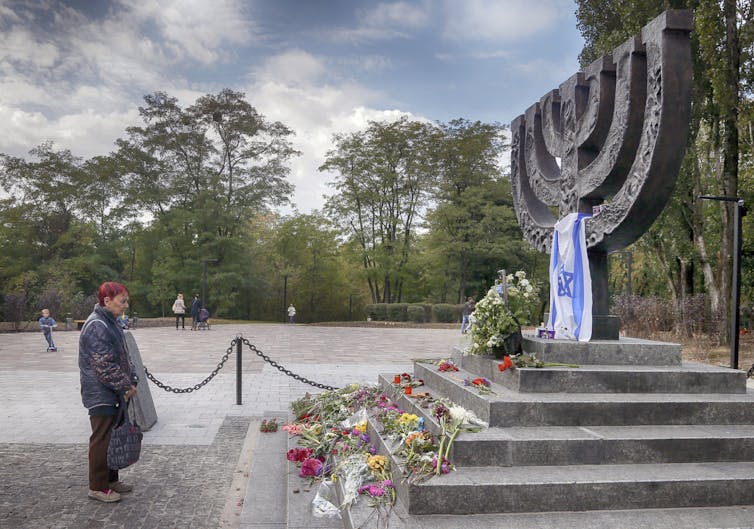
A woman pays homage at the memorial to victims of the 1941 Nazi massacre of Jews in Babi Yar in Kyiv, Ukraine. AP Photo/Efrem Lukatsky

At Babi Yar no memorials preside.”

Russian poet Yevgeny Yevtushenko wrote that line in a 1961 poem in a reference to to the ravine in the suburbs of Kyiv where, starting on Sept. 29, 1941, and continuing into the following day, over 33,000 Jews were murdered by Nazi forces and their Ukrainian collaborators.

On March 1, 2022, according to Ukrainian President Volodymyr Zelenskyy, a Russian strike against a TV tower in Kyiv killed five people and damaged the nearby site.

“What is the point of saying ‘never again’ for 80 years, if the world stays silent when a bomb drops on the same site of Babyn Yar?” Zelenskyy asked in an anguished tweet, using the Ukrainian variant of the name.

But silence and Babi Yar have a long history together. “All the silence screams,” as Yevtushenko put it in his poem.

The Babi Yar massacre

As a historian of the Holocaust in Ukraine and the author of the recently published “In the Midst of Civilized Europe: The Pogroms of 1918-1921 and the Onset of the Holocaust,” I have sought to fill in some of these silences by speaking and writing about the atrocities that took place.

On Friday, Sept. 26, 1941, when the Germans occupied Kyiv, announcements printed in Russian, Ukrainian and German began to appear on lampposts and walls around the city ordering all Jews to assemble Monday at 8 a.m. near the site of a Jewish cemetery. That morning, the day before the Jewish holiday of Yom Kippur was to begin, over 33,000 people gathered, mostly women, children and the elderly, as the Soviet government had already mobilized the men capable of fighting into the Red Army.

The multitude was marched under guard through a barbed wire enclosure leading into Babi Yar. Babi Yar – “yar” means ravine in Russian and Ukrainian – is actually a system of ravines, where estuaries that once fed into a tributary of the Dnieper River had left steep troughs and inland fields. It is a scenic site, still crowded on weekends with picnickers and soccer players.

As the assembled Jews entered the ravine on that day in 1941, German SS units, together with Ukrainian prisoners recruited from a nearby prisoner-of-war camp to serve the Nazis as local police, robbed them of their money, possessions and documents. They made the Jews wait in the meadow, from where, behind a mound of earth, they could hear the relentless sound of machine gun fire. Over the next 36 hours, the Germans took small groups of Jews, stripped them naked and murdered them.

The postwar trial records give a sense of what occurred. The victims “were made to lie facedown on the bloodied corpses of victims who had already been shot. If they did not do this willingly, they were beaten and knocked down. Then the gunners climbed over the wobbly mounds toward the victims and shot them in the back of the neck.” According to an operational situation report the Germans sent back to Berlin, they had shot 33,371 Jews.

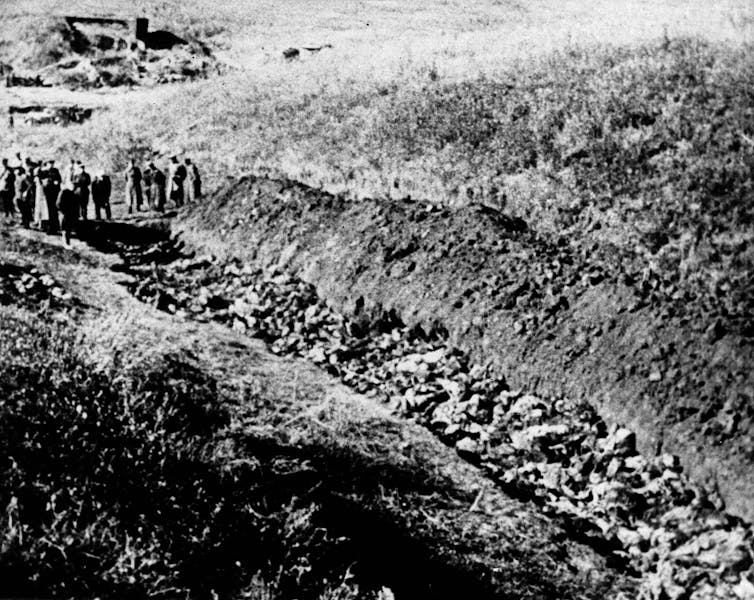
A black and white photo showing the site of a massacre of Jews in the Babi Yar ravine in Ukraine.
Part of the Babi Yar ravine on the outskirts of Kyiv, Ukraine, where the advancing Red Army in 1944 unearthed the bodies of 14,000 civilians killed by fleeing Nazis. AP Photo

Over the next two years, the Germans would continue to use the site as a killing ground, murdering another 70,000 individuals – Romani people, psychiatric patients, prisoners of war, and other civilians – before the Red Army liberated the city in November 1943.

The Germans were the first to try to silence the memory of the crimes committed at the site. In August 1943, fearful of the approaching Red Army, they forced prisoners from the nearby Syrets concentration camp to dig up and burn remains from the site.

The Soviet government, too, attempted to conceal what had taken place at the site. In 1961, they tried to fill in the ravine, unintentionally setting off a mudslide that killed at least 145 people. But Yevtushenko’s poem, published that same year, gave voice to the victims in the ground. In 1962, Dmitry Shostakovich dedicated his 13th Symphony to Babi Yar, further amplifying the memory of the crimes that had taken place there.

The full story of what took place was first told to the public by the Soviet writer Anatolii Kuznetsov, whose “Babi Yar: A Document in the Form of a Novel” was published in a censored form in the Soviet Union in 1966 and released in an uncensored version in 1970 after Kuznetsov’s defection to Great Britain.

Breaking the silence

Beginning in the late 1960s, grassroots groups of Jewish Holocaust survivors began to gather informally at the ravine on the anniversary of the massacre, and in 1966 they hung an unofficial memorial sign. But it was not until 1976 that the first official monument was installed at the site. Officially called “The Monument to Soviet citizens and POWs shot by the Nazi Occupiers,” it was silent about the relevance of the site to Jews.

The massacre of Jews at Babi Yar and other locations did not fit with the official Soviet version of the war. The Soviets spoke of what they called “The Great Patriotic War” as a historic battle between fascism and communism, and played down the racial and ethnic chauvinism of Nazism.

Silence on Jewish victimhood also avoided difficult questions about the collaboration of ethnic Ukrainians and others. In the Soviet myth, all Soviet citizens were equal victims of Nazi barbarism and could share in the ultimate victory of the Red Army over the German Wehrmacht, the armed forces of the Third Reich.

It wasn’t until 1991, after Ukrainian independence, that a menorah-shaped monument was erected at Babi Yar for the 50th anniversary of the massacre. It was the first official public acknowledgment of the Jews who were murdered at the site.

Since then, the site has become as contentious as the war itself as different stakeholders have come forward to erect their own memorials to other ethnic, religious, political and demographic groups murdered at Babi Yar – Romani people, children, priests and Ukrainian nationalists.

Only in 2016 was a commission formed to establish a more permanent memorial on the site. The Babi Yar Holocaust Memorial Center, scheduled to open in 2025, though, has drawn widespread controversy on account of the high-tech interactive museum envisioned by artistic director Ilya Khrzhanovsky as the centerpiece of the memorial. Pointing to the role-playing virtual reality experience of the planned museum, at least one critic dismissed it as “Holocaust Disneyland.”

As the sound of shelling barraged Kyiv, Zelenskyy once again used the Russian attack near the Babi Yar site as an appeal for action: “Nazism is born in silence,” he warned.The Conversation

Jeffrey Veidlinger, Professor of History and Judaic Studies, University of Michigan

This article is republished from The Conversation under a Creative Commons license.

Sunday, January 9, 2022

What’s the difference between sugar, other natural sweeteners and artificial sweeteners? A food chemist explains sweet science


Sugar is just one of many flavor enhancers people and companies use to sweeten foods and beverages. Marie LaFauci/Moment via Getty Images

A quick walk down the drink aisle of any corner store reveals the incredible ingenuity of food scientists in search of sweet flavors. In some drinks you’ll find sugar. A diet soda might have an artificial or natural low-calorie sweetener. And found in nearly everything else is high fructose corn syrup, the king of U.S. sweetness.

I am a chemist who studies compounds found in nature, and I am also a lover of food. With confusing food labels claiming foods and beverages to be diet, zero-sugar or with “no artificial sweeteners,” it can be confusing to know exactly what you are consuming.

So what are these sweet molecules? How can cane sugar and artificial sweeteners produce such similar flavors? First, it is helpful to understand how taste buds work.

Two girls licking lollipops.
You perceive sweet flavors when certain molecules bind to the taste buds on your tongue. Bomin Jeong/EyeEm via Getty Images

Taste buds and chemistry

The “taste map” – the idea that you taste different flavors on different parts of your tongue – is far from the truth. People are able to taste all flavors anywhere there are taste buds. So what’s a taste bud?

Taste buds are areas on your tongue that contain dozens of taste receptor cells. These cells can detect the five flavors – sweet, sour, salty, bitter and umami. When you eat, food molecules are dissolved in saliva and then washed across the taste buds, where they bind to the different taste receptor cells. Only molecules with certain shapes can bind to certain receptors, and this produces the perception of different flavors.

Molecules that taste sweet bind to specific proteins on the taste receptor cells called G-proteins. When a molecule binds these G-proteins, it triggers a series of signals that are sent to the brain where it is interpreted as sweet.

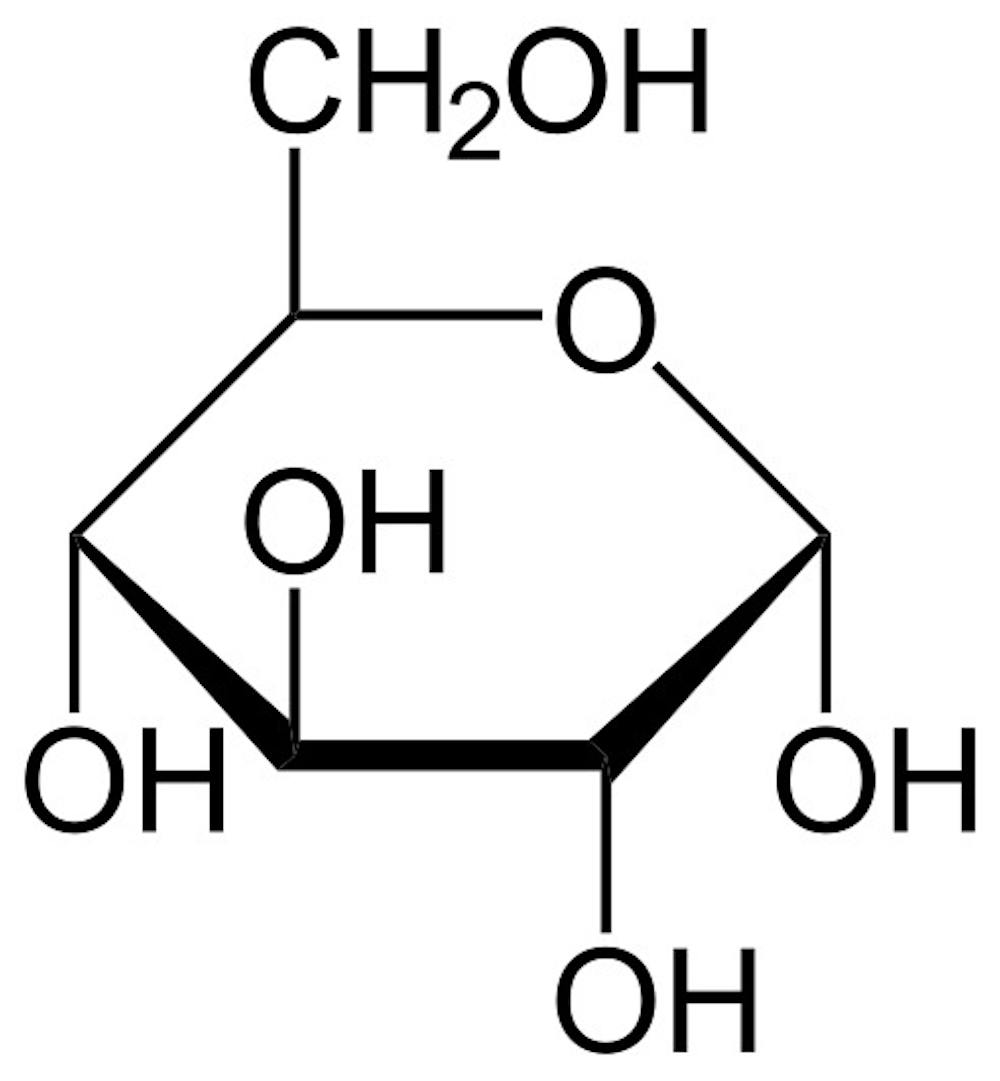
A diagram of a glucose molucule.
Glucose is the simplest of sugars and is a circle of carbon atoms with oxygen and hydrogen atoms attached to the ring. NEUROtiker/WikimediaCommons

Natural sugars

Natural sugars are types of carbohydrates known as saccharides that are made of carbon, oxygen and hydrogen. You can imagine sugars as rings of carbon atoms with pairs of oxygen and hydrogen attached to the outside of the rings. The oxygen and hydrogen groups are what make sugar sticky to the touch. They behave like Velcro, sticking to the oxygen and hydrogen pairs on other sugar molecules.

The simplest sugars are single-molecule sugars called monosaccharides. You’ve probably heard of some of these. Glucose is the most basic sugar and is mostly made by plants. Fructose is a sugar from fruit. Galactose is a sugar in milk.

Table sugar – or sucrose, which comes from sugar cane – is an example of a dissacharide, a compound made of two monosaccharides. Sucrose is formed when a glucose molecule and a fructose molecule join together. Other common dissacharides are lactose from milk and maltose, which comes grains.

When these sugars are eaten, the body processes each of them slightly differently. But eventually they are broken down into molecules that your body converts into energy. The amount of energy from sugar – and all food – is measured in calories.

An aisle of soda.
High fructose corn syrup is the main sweetener for many processed foods and drinks. Jeff Greenberg/Universal Images Group via Getty Images

High fructose corn syrup

High fructose corn syrup is a staple of U.S. foods, and this hybrid sugar sweetener needs a category all on its own. High fructose corn syrup is made from corn starch – the main carbohydrate found in corn. Corn starch is made of thousands of glucose molecules bonded together. At an industrial scale, the starch is broken into individual glucose molecules using enzymes. This glucose is then treated with a second enzyme to convert some of it into fructose. Generally, high fructose corn syrup is roughly 42%-55% fructose.

This blend is sweet and cheap to produce but has a high calorie content. As with other natural sugars, too much high fructose corn syrup is bad for your health. And since most processed foods and drinks are packed full of the stuff, it is easy to consume too much.

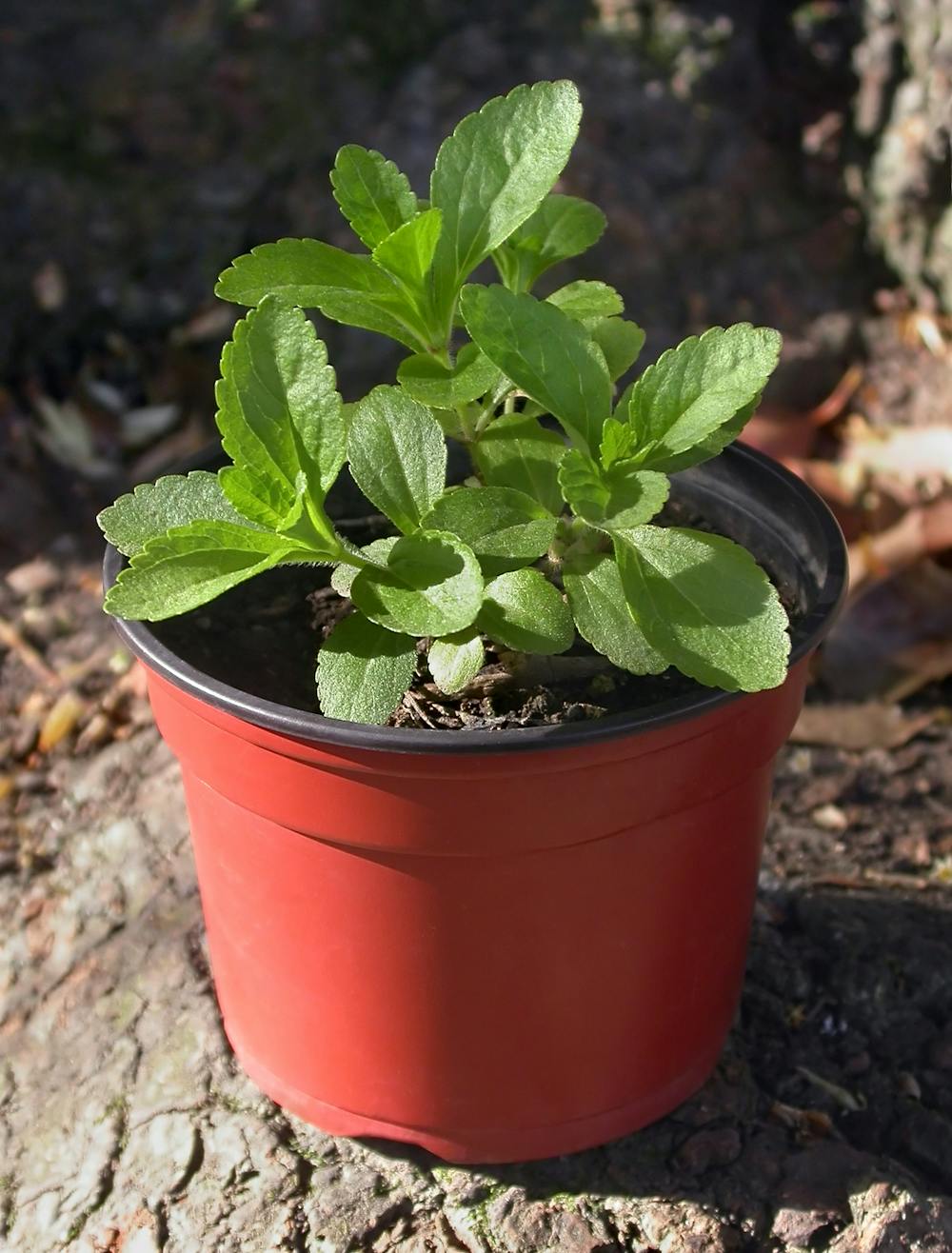
A small green plant in a pot.
A chemical in the stevia plant also produces sweet flavors. Gabriela F. Ruellan/WikimediaCommons

Natural nonsugar sweeteners

The second category of sweeteners could be defined as natural nonsugar sweeteners. These are food additives such as stevia and monk fruit, as well as natural sugar alcohols. These molecules aren’t sugars, but they can still bind to the sweet receptors and therefore taste sweet.

Stevia is a molecule that comes from the leaves of the Stevia redaudiana plant. It contains “sweet” molecules that are much larger than most sugars and have three glucose molecules attached to them. These molecules are 30 to 150 times sweeter than glucose itself. The sweet molecules from monk fruit are similar to stevia and 250 times sweeter than glucose.

The human body has a really hard time breaking down both stevia and monk fruit. So even though they’re both really sweet, you don’t get any calories from eating them.

Sugar alcohols, like sorbital, for example, are not as sweet as sucrose. They can be found in a variety of foods, including pineapples, mushrooms, carrots and seaweed, and are often added to diet drinks, sugar-free chewing gum and many other foods and drinks. Sugar alcohols are made of chains of carbon atoms instead of circles like normal sugars. While they are composed of the same atoms as the sugars, sugar alcohols are not absorbed well by the body so they are considered low-calorie sweeteners.

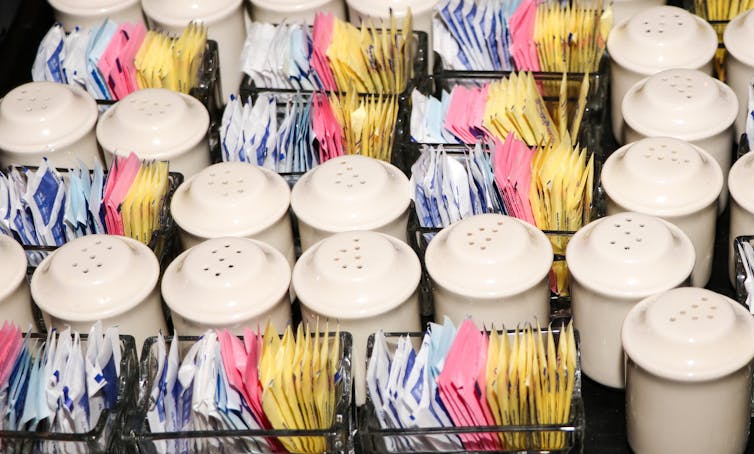
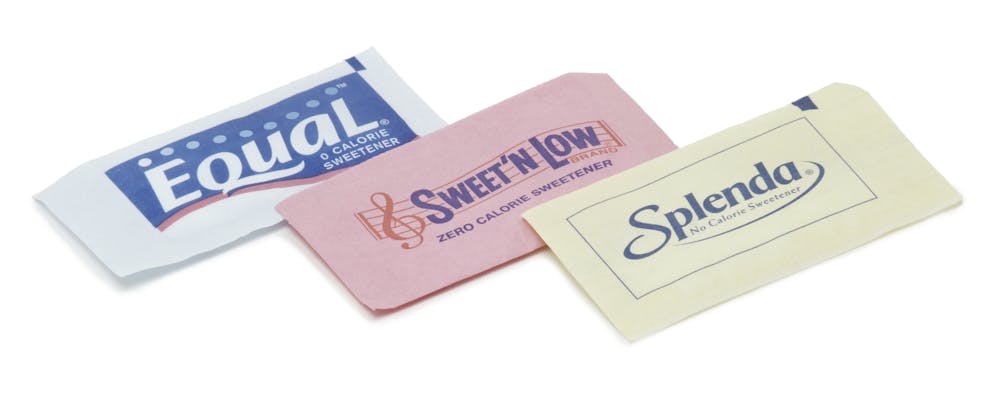
Packets of Splenda, Sweet'N Low and Equal.
Chemists have developed a number of lab-made chemicals that taste sweet and are sold as no-sugar sweeteners. Evan Amos/WikimediaCommons

Artificial sweeteners

The third way to make something sweet is to add artificial sweeteners. These chemicals are produced in labs and factories and are not found in nature. Like all things that taste sweet, they do so because they can bind to certain receptors in taste buds.

So far, the U.S. Food and Drug Administration has approved six artificial sweeteners. The most well known are probably saccharin, aspartame and sucralose – better known as Splenda. Artificial sweeteners all have different chemical formulas. Some resemble natural sugars while others are radically different. They are usually many times sweeter than sugar – saccharin is an incredible 200 to 700 times sweeter than table sugar – and some of them are hard for the body to break down.

While a sweet dessert may be a simple pleasure for many, the chemistry of how your taste buds perceive sweetness is not so simple. Only molecules with the perfect combination of atoms taste sweet, but bodies deal with each of these molecules differently when it comes to calories.


This article is part of a series examining sugar’s effects on human health and culture. To see all articles on this series, click here.The Conversation

Kristine Nolin, Associate Professor of Chemistry, University of Richmond

This article is republished from The Conversation under a Creative Commons license.
Regret can be all-consuming – a neurobehavioral scientist explains how people can overcome it


Regret can increase stress and negatively affect one’s physical health. JGI/Tom Grill via Getty Images

A friend of mine – we will call him “Jay” – was working for IBM in New York City in the early ‘90s. He was a computer programmer and made a good salary. Occasionally, competitors and startups approached Jay to join their companies. He had an offer from an interesting but small organization in Seattle, but the salary was paltry and most of the offer package was in company shares. After consulting with friends and his parents, Jay declined the offer and stayed with IBM. He has regretted it ever since. That small company was Microsoft.

Regret is a very real reaction to a disappointing event in your life, a choice you made that can’t be changed, something you said that you can’t take back. It’s one of those feelings you can’t seem to shake, a heavy and intrusive negative emotion that can last for minutes, days, years or even a lifetime. Imaging studies reveal that feelings of regret show increased activity in an area of the brain called the medial orbitofrontal cortex.

Dealing with regret is even more difficult because of the other negative emotions connected to it: remorse, sorrow and helplessness. Regret can increase our stress, negatively affect physical health and throw off the balance of hormone and immune systems. Regret is not only unpleasant. It is unhealthy.

As a licensed clinical psychologist at the University of Virginia School of Medicine, I conduct research on stressful emotions. Through this work, I help patients overcome regret, move on with their lives and grow. And that is the good news: Regret can be overcome through interventions like therapy and evidence-based strategies.

A man in session with a female therapist.
Therapy can help people consumed with regret to face their feelings and develop resilience. FatCamera/E+ via Getty Images

A 'sense of stuckness’

There are basically two ways to experience regret: One is what researchers refer to as the action path and the other is the inaction path. That is, we can regret the things we did – or we can regret the things we did not do.

Research suggests that action-related regrets, although painful, spur people to learn from their mistakes and move on. But regret related to the inaction path – the things undone, the opportunities lost – is harder to fix. This kind of regret is more likely to lead to depression, anxiety, a sense of “stuckness” and a feeling of longing over not knowing what could have been.

As with other negative emotions, it doesn’t work to avoid, deny or try to squash regret. In the long run, these tactics only increase negative feelings and prolong the time you suffer with them. Rather than stay stuck, people can manage these emotions in four steps: First, accept the fact that you are feeling them; determine why you are feeling them; allow yourself to learn from them; and finally, release them and move forward.

You can help release these feelings of regret by practicing self-compassion. This means reminding yourself that you are human, you are doing the best you can, and you can learn from past decisions and grow. Showing this compassion to yourself can help you accept and move past the regret.

Accepting that you have feelings of regret does not mean that you like these feelings. It just means you know they are there. It also helps to identify the specific emotion you’re feeling. Instead of telling yourself, “I feel bad,” say “This is me, feeling regret.” Simple as it sounds, the semantic difference has a big emotional impact.

Accept, acknowledge and forgive yourself

Acknowledging your thoughts and feelings can bring relief from strong negative emotions. In Jay’s case, he could remind himself that he had no crystal ball. Instead, he made the best decision he could, given the information he had at the time, and given the same circumstances, most of his contemporaries would have made the same decision.

This method of noticing and then restructuring your thoughts is sometimes called cognitive reappraisal. Seeing the situation in a different way may help reduce regret and help you make future decisions.

Forgiving yourself for actions taken or not taken is a powerful step toward overcoming regret. This has been formalized into a commonly used cognitive psychological model called REACH, which asks people to recall the hurt (face it), empathize (be kind and compassionate), altruistically offer forgiveness (to oneself), commit publicly (share it) and then hold on to that forgiveness and stay true to the decision. Research shows that six hours of work with a trained professional using this model can have a positive impact.

Author and journalist Kathryn Schulz reflects on the value of learning to embrace and make peace with regret.

More knowledge = less regret

At first, Jay pushed away his feelings of regret. He continued to struggle with thoughts of what he missed. He did not change until he approached and explored his feelings of regret, first with a friend and ultimately with a therapist.

Eventually, he accepted the pain of not knowing what might have happened, but also reminded himself of his rationale at the time, which was actually quite reasonable. He demonstrated compassion towards himself, and spoke to himself kindly, the way he would when talking to a loved one or close friend. Practicing this self-compassion allowed him to build resilience, move on from the negative emotions and ultimately forgive himself.

On making future decisions, Jay recognized the importance of obtaining as much information about opportunities as possible. He challenged himself to learn about the big players in the field. Doing so allowed him to overcome his regret and move forward. New opportunities came along. Jay, currently employed by another giant computer engineering company, is doing quite well for himself, and has been able to move beyond the regret of his past decision.The Conversation

J. Kim Penberthy, Professor of Psychiatry and Neurobehavioral Sciences, University of Virginia

This article is republished from The Conversation under a Creative Commons license.