Saturday, July 2, 2022

Your body has an internal clock that dictates when you eat, sleep and might have a heart attack – all based on time of day


Syncing your circadian rhythm to a natural light-dark cycle could improve your health and well-being. nambitomo/iStock via Getty Images Plus

Anyone who has suffered from jet lag or struggled after turning the clock forward or back an hour for daylight saving time knows all about what researchers call your biological clock, or circadian rhythm – the “master pacemaker” that synchronizes how your body responds to the passing of one day to the next.

This “clock” is made up of about 20,000 neurons in the hypothalamus, the area near the center of the brain that coordinates your body’s unconscious functions, like breathing and blood pressure. Humans aren’t the only beings that have an internal clock system: All vertebrates – or mammals, birds, reptiles, amphibians and fish – have biological clocks, as do plants, fungi and bacteria. Biological clocks are why cats are most active at dawn and dusk, and why flowers bloom at certain times of day.

Circadian rhythms are also essential to health and well-being. They govern your body’s physical, mental and behavioral changes over each 24-hour cycle in response to environmental cues like light and food. They’re why more heart attacks and strokes occur early in the morning. They’re also why mice that are missing their biological clocks age faster and have shorter lifespans, and people with a mutation in their circadian clock genes have abnormal sleep patterns. Chronic misalignment of your circadian rhythm with external cues, as seen in night-shift workers, can lead to a wide range of physical and mental disorders, including obesity, Type 2 diabetes, cancer and cardiovascular diseases.

In short, there is ample evidence that your biological clock is critical to your health. And chronobiologists like me are studying how the day-night cycle affects your body to better understand how you can modify your behaviors to use your internal clock to your advantage.

Your body has an internal clock that helps keep it in working order.

How biological rhythms affect your health

Your biological clock affects your health by regulating your sleep-wake cycles and fluctuations in blood pressure and body temperature. It does this primarily by syncing your endocrine system to environmental light-dark cycles so that certain hormones are released in certain amounts at certain times of day.

The pineal grand in your brain, for example, produces melatonin, a hormone that helps regulate sleep in response to darkness. Doctors advise reducing exposure to artificial blue light from electronic devices before bedtime because it can disrupt melatonin secretion and sleep quality.

Your circadian rhythm also affects your metabolism. Among other things, sleep helps you regulate leptin, a hormone that controls appetite. Your leptin levels fluctuate throughout the day according to a rhythm set by your circadian clock. Insufficient or irregular sleep can disrupt leptin production, which can make us hungrier and lead to weight gain.
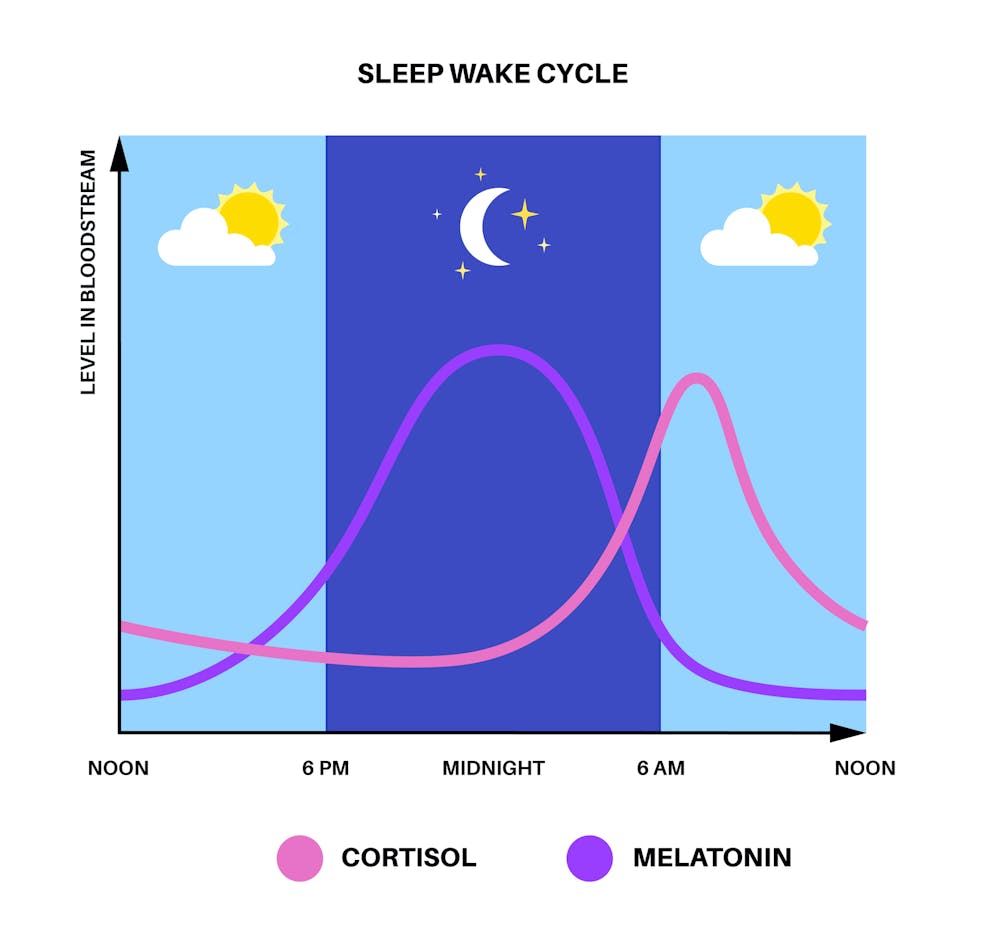
Chart showing cortisol and melatonin levels fluctuating over the course of the day, with cortisol levels peaking at around 6 AM and melatonin peaking at around midnight
Your hormones fluctuate rhythmically over the course of the day. The stress hormone cortisol typically peaks in the morning, while the sleep hormone melatonin typically peaks in the night. Pikovit44/iStock via Getty Images Plus

In recent years, researchers have discovered even more ways your circadian clock can affect your health. For example, there is now research suggesting that eating at set times of day, or time-restricted feeding, can prevent obesity and metabolic diseases. Depression and other mood disorders may also be linked to dysfunctional circadian control that lead to changes in how your genes are expressed.

The time of day when you take your medicine can also affect how well it works and how severe any side effects might be. Likewise, your biological clock is a potential target for cancer chemotherapies and anti-obesity treatments.

And finally, even your personality might be shaped by whether your internal clock make you a “morning person” or a “night person.”

Getting the most out of exercise

Circadian clocks also provide a potential answer to when is the best time of day to maximize the benefits of physical exercise.

To study this, my colleagues and I collected blood and tissue samples from the brains, hearts, muscles, livers and fat of mice that exercised either before breakfast in the early morning or after dinner in the late evening. We used a tool called a mass spectrometer to detect approximately 600 to 900 molecules each organ produced. These metabolites served as real-time snapshots of how the mice responded to exercise at specific times of day.

We stitched these snapshots together to create a map of how exercise in the morning versus evening affected each of the mice’s different organ systems – what we called an atlas of exercise metabolism.
Silhouette of person running by the sea at sunrise
The best time of day to exercise might be the time when you feel you perform best. Anuruk Charoenamornrat/EyeEm via Getty Images

Using this atlas, we saw that time of day affects how each organ uses energy during exercise. For instance, we found that early morning exercise reduced blood glucose levels more than late evening exercise. Exercise in the late evening, however, allowed the mice to benefit from energy they stored from their meals and increased their endurance.

Of course, mice and humans have many differences along with their similarities. For one, mice are more active at night than during the day. Still, we believe that our findings could help researchers better understand how exercise affects your health and, if timed appropriately, can be optimized based on time of day to meet your personal health goals.

Getting along with your biological clock

I believe that the field of chronobiology is growing, and we will produce even more research providing practical applications and insights into health and well-being in the future.

In my own work, for example, a better understanding of how exercising at different times of day affects your body could help tailor exercise plans to maximize specific benefits for patients with obesity, Type 2 diabetes and other diseases.

There is still much to learn about how your circadian clock works. But in the meantime, there are some tried and true ways people can synchronize their internal clocks for better health. These include regular exposure to sunlight to trigger the endocrine system to produce vitamin D, staying active during the day so you fall asleep more easily at night and avoiding caffeine and reducing your exposure to artificial light before bedtime.The Conversation

Shogo Sato, Assistant Professor of Biology, Texas A&M University

This article is republished from The Conversation under a Creative Commons license.

Monday, April 18, 2022

A large solar storm could knock out the power grid and the internet – an electrical engineer explains how


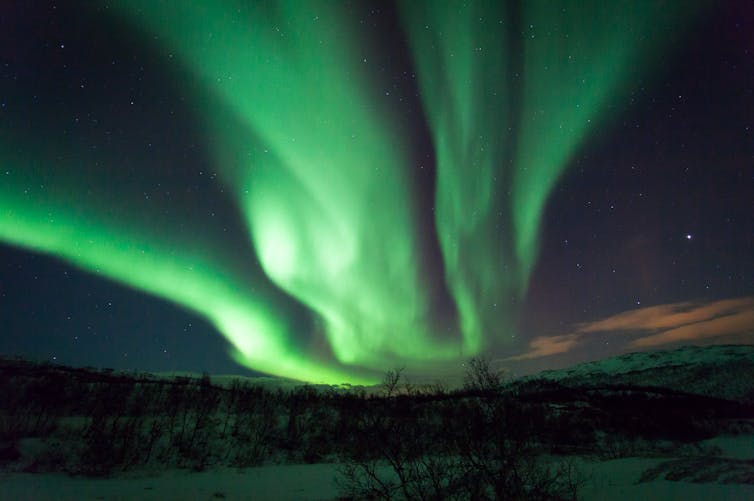
Typical amounts of solar particles hitting the earth’s magnetosphere can be beautiful, but too much could be catastrophic. Svein-Magne Tunli - tunliweb.no/Wikimedia, CC BY-NC-SA

On Sept. 1 and 2, 1859, telegraph systems around the world failed catastrophically. The operators of the telegraphs reported receiving electrical shocks, telegraph paper catching fire, and being able to operate equipment with batteries disconnected. During the evenings, the aurora borealis, more commonly known as the northern lights, could be seen as far south as Colombia. Typically, these lights are only visible at higher latitudes, in northern Canada, Scandinavia and Siberia.

What the world experienced that day, now known as the Carrington Event, was a massive geomagnetic storm. These storms occur when a large bubble of superheated gas called plasma is ejected from the surface of the sun and hits the Earth. This bubble is known as a coronal mass ejection.

The plasma of a coronal mass ejection consists of a cloud of protons and electrons, which are electrically charged particles. When these particles reach the Earth, they interact with the magnetic field that surrounds the planet. This interaction causes the magnetic field to distort and weaken, which in turn leads to the strange behavior of the aurora borealis and other natural phenomena. As an electrical engineer who specializes in the power grid, I study how geomagnetic storms also threaten to cause power and internet outages and how to protect against that.

Geomagnetic storms

The Carrington Event of 1859 is the largest recorded account of a geomagnetic storm, but it is not an isolated event.

Geomagnetic storms have been recorded since the early 19th century, and scientific data from Antarctic ice core samples has shown evidence of an even more massive geomagnetic storm that occurred around A.D. 774, now known as the Miyake Event. That solar flare produced the largest and fastest rise in carbon-14 ever recorded. Geomagnetic storms trigger high amounts of cosmic rays in Earth’s upper atmosphere, which in turn produce carbon-14, a radioactive isotope of carbon.

A geomagnetic storm 60% smaller than the Miyake Event occurred around A.D. 993. Ice core samples have shown evidence that large-scale geomagnetic storms with similar intensities as the Miyake and Carrington events occur at an average rate of once every 500 years.

Nowadays the National Oceanic and Atmospheric Administration uses the Geomagnetic Storms scale to measure the strength of these solar eruptions. The “G scale” has a rating from 1 to 5 with G1 being minor and G5 being extreme. The Carrington Event would have been rated G5.

It gets even scarier when you compare the Carrington Event with the Miyake Event. Scientist were able to estimate the strength of the Carrington Event based on the fluctuations of Earth’s magnetic field as recorded by observatories at the time. There was no way to measure the magnetic fluctuation of the Miyake event. Instead, scientists measured the increase in carbon-14 in tree rings from that time period. The Miyake Event produced a 12% increase in carbon-14. By comparison, the Carrington Event produced less than 1% increase in Carbon-14, so the Miyake Event likely dwarfed the G5 Carrington Event.

Knocking out power

Today, a geomagnetic storm of the same intensity as the Carrington Event would affect far more than telegraph wires and could be catastrophic. With the ever-growing dependency on electricity and emerging technology, any disruption could lead to trillions of dollars of monetary loss and risk to life dependent on the systems. The storm would affect a majority of the electrical systems that people use every day.

The National Weather Service operates the Space Weather Prediction Center, which watches for solar flares that could lead to geomagnetic storms.

Geomagnetic storms generate induced currents, which flow through the electrical grid. The geomagnetically induced currents, which can be in excess of 100 amperes, flow into the electrical components connected to the grid, such as transformers, relays and sensors. One hundred amperes is equivalent to the electrical service provided to many households. Currents this size can cause internal damage in the components, leading to large scale power outages.

A geomagnetic storm three times smaller than the Carrington Event occurred in Quebec, Canada, in March 1989. The storm caused the Hydro-Quebec electrical grid to collapse. During the storm, the high magnetically induced currents damaged a transformer in New Jersey and tripped the grid’s circuit breakers. In this case, the outage led to five million people being without power for nine hours.

Breaking connections

In addition to electrical failures, communications would be disrupted on a worldwide scale. Internet service providers could go down, which in turn would take out the ability of different systems to communicate with each other. High-frequency communication systems such as ground-to-air, shortwave and ship-to-shore radio would be disrupted. Satellites in orbit around the Earth could be damaged by induced currents from the geomagnetic storm burning out their circuit boards. This would lead to disruptions in satellite-based telephone, internet, radio and television.

Also, as geomagnetic storms hit the Earth, the increase in solar activity causes the atmosphere to expand outward. This expansion changes the density of the atmosphere where satellites are orbiting. Higher density atmosphere creates drag on a satellite, which slows it down. And if it isn’t maneuvered to a higher orbit, it can fall back to Earth.

One other area of disruption that would potentially affect everyday life is navigation systems. Virtually every mode of transportation, from cars to airplanes, use GPS for navigation and tracking. Even handheld devices such as cell phones, smart watches and tracking tags rely on GPS signals sent from satellites. Military systems are heavily dependent on GPS for coordination. Other military detection systems such as over-the-horizon radar and submarine detection systems could be disrupted, which would hamper national defense.

A crew works on a machine with a giant spool laying a cable in the water
The global internet is held together by a network of cables crisscrossing the world’s oceans. Jens Köhler/ullstein bild via Getty Images

In terms of the internet, a geomagnetic storm on the scale of the Carrington Event could produce geomagnetically induced currents in the submarine and terrestrial cables that form the backbone of the internet as well as the data centers that store and process everything from email and text messages to scientific data sets and artificial intelligence tools. This would potentially disrupt the entire network and prevent the servers from connecting to each other.

Just a matter of time

It is only a matter of time before the Earth is hit by another geomagnetic storm. A Carrington Event-size storm would be extremely damaging to the electrical and communication systems worldwide with outages lasting into the weeks. If the storm is the size of the Miyake Event, the results would be catastrophic for the world with potential outages lasting months if not longer. Even with space weather warnings from NOAA’s Space Weather Prediction Center, the world would have only a few minutes to a few hours notice.

I believe it is critical to continue researching ways to protect electrical systems against the effects of geomagnetic storms, for example by installing devices that can shield vulnerable equipment like transformers and by developing strategies for adjusting grid loads when solar storms are about to hit. In short, it’s important to work now to minimize the disruptions from the next Carrington Event.The Conversation

David Wallace, Assistant Clinical Professor of Electrical Engineering, Mississippi State University

This article is republished from The Conversation under a Creative Commons license.

How a coffee company and a marketing maven brewed up a Passover tradition: A brief history of the Maxwell House Haggadah


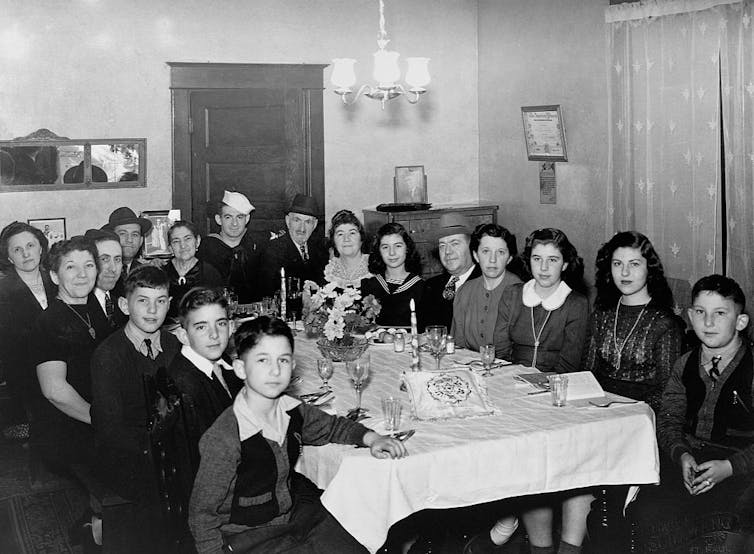
A Jewish family welcomes home their Navy man and gathers for a Passover Seder at their home in St. Paul, Minnesota in 1943. Minnesota Historical Society/CORBIS/Corbis Historical via Getty Images

For more than a millennium, the haggadah has been the centerpiece of the Jewish holiday of Passover. The book sets out the ceremony for the Seder meal, when families tell the biblical Exodus story of God delivering the ancient Israelites from slavery in Egypt.

Today, thousands of different haggadahs exist, with prayers, rituals and readings tailored to every type of Seder – from LGBTQ+-affirming to climate-conscious. But for decades, one of the most popular and influential haggadahs in the United States has been a simple version with an unlikely source: the Maxwell House Haggadah, dreamed up in 1932 by the coffee corporation and a Jewish advertising executive.

The cover page of the Maxwell House Haggadah, in English and Hebrew.
The Maxwell House Haggadah, first published in 1932. Joseph Jacobs Advertising

Its history reflects how Jews modernized and adapted to their new country, while also upholding traditions. But coffee has no ritual ties to Passover. So what explains the Maxwell House Haggadah’s sustained popularity?

Coffee competition

One explanation is advertising: a field so pervasive and powerful in people’s lives that it becomes almost invisible. As a scholar of American Jewish visual culture and communication, I have researched how marketing can influence Americans’ religious and cultural identities.

The story of the Maxwell House Haggadah begins with the meeting of two marketing masterminds. The first, Joseph Jacobs, grew up on the Lower East Side in New York at the turn of the 20th century, amid a wave of Jewish immigration from Eastern Europe. He went on to establish his advertising company in 1919. The second was Joel Owsley Cheek of the Cheek-Neal Coffee Company, who hailed from the South. Cheek-Neal was then the parent company of Maxwell House coffee, with its famous slogan “good to the last drop.”

Jacobs’ quest to familiarize companies with the buying power of the growing population of Jewish Americans led him to talk with Cheek in 1922 about placing ads for Maxwell House coffee in Jewish journals. There was only one problem: American Jews of Eastern European descent believed that coffee beans, like other legumes, were forbidden for Passover, when certain foods must be avoided, so they drank tea during the weeklong holiday.

Consulting a rabbi from the Lower East Side, who declared that technically coffee beans were like berries and therefore kosher for Passover, Jacobs secured a rabbinical stamp of approval for Maxwell coffee in 1923.

During the Great Depression of the 1930s, when a major grocery chain discounted their own brand of coffee, Maxwell House turned to Jacobs’ firm to help them stay competitive. The Maxwell House Haggadah was born when he suggested distributing a book for free with each purchased can of coffee.

Beyond its appeal as a giveaway, however, the content of the haggadah needed to earn Jewish customers’ trust. The front cover relied upon a classical design of centered text in Hebrew, but also English. Inside, pen and ink illustrations of biblical stories continued the sense of tradition. The pages of the haggadah turned from right to left, as is typical of Hebrew texts.

It worked. According to a market report commissioned by the Joseph Jacobs Organization to guide its marketing efforts, Maxwell House became the coffee of choice for Jewish households around New York City.

Modernizing the haggadah

The Maxwell House Haggadah remained largely the same through the 1940s and ‘50s, and soon achieved the status of a Passover classic. Yet the 1965 version marked a definitive break with the past. As 1960s culture introduced more minimalist, graphic art, raging against the classicism of the past, the haggadah’s images changed to reflect the times. And though the written text remained largely the same, the addition of English transliterations of blessings and prayers hinted at Americanizing Jews’ loss of Hebrew reading skills.

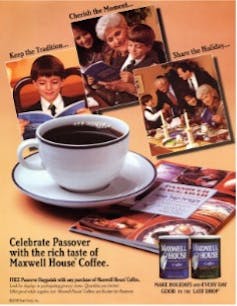
An advertisement for Maxwell House Coffee.
An ad for Maxwell House coffee, themed for Passover. Joseph Jacobs Advertising

For the next 30 years, very little changed in the haggadah. But in 2000, it finally received a visual makeover, as seen in an advertisement that year. Stark graphics, popular since the mid-‘60s, were replaced with nostalgic photos depicting an intergenerational family at a Seder. This tender imagery invoked tradition at a time when many Americans had grown more distant from their Jewish communities, prompting concern from Jewish leaders.

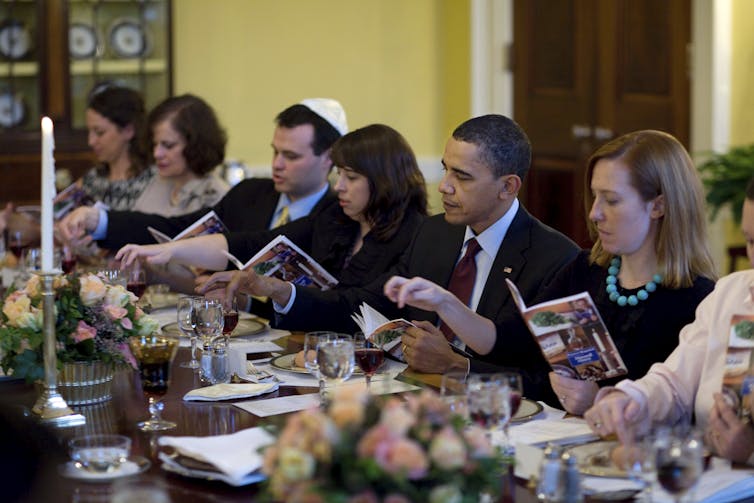
In 2009, the haggadah achieved worldwide fame when President Barack Obama used it to conduct his first White House Seder. Shortly after, it underwent a complete overhaul for the 21st century. Maxwell House’s version was now less illustrated and included more written text, like the haggadahs used by more religious Jews. By eliminating antiquated words like “thee” and “thine,” along with gender-specific pronouns for God, the new version felt more relevant for a younger and more secular Jewish population.

President Obama and guests sit around a dinner table at the White House.
In this image released by the White House, President Barack Obama and the first family mark the Jewish holiday of Passover with a Seder at the White House in 2010. AP Photo/The White House, Pete Souza

And in 2019, when “The Marvelous Mrs. Maisel,” the television show about a mid-century Jewish housewife-turned-comedian, was at its height of popularity, Maxwell House published a special Mrs. Maisel edition of its haggadah. A throwback to the haggadah’s heyday in the late ‘50s, this television tie-in represented yet another marketing effort to retain American Jews’ affection for Maxwell House coffee in a crowded market.

The pink cover of the
Maxwell House/Amazon

In a sea of thousands of haggadahs, it is Maxwell House’s that has become the de facto representative of American Jewish life. The story of its place within U.S. households points to marketing’s key role in shaping a yearly tradition.The Conversation

Kerri Steinberg, Department Chair of Liberal Arts and Sciences, Otis College of Art and Design

This article is republished from The Conversation under a Creative Commons license.
Wednesday, March 9, 2022

A brief history of Babi Yar, where Nazis massacred Jews, Soviets kept silence and now Ukraine says Russia fired a missile


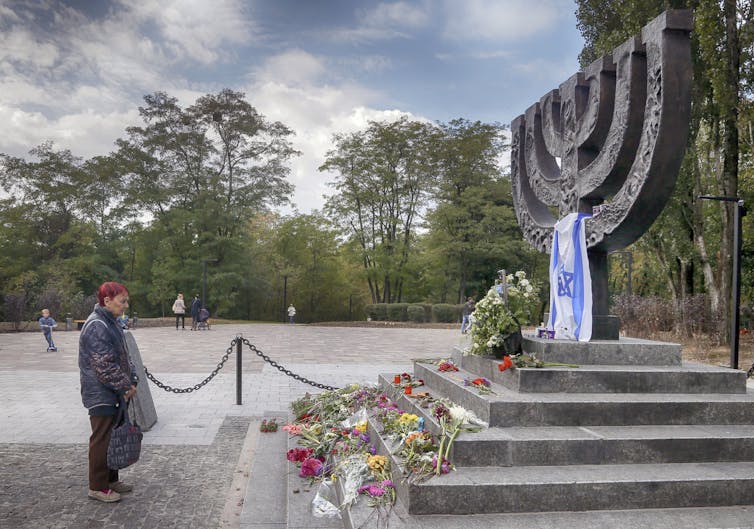
A woman pays homage at the memorial to victims of the 1941 Nazi massacre of Jews in Babi Yar in Kyiv, Ukraine. AP Photo/Efrem Lukatsky

“At Babi Yar no memorials preside.”

Russian poet Yevgeny Yevtushenko wrote that line in a 1961 poem in a reference to to the ravine in the suburbs of Kyiv where, starting on Sept. 29, 1941, and continuing into the following day, over 33,000 Jews were murdered by Nazi forces and their Ukrainian collaborators.

On March 1, 2022, according to Ukrainian President Volodymyr Zelenskyy, a Russian strike against a TV tower in Kyiv killed five people and damaged the nearby site.

“What is the point of saying ‘never again’ for 80 years, if the world stays silent when a bomb drops on the same site of Babyn Yar?” Zelenskyy asked in an anguished tweet, using the Ukrainian variant of the name.

But silence and Babi Yar have a long history together. “All the silence screams,” as Yevtushenko put it in his poem.

The Babi Yar massacre

As a historian of the Holocaust in Ukraine and the author of the recently published “In the Midst of Civilized Europe: The Pogroms of 1918-1921 and the Onset of the Holocaust,” I have sought to fill in some of these silences by speaking and writing about the atrocities that took place.

On Friday, Sept. 26, 1941, when the Germans occupied Kyiv, announcements printed in Russian, Ukrainian and German began to appear on lampposts and walls around the city ordering all Jews to assemble Monday at 8 a.m. near the site of a Jewish cemetery. That morning, the day before the Jewish holiday of Yom Kippur was to begin, over 33,000 people gathered, mostly women, children and the elderly, as the Soviet government had already mobilized the men capable of fighting into the Red Army.

The multitude was marched under guard through a barbed wire enclosure leading into Babi Yar. Babi Yar – “yar” means ravine in Russian and Ukrainian – is actually a system of ravines, where estuaries that once fed into a tributary of the Dnieper River had left steep troughs and inland fields. It is a scenic site, still crowded on weekends with picnickers and soccer players.

As the assembled Jews entered the ravine on that day in 1941, German SS units, together with Ukrainian prisoners recruited from a nearby prisoner-of-war camp to serve the Nazis as local police, robbed them of their money, possessions and documents. They made the Jews wait in the meadow, from where, behind a mound of earth, they could hear the relentless sound of machine gun fire. Over the next 36 hours, the Germans took small groups of Jews, stripped them naked and murdered them.

The postwar trial records give a sense of what occurred. The victims “were made to lie facedown on the bloodied corpses of victims who had already been shot. If they did not do this willingly, they were beaten and knocked down. Then the gunners climbed over the wobbly mounds toward the victims and shot them in the back of the neck.” According to an operational situation report the Germans sent back to Berlin, they had shot 33,371 Jews.

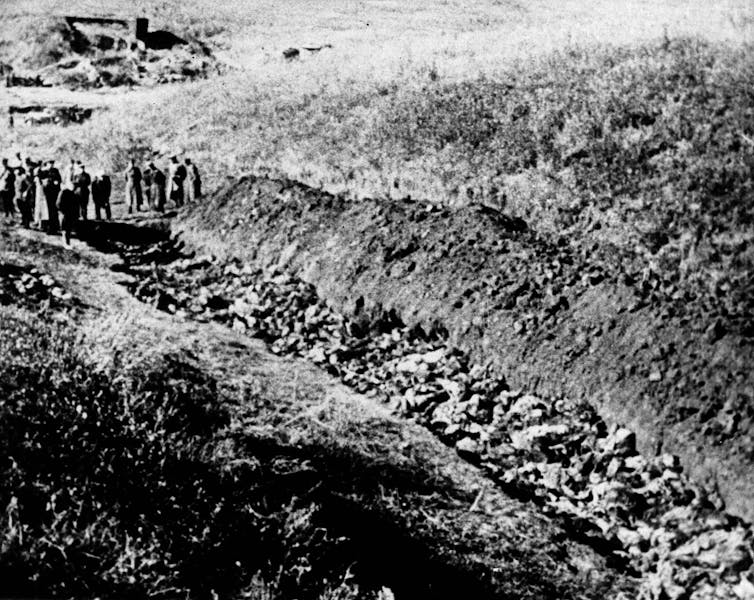
A black and white photo showing the site of a massacre of Jews in the Babi Yar ravine in Ukraine.
Part of the Babi Yar ravine on the outskirts of Kyiv, Ukraine, where the advancing Red Army in 1944 unearthed the bodies of 14,000 civilians killed by fleeing Nazis. AP Photo

Over the next two years, the Germans would continue to use the site as a killing ground, murdering another 70,000 individuals – Romani people, psychiatric patients, prisoners of war, and other civilians – before the Red Army liberated the city in November 1943.

The Germans were the first to try to silence the memory of the crimes committed at the site. In August 1943, fearful of the approaching Red Army, they forced prisoners from the nearby Syrets concentration camp to dig up and burn remains from the site.

The Soviet government, too, attempted to conceal what had taken place at the site. In 1961, they tried to fill in the ravine, unintentionally setting off a mudslide that killed at least 145 people. But Yevtushenko’s poem, published that same year, gave voice to the victims in the ground. In 1962, Dmitry Shostakovich dedicated his 13th Symphony to Babi Yar, further amplifying the memory of the crimes that had taken place there.

The full story of what took place was first told to the public by the Soviet writer Anatolii Kuznetsov, whose “Babi Yar: A Document in the Form of a Novel” was published in a censored form in the Soviet Union in 1966 and released in an uncensored version in 1970 after Kuznetsov’s defection to Great Britain.

Breaking the silence

Beginning in the late 1960s, grassroots groups of Jewish Holocaust survivors began to gather informally at the ravine on the anniversary of the massacre, and in 1966 they hung an unofficial memorial sign. But it was not until 1976 that the first official monument was installed at the site. Officially called “The Monument to Soviet citizens and POWs shot by the Nazi Occupiers,” it was silent about the relevance of the site to Jews.

The massacre of Jews at Babi Yar and other locations did not fit with the official Soviet version of the war. The Soviets spoke of what they called “The Great Patriotic War” as a historic battle between fascism and communism, and played down the racial and ethnic chauvinism of Nazism.

Silence on Jewish victimhood also avoided difficult questions about the collaboration of ethnic Ukrainians and others. In the Soviet myth, all Soviet citizens were equal victims of Nazi barbarism and could share in the ultimate victory of the Red Army over the German Wehrmacht, the armed forces of the Third Reich.

It wasn’t until 1991, after Ukrainian independence, that a menorah-shaped monument was erected at Babi Yar for the 50th anniversary of the massacre. It was the first official public acknowledgment of the Jews who were murdered at the site.

Since then, the site has become as contentious as the war itself as different stakeholders have come forward to erect their own memorials to other ethnic, religious, political and demographic groups murdered at Babi Yar – Romani people, children, priests and Ukrainian nationalists.

Only in 2016 was a commission formed to establish a more permanent memorial on the site. The Babi Yar Holocaust Memorial Center, scheduled to open in 2025, though, has drawn widespread controversy on account of the high-tech interactive museum envisioned by artistic director Ilya Khrzhanovsky as the centerpiece of the memorial. Pointing to the role-playing virtual reality experience of the planned museum, at least one critic dismissed it as “Holocaust Disneyland.”

As the sound of shelling barraged Kyiv, Zelenskyy once again used the Russian attack near the Babi Yar site as an appeal for action: “Nazism is born in silence,” he warned.The Conversation

Jeffrey Veidlinger, Professor of History and Judaic Studies, University of Michigan

This article is republished from The Conversation under a Creative Commons license.