Sunday, January 22, 2023

Sitting all day is terrible for your health – now, a new study finds a relatively easy way to counteract it


Researchers have long known that sitting at your desk hour after hour is an unhealthy habit. Morsa Images/Digital Vision via Getty Images

The Research Brief is a short take about interesting academic work.

The big idea

To reduce the harmful health effects of sitting, take a five-minute light walk every half-hour. That’s the key finding of a new study that my colleagues and I published in the journal Medicine & Science in Sports & Exercise.

We asked 11 healthy middle-aged and older adults to sit in our lab for eight hours – representing a standard workday – over the course of five separate days. On one of those days, participants sat for the entire eight hours with only short breaks to use the bathroom. On the other days, we tested a number of different strategies to break up a person’s sitting with light walking. For example, on one day, participants walked for one minute every half-hour. On another day, they walked for five minutes every hour.

Our goal was to find the least amount of walking one could do to offset the harmful health effects of sitting. In particular, we measured changes in blood sugar levels and blood pressure, two important risk factors for heart disease.

We found that a five-minute light walk every half-hour was the only strategy that reduced blood sugar levels substantially compared with sitting all day. In particular, five-minute walks every half-hour reduced the blood sugar spike after eating by almost 60%.

That strategy also reduced blood pressure by four to five points compared with sitting all day. But shorter and less frequent walks improved blood pressure too. Even just a one-minute light walk every hour reduced blood pressure by five points.

In addition to physical health benefits, there were also mental health benefits to the walking breaks. During the study, we asked participants to rate their mental state by using a questionnaire. We found that compared with sitting all day, a five-minute light walk every half-hour reduced feelings of fatigue, put participants in a better mood and helped them feel more energized. We also found that even walks just once every hour were enough to boost mood and reduce feelings of fatigue.

Along with short, frequent walks, a long daily walk could add years to your life.

Why it matters

People who sit for hours on end develop chronic diseases including diabetes, heart disease, dementia and several types of cancer at much higher rates than people who move throughout their day. A sedentary lifestyle also puts people at a much greater risk of early death. But just exercising daily may not reverse the harmful health effects of sitting.

Because of technological advances, the amount of time adults in industrialized countries like the U.S. spend sitting has been steadily increasing for decades. Many adults now spend the majority of their day sitting. This problem has only gotten worse since the start of the COVID-19 pandemic. With the migration to more remote work, people are less inclined to venture out of the house these days. So it’s clear that strategies are needed to combat a growing 21st century public health problem.

Current guidelines recommend that adults should “sit less, move more.” But these recommendations don’t provide any specific advice or strategies for how often and how long to move.

Our work provides a simple and affordable strategy: Take a five-minute light walk every half-hour. If you have a job or lifestyle where you have to sit for prolonged periods, this one behavior change could reduce your health risks from sitting.

Our study also offers clear guidance to employers on how to promote a healthier workplace. While it may seem counterintuitive, taking regular walking breaks can actually help workers be more productive than working without stopping.

What still isn’t known

Our study primarily focused on taking regular walking breaks at a light intensity. Some of the walking strategies – for example, one-minute light walks every hour – did not lower blood sugar levels. We don’t know if more rigorous walking would have provided health benefits at these doses.

What’s next

We are currently testing over 25 different strategies for offsetting the health harms of prolonged sitting. Many adults have jobs, such as driving trucks or taxis, where they simply cannot walk every half-hour. Finding alternative strategies that yield comparable results can provide the public with several different options and ultimately allow people to pick the strategy that works best for them and their lifestyle.The Conversation

Keith Diaz, Associate Professor of Behavioral Medicine, Columbia University

This article is republished from The Conversation under a Creative Commons license.

Cold weather brings itchy, irritated, dry and scaly skin – here’s how to treat eczema and other skin conditions and when to see a doctor


For some skin conditions, keeping hydrated is key. Yuliya Shevtsova/EyeEm via Getty Images

In many parts of the U.S., the winter months bring frigid temperatures and drier conditions that can wreak havoc on the skin.

The primary role of the skin, as the largest organ in the body, is to act as a physical barrier to the external environment. When your skin is healthy, it helps protect you from allergens and infections. But in winter, when the outside temperature and humidity drop, skin can become especially irritated.

We are a dermatologist and a medical student who study a broad range of common skin conditions and the effects of the environment on skin health.

Heading into the winter months, a handful of common dermatological conditions can develop or worsen in response to the cold. These include eczema, chilblains, Raynaud’s phenomenon, cold urticaria and cold panniculitis. All are conditions that can be irritating and uncomfortable, and some are harder to treat than others. So it’s helpful to know when to manage these conditions on your own and when to see a dermatologist.

Although eczema often affects infants, one form affects people 60 and older.

Eczema

Eczema is an inflammatory skin condition that causes dry and itchy skin and may be triggered by soaps and detergents, environmental or food allergens, hormonal changes and skin infections. There are numerous types of eczema, which often have overlapping symptoms.

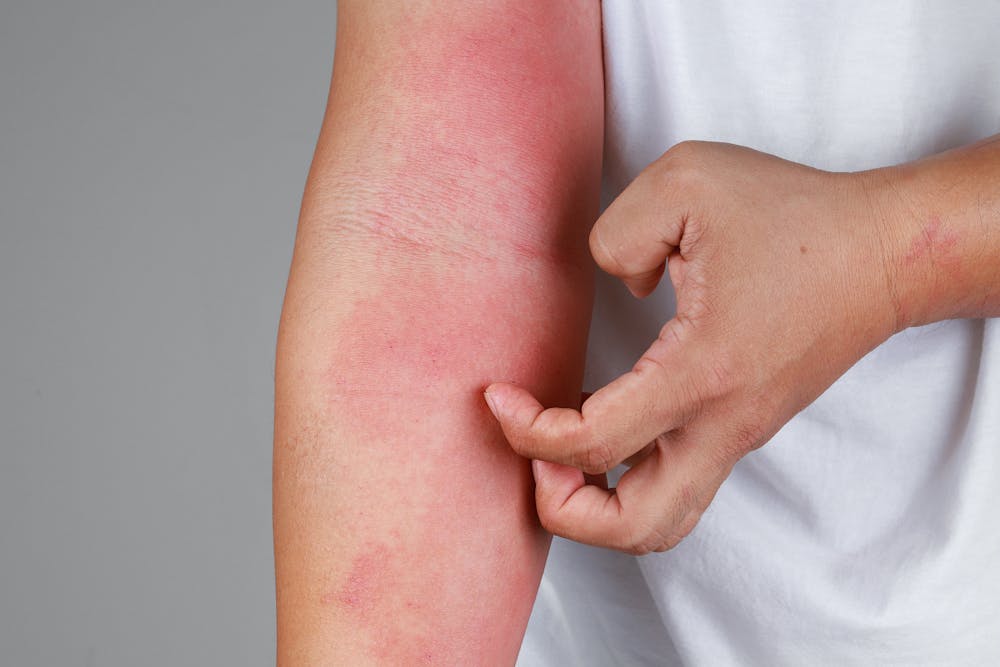
Pinkish splotches of eczema appear on an extended right arm.
According to the Cleveland Clinic, eczema affects more then 30 million Americans. tylim/iStock via Getty Images Plus

Asteatotic eczema, also known as winter itch, is common in older adults. During the winter months, skin can become drier and, in some instances, cracked, fissured and inflamed.

Severe dryness may lead to itchiness and scratching. In turn, this can create open wounds that may allow allergens and bacteria to penetrate the skin and cause a rash or an infection.

This type of eczema typically occurs on the lower legs, but eruptions can occur anywhere on the skin, such as the trunk, arms and hands.

Keeping the skin hydrated is the primary treatment. Water-based lotions may worsen skin drying, so applying moisturizers with a high oil content – like petroleum jelly, mineral oil or Vaseline – on wet or damp skin is recommended. Hypoallergenic and anti-itch moisturizers designed specifically for eczema are also available.

Other tips include replacing long hot baths with quick warm showers, switching to a milder soap, and using a room humidifier if the climate is dry. If itchiness and dryness persist, seek care from a dermatologist, who may prescribe a topical steroid.

Hand eczema may also worsen in the winter as your hands are frequently exposed to cold, dry air. Scaling, fissuring and bleeding on the hands is common. Minimizing exposure to hard or antibacterial soaps, along with using gentle cleansing products followed by applying a petroleum-based unscented moisturizer can improve symptoms.

Chilblains

Chilblains, also known as pernio, are small, itchy patches that can occur when the skin is exposed to cold and damp weather, resulting in swollen and painful bumps that affect the fingers, toes, ears and face. Poor circulation, blood vessel constriction, a history of autoimmune disease and being underweight may predispose people to chilblains.

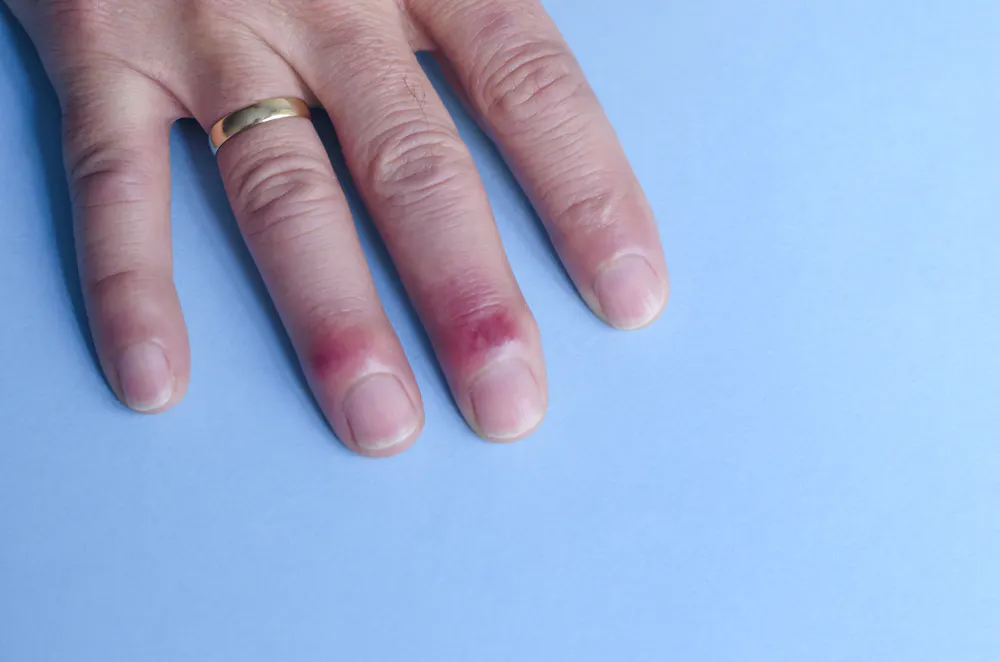
Against a blue background, a woman's hand shows chilblains -- swollen, bright red markings on her middle and ring fingers just below the nails.
Although they usually heal if protected from cold, chilblains can be painful. Elizabeth Fernandez/Moment via Getty Images

Afflicted areas are painful, itchy, swollen and usually have a blueish to purple hue. In severe cases, blisters and ulcers may occur. But for most people, the condition tends to spontaneously resolve within one to three weeks.

Until that happens, it’s important to keep affected areas protected from the cold. If the sensitive area starts to blister, or if fevers, muscle aches and chills develop, it’s best to see a dermatologist or physician.

Pseudo-chilblains, also known as “COVID toes,” can be caused by COVID-19 infection. Chilblains associated with COVID-19 resemble the rash in chilblains – painful red to blue-colored nodules on the toes – but it is not specific to winter.

Dry, cracked skin can lead to infections.

Raynaud’s phenomenon

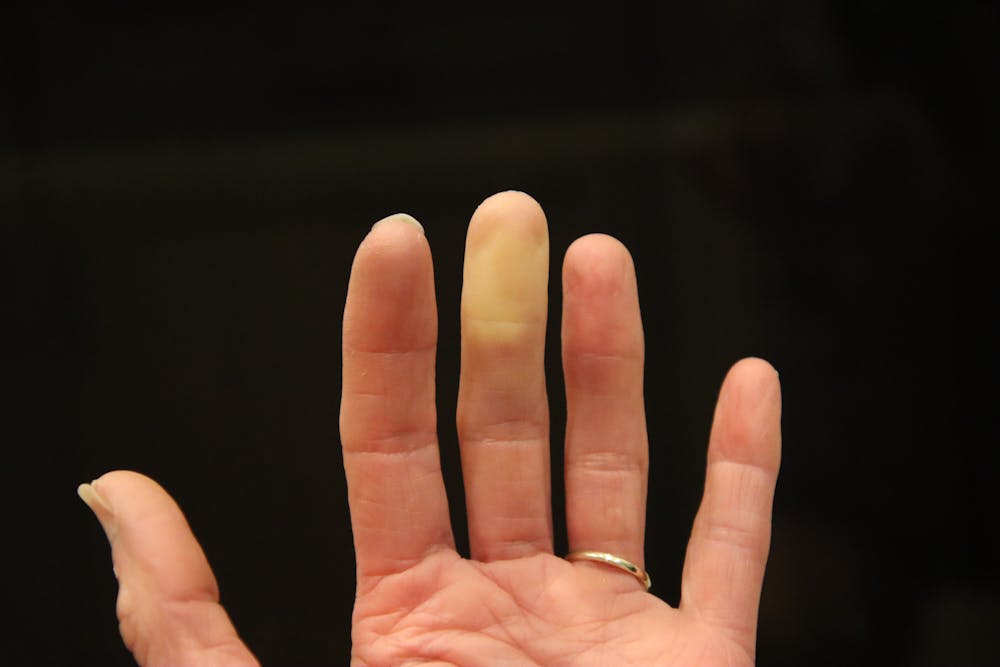
Like chilblains, Raynaud’s phenomenon is a skin condition characterized by an significant constriction of blood vessels in the fingers and toes in response to cold exposure. The digits may turn red or blue, but they quickly flush red upon rewarming. Afflicted areas may also be numb or painful, and when severe, may develop ulcers.

Against a black background, an adult hand with a pale middle finger displays Raynaud's phenomenon.
Although Raynaud’s phenomenon typically affects fingers and toes, it can also affect the nose, ears and lips. Barb Elkin/iStock via Getty Images Plus

To treat Raynaud’s phenomenon, it’s necessary to avoid cold-weather exposure. Ideally patients with Raynaud’s should dress for the cold in layers. At a minimum, make sure to wear gloves and insulated footwear. Avoid tobacco, caffeine and decongestants; they may cause blood vessels to constrict more. If symptoms don’t improve quickly – Raynaud’s due to cold typically gets better after only a few minutes – see a dermatologist or your physician, as Raynaud’s phenomenon can also be a manifestation of a more serious systemic disease, including cancer, infections and/or trauma.

Cold urticaria

Cold urticaria is a skin rash believed to be triggered by an autoimmune response, which leads to the release of inflammatory molecules, including histamine.

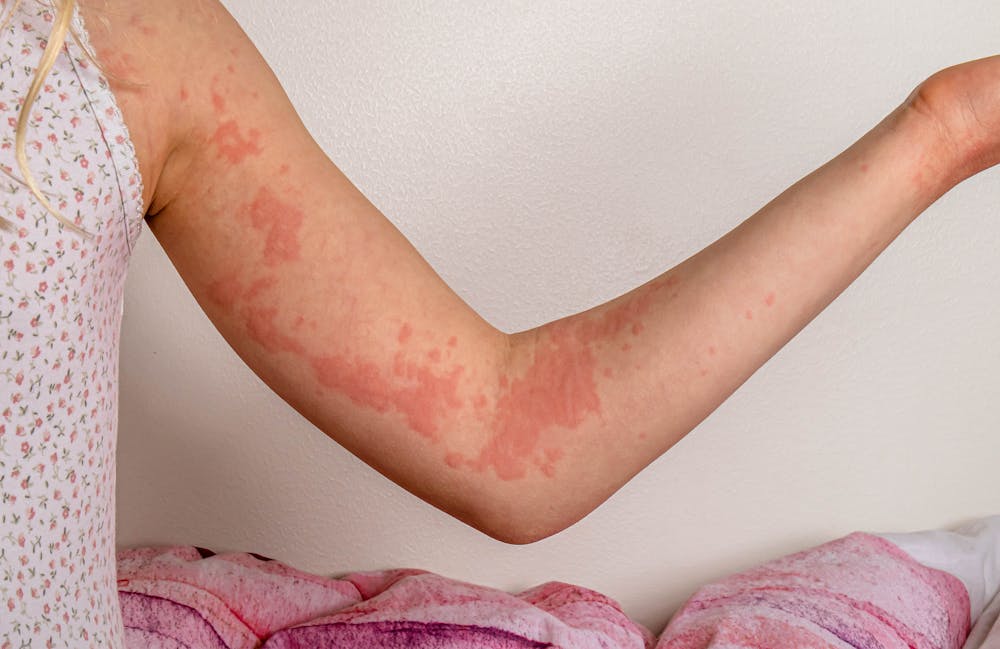
A woman's arm covered in the blotchy red marks known as hives.
Cold urticaria is more commonly known as hives. Elk Scott/i Stock via Getty Images

Soon after the skin is exposed to sudden drops in temperature, wheals – also known as hives – may develop. These are reddish, itchy and swollen areas of skin. Such episodes can last for approximately two hours. Occasionally, other symptoms accompany the outbreak, including headache, chills, shortness of breath, abdominal pain and diarrhea.

People can test for cold urticaria using the ice cube test. This is done simply by placing an ice cube on an area of skin for five minutes; if you have cold urticaria, the skin will raise and itch within five to 15 minutes. Treatment involves avoiding cold exposure and using over-the-counter antihistamines.

For those who have experienced cold urticaria, swimming in cold water can be dangerous, as it can lead to loss of consciousness and drowning.

Cold panniculitis

Cold panniculitis – which appears as enlarged, red and painful nodules on the skin – develops 12 to 72 hours after cold exposure.

Cases of cold panniculitis have been documented in children eating Popsicles and in adults undergoing whole-body cryotherapy, which is often used as treatment for chronic inflammatory conditions such as rheumatoid arthritis, or for improving post-exercise recovery.

Cold panniculitis is more common during childhood and usually resolves on its own by avoiding cold exposure and direct contact with frozen products.

Symptoms from winter skin conditions are often self-limiting and resolve on their own with adequate protection from the cold. But if symptoms do not resolve, you should see a licensed dermatologist, as cold-induced rashes may be a sign of a more concerning underlying health condition.

If visiting your dermatologist in person proves difficult, you may consider seeing a dermatologist virtually, as many academic medical centers and private practices now offer telehealth dermatology.The Conversation

Sonal Choudhary, Assistant Professor of Dermatology and Dermatopathology, University of Pittsburgh Health Sciences and Jeffrey Chen, Medical Student, University of Pittsburgh Health Sciences

This article is republished from The Conversation under a Creative Commons license.

Saturday, November 5, 2022

Mass migration from Twitter is likely to be an uphill battle – just ask ex-Tumblr users


The turmoil inside Twitter headquarters is sparking discussion of a mass exodus of users. What will happen if there is a rush to the exits? AP Photo/Jeff Chiu

Elon Musk announced that “the bird is freed” when his US$44 billion acquisition of Twitter officially closed on Oct. 27, 2022. Some users on the microblogging platform saw this as a reason to fly away.

Over the course of the next 48 hours, I saw countless announcements on my Twitter feed from people either leaving the platform or making preparations to leave. The hashtags #GoodbyeTwitter, #TwitterMigration and #Mastodon were trending. The decentralized, open source social network Mastodon gained over 100,000 users in just a few days, according to a user counting bot.

As an information scientist who studies online communities, this felt like the beginning of something I’ve seen before. Social media platforms tend not to last forever. Depending on your age and online habits, there’s probably some platform that you miss, even if it still exists in some form. Think of MySpace, LiveJournal, Google+ and Vine.

When social media platforms fall, sometimes the online communities that made their homes there fade away, and sometimes they pack their bags and relocate to a new home. The turmoil at Twitter is causing many of the company’s users to consider leaving the platform. Research on previous social media platform migrations shows what might lie ahead for Twitter users who fly the coop.

Elon Musk’s acquisition of Twitter has caused turmoil within the company and prompted many users to consider leaving the social media platform.

Several years ago, I led a research project with Brianna Dym, now at University of Maine, where we mapped the platform migrations of nearly 2,000 people over a period of almost two decades. The community we examined was transformative fandom, fans of literary and popular culture series and franchises who create art using those characters and settings.

We chose it because it is a large community that has thrived in a number of different online spaces. Some of the same people writing Buffy the Vampire Slayer fan fiction on Usenet in the 1990s were writing Harry Potter fan fiction on LiveJournal in the 2000s and Star Wars fan fiction on Tumblr in the 2010s.

By asking participants about their experiences moving across these platforms – why they left, why they joined and the challenges they faced in doing so – we gained insights into factors that might drive the success and failure of platforms, as well as what negative consequences are likely to occur for a community when it relocates.

‘You go first’

Regardless of how many people ultimately decide to leave Twitter, and even how many people do so around the same time, creating a community on another platform is an uphill battle. These migrations are in large part driven by network effects, meaning that the value of a new platform depends on who else is there.

In the critical early stages of migration, people have to coordinate with each other to encourage contribution on the new platform, which is really hard to do. It essentially becomes, as one of our participants described it, a “game of chicken” where no one wants to leave until their friends leave, and no one wants to be first for fear of being left alone in a new place.

For this reason, the “death” of a platform – whether from a controversy, disliked change or competition – tends to be a slow, gradual process. One participant described Usenet’s decline as “like watching a shopping mall slowly go out of business.”

It’ll never be the same

The current push from some corners to leave Twitter reminded me a bit of Tumblr’s adult content ban in 2018, which reminded me of LiveJournal’s policy changes and new ownership in 2007. People who left LiveJournal in favor of other platforms like Tumblr described feeling unwelcome there. And though Musk did not walk into Twitter headquarters at the end of October and turn a virtual content moderation lever into the “off” position, there was an uptick in hate speech on the platform as some users felt emboldened to violate the platform’s content policies under an assumption that major policy changes were on the way.

So what might actually happen if a lot of Twitter users do decide to leave? What makes Twitter Twitter isn’t the technology, it’s the particular configuration of interactions that takes place there. And there is essentially zero chance that Twitter, as it exists now, could be reconstituted on another platform. Any migration is likely to face many of the challenges previous platform migrations have faced: content loss, fragmented communities, broken social networks and shifted community norms.

But Twitter isn’t one community, it’s a collection of many communities, each with its own norms and motivations. Some communities might be able to migrate more successfully than others. So maybe K-Pop Twitter could coordinate a move to Tumblr. I’ve seen much of Academic Twitter coordinating a move to Mastodon. Other communities might already simultaneously exist on Discord servers and subreddits, and can just let participation on Twitter fade away as fewer people pay attention to it. But as our study implies, migrations always have a cost, and even for smaller communities, some people will get lost along the way.

The ties that bind

Our research also pointed to design recommendations for supporting migration and how one platform might take advantage of attrition from another platform. Cross-posting features can be important because many people hedge their bets. They might be unwilling to completely cut ties all at once, but they might dip their toes into a new platform by sharing the same content on both.

Ways to import networks from another platform also help to maintain communities. For example, there are multiple ways to find people you follow on Twitter on Mastodon. Even simple welcome messages, guides for newcomers and easy ways to find other migrants could make a difference in helping resettlement attempts stick.

And through all of this, it’s important to remember that this is such a hard problem by design. Platforms have no incentive to help users leave. As long-time technology journalist Cory Doctorow recently wrote, this is “a hostage situation.” Social media lures people in with their friends, and then the threat of losing those social networks keeps people on the platforms.

But even if there is a price to pay for leaving a platform, communities can be incredibly resilient. Like the LiveJournal users in our study who found each other again on Tumblr, your fate is not tied to Twitter’s.The Conversation

Casey Fiesler, Associate Professor of Information Science, University of Colorado Boulder

This article is republished from The Conversation under a Creative Commons license.
Why is 13 considered unlucky? Explaining the power of its bad reputation


Many elevators do not have a floor numbered 13 because of common superstitions about the number. Luis Alvarez/DigitalVision via Getty Images

Would you think it weird if I refused to travel on Sundays that fall on the 22nd day of the month?

How about if I lobbied the homeowner association in my high-rise condo to skip the 22nd floor, jumping from the 21st to 23rd?

It’s highly unusual to fear 22 – so, yes, it would be appropriate to see me as a bit odd. But what if, in just my country alone, more than 40 million people shared the same baseless aversion?

That’s how many Americans admit it would bother them to stay on one particular floor in high-rise hotels: the 13th.

According to the Otis Elevator Co., for every building with a floor numbered “13,” six other buildings pretend to not have one, skipping right to 14.

Many Westerners alter their behaviors on Friday the 13th. Of course bad things do sometimes happen on that date, but there’s no evidence they do so disproportionately.

As a sociologist specializing in social psychology and group processes, I’m not so interested in individual fears and obsessions. What fascinates me is when millions of people share the same misconception to the extent that it affects behavior on a broad scale. Such is the power of 13.

Origins of the superstition

The source of 13’s bad reputation – “triskaidekaphobia” – is murky and speculative. The historical explanation may be as simple as its chance juxtaposition with lucky 12. Joe Nickell investigates paranormal claims for the Committee for Skeptical Inquiry, a nonprofit that scientifically examines controversial and extraordinary claims. He points out that 12 often represents “completeness”: the number of months in the year, gods on Olympus, signs of the zodiac and apostles of Jesus. Thirteen contrasts with this sense of goodness and perfection.

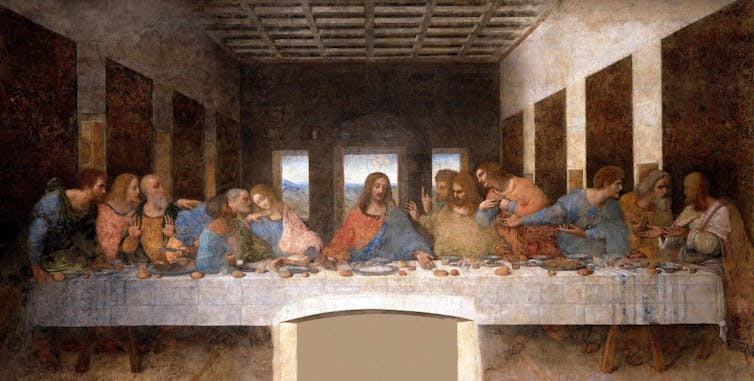
The number 13 may be associated with some famous but undesirable dinner guests. In Norse mythology, the god Loki was 13th to arrive at a feast in Valhalla, where he tricked another attendee into killing the god Baldur. In Christianity, Judas – the apostle who betrayed Jesus – was the 13th guest at the Last Supper.

A painting shows thirteen men seated on one side of a long table, wearing colored robes.
‘The Last Supper,’ a 15th-century mural painting in Milan created by Leonardo da Vinci. Universal History Archive/Getty Images

But the truth is, sociocultural processes can associate bad luck with any number. When the conditions are favorable, a rumor or superstition generates its own social reality, snowballing like an urban legend as it rolls down the hill of time.

In Japan, 9 is unlucky, probably because it sounds similar to the Japanese word for “suffering.” In Italy, it’s 17. In China, 4 sounds like “death” and is more actively avoided in everyday life than 13 is in Western culture – including a willingness to pay higher fees to avoid it in cellphone numbers. And though 666 is considered lucky in China, many Christians around the world associate it with an evil beast described in the biblical Book of Revelation. There is even a word for an intense fear of 666: hexakosioihexekontahexaphobia.

Social and psychological explanations

There are many kinds of specific phobias, and people hold them for a variety of psychological reasons. They can arise from direct negative experiences – fearing bees after being stung by one, for example. Other risk factors for developing a phobia include being very young, having relatives with phobias, having a more sensitive personality and being exposed to others with phobias.

Part of 13’s reputation may be connected to a feeling of unfamiliarity, or “felt sense of anomaly,” as it is called in the psychological literature. In everyday life, 13 is less common than 12. There’s no 13th month, 13-inch ruler, or 13 o'clock. By itself a sense of unfamiliarity won’t cause a phobia, but psychological research shows that we favor what is familiar and disfavor what is not. This makes it easier to associate 13 with negative attributes.

People also may assign dark attributes to 13 for the same reason that many believe in “full moon effects.” Beliefs that the full moon influences mental health, crime rates, accidents and other human calamities have been thoroughly debunked. Still, when people are looking to confirm their beliefs, they are prone to infer connections between unrelated factors. For example, having a car accident during a full moon, or on a Friday the 13th, makes the event seem all the more memorable and significant. Once locked in, such beliefs are very hard to shake.

Then there are the potent effects of social influences. It takes a village – or Twitter – to make fears coalesce around a particular harmless number. The emergence of any superstition in a social group – fear of 13, walking under ladders, not stepping on a crack, knocking on wood, etc. – is not unlike the rise of a “meme.” Although now the term most often refers to widely shared online images, it was first introduced by biologist Richard Dawkins to help describe how an idea, innovation, fashion or other bit of information can diffuse through a population. A meme, in his definition, is similar to a piece of genetic code: It reproduces itself as it is communicated among people, with the potential to mutate into alternative versions of itself.

The 13 meme is a simple bit of information associated with bad luck. It resonates with people for reasons given above, and then spreads throughout the culture. Once acquired, this piece of pseudo-knowledge gives believers a sense of control over the evils associated with it.

False beliefs, true consequences

Groups concerned with public relations seem to feel the need to kowtow to popular superstitions. Perhaps owing to the near-tragic Apollo 13 mission, NASA stopped sequentially numbering space shuttle missions, dubbing the 13th shuttle flight STS-41-G. In Belgium, complaints from superstitious passengers led Brussels Airlines to revamp its logo in 2006. It had been a “b”-like image made of 13 dots. The airline added a 14th. Like many other airlines, its planes’ row numbering skips 13.

Because superstitious beliefs are inherently false, they are as likely to do harm as good – consider health frauds, for example. I’d like to believe influential organizations – perhaps even elevator companies – would do better to warn the public about the dangers of clinging to false beliefs than to continue legitimizing them.The Conversation

Barry Markovsky, Distinguished Professor Emeritus of Sociology, University of South Carolina

This article is republished from The Conversation under a Creative Commons license.