Friday, February 5, 2021

Conflating morality and the law does South Africa's governing party no good


Supporters of Ace Magashule, the secretary general of the ANC, protest outside the court where he appeared on corruption charges. EFE-EPA/Conrad Bornman

Since the African National Congress (ANC) came to power in South Africa in 1994, it has been dogged by corruption and abuse of power.

These “sins of incumbency” – the seduction of politicians and public officials by power and their abuse of it for their own ends – became endemic during former president Jacob Zuma’s term (May 2009 to February 2018).

The details coming out of the Zondo commission of inquiry into state capture have shown how deeply this has taken root. Can the governing party dig it out?

The ANC passed a resolution on how to deal with dishonesty in its ranks at its 54th national conference in December 2017.

It resolved that any of its cadres “accused of, or reported to be involved in, corrupt practices are to account to the Integrity Committee immediately or face disciplinary processes”.

It added that those

who fail to give an acceptable explanation or to voluntarily step down while they face disciplinary, investigative or prosecutorial procedures were to be summarily suspended.

The party’s integrity commission was established in 2013 to be the custodian of this moral stance, after a series of scandals that damaged its public image.

On a path to political morality?

This, followed by the adoption of the anti-corruption resolution and election of Cyril Ramaphosa as president of the ANC, and of the country, created optimism that, finally, the party was set to mend its ways.

That was easier said than done.

Three years later, the resolution is embroiled in controversies, pitting the ANC’s factions against each other. The biggest test came last November, when the party’s secretary general, Ace Magashule, was charged with corruption and appeared in court.

He defied the integrity commission’s call on him to step aside, insisting that only the party’s branches could make that demand.

His loyalists pushed back against the resolution while those aligned to Ramaphosa supported it. The matter became embroiled in legalistic arguments about whether his stepping aside would be just and in keeping with the ANC’s constitution, and that of the country, or not.

But this misses the point in that it conflates morality and the law. It will scupper the resolution, robbing the ANC of a chance to clean up its act. If the distinction between morality and legality is blurred, the resolution could be mired in misconceptions.

Morality versus the law

Morality shapes people’s lives, including their thoughts and actions, on the basis of what society generally accepts as right and wrong. It is used to check people’s “self-interested, emotional, or sentimental reactions to serious questions of human conduct”. This is what enables people to coexist.

Morality depends on one’s conscience to freely comply with societal expectations.

The law, which the legal scholar Arthur Scheller Jr defines as “an ordination of reason for the common good”, is a system of rules that prescribe behaviour and is enforceable.

Various formations in society, such as political parties, may have their own laws or rules to regulate the conduct of their members. But such rules should not contradict the supreme law of the land - the constitution - especially in a constitutional democracy founded on the principles of the rule of law.

Morals and laws are not binaries. They complement each other. When the law enhances moral conscience and morality promotes legal consciousness, people can live together harmoniously and ethically.

The confluence of morality and law is what makes for a good society. This is what the ANC fails to grasp. It uses the law to stymie its own resolution, which is basically about the party reclaiming its political morality.

Instead of those who run foul of the resolution stepping aside, contrasting legal opinions are sought. They don’t provide clarity; they cloud a resolution that has all along been clear.

As the American sociologist Robert MacIver once said,

to turn all moral obligations into legal obligations would be to destroy morality.

Innocent till proven guilty

Subjecting the ANC’s “step-aside” resolution to legal interpretation ignores the context that gave rise to it, and its aim of restoring morality within the party. That is imperative if the ANC is to regain trust in society and win votes.

Sticking to the legal principle that one is innocent until proven guilty, just to keep those who flout the resolution in office, misses the point.

The guilt or innocence of a person is a function of a juridical process or law. That they should step aside is a moral stance. It is also for this reason that the party established its integrity commission, whose mandate is to

protect the image of the organisation and enhance its standing in society by ensuring, among others, that urgent action is taken to deal with public officials, leaders and members of the ANC who face damaging allegations of improper conduct.

The commission cannot pronounce on the guilt or blamelessness of a person, but on political morality – a function of moral conscience and consciousness. Unfortunately, it is becoming difficult for some in the ANC to appreciate this. Indeed, as the American political activist Upton Sinclair once said:

it is difficult to get a man to understand something when his salary depends upon his not understanding it.

Way forward

The conflation of morality with legality has obfuscated a resolution that led many corruption-weary South Africans to believe that the ANC, which fancies itself “the leader of society”, was set on a new path of moral political rectitude.

Building organisational integrity requires that party leaders be guided by their moral conscience. These should shape the party’s moral disposition in line with its values and principles to achieve its purpose, which has always been about the common good.

Changing the party’s rules to make the integrity commission’s recommendations binding is not going to make party leaders and members internalise morality. What the ANC needs is genuine commitment to institutionalise ethical leadership among all in its ranks.The Conversation

Mashupye Herbert Maserumule, Professor of Public Affairs, Tshwane University of Technology

This article is republished from The Conversation under a Creative Commons license.

Why ocean pollution is a clear danger to human health


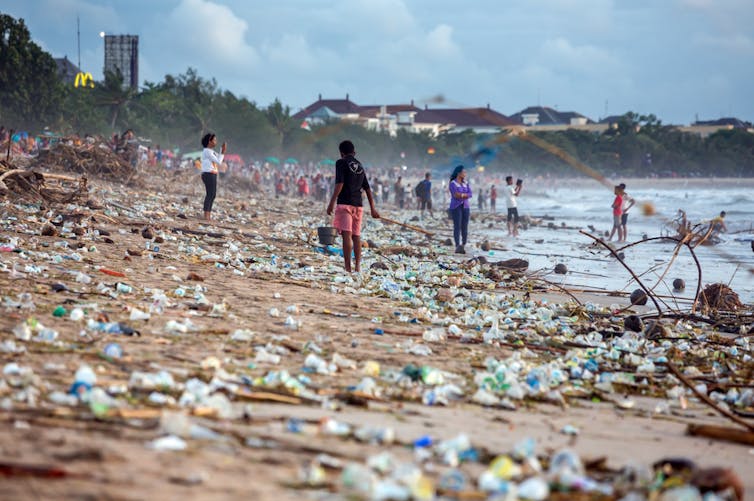
Plastic waste is the most visible component of ocean pollution. Maxim Blinkov/Shutterstock

Ocean pollution is widespread, worsening, and poses a clear and present danger to human health and wellbeing. But the extent of this danger has not been widely comprehended – until now. Our recent study provides the first comprehensive assessment of the impacts of ocean pollution on human health.

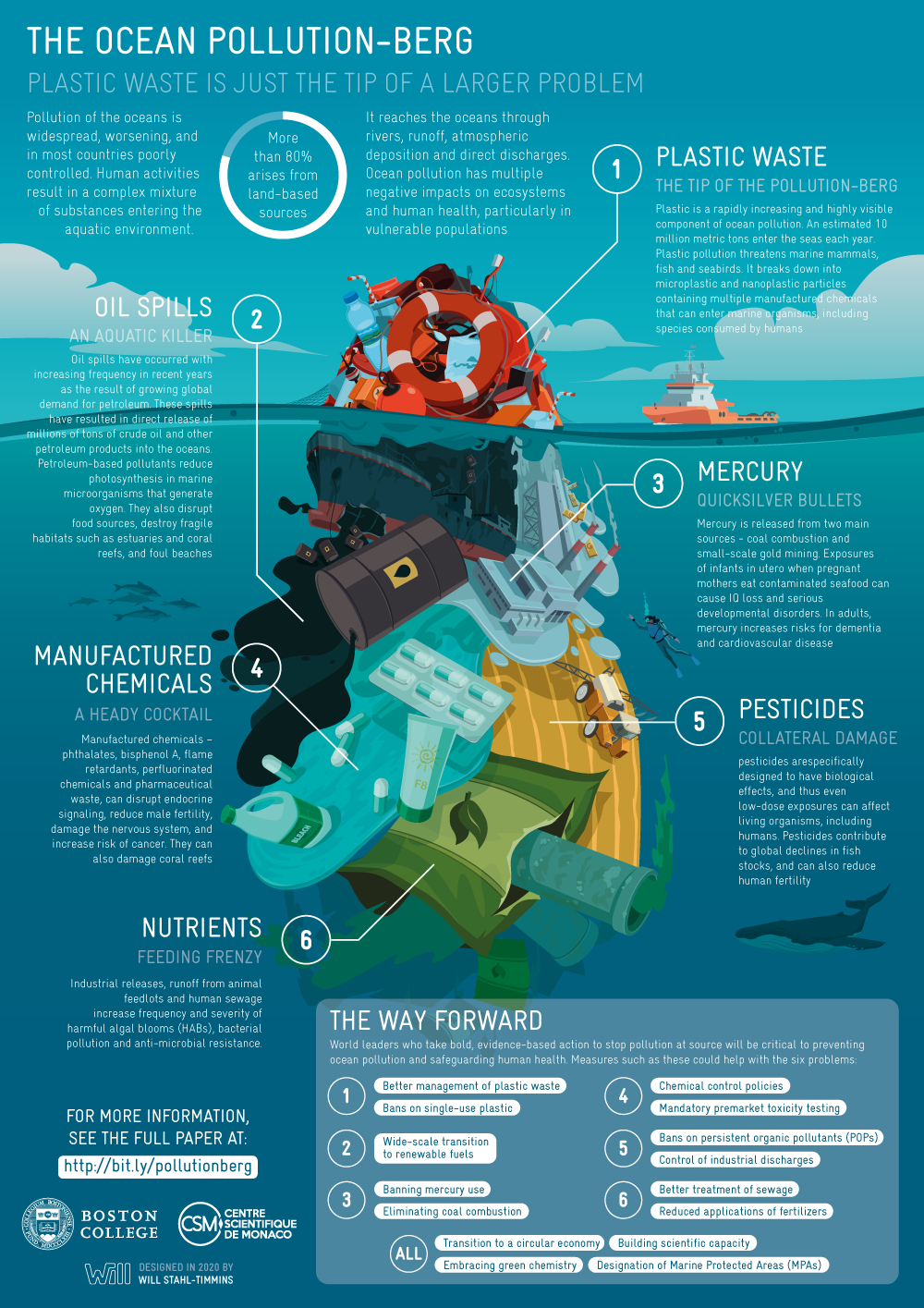
Ocean pollution is a complex mixture of toxic metals, plastics, manufactured chemicals, petroleum, urban and industrial wastes, pesticides, fertilisers, pharmaceutical chemicals, agricultural runoff, and sewage. More than 80% arises from land-based sources and it reaches the oceans through rivers, runoff, deposition from the atmosphere – where airborne pollutants are washed into the ocean by rain and snow – and direct dumping, such as pollution from waste water treatment plants and discarded waste. Ocean pollution is heaviest near the coasts and most highly concentrated along the coastlines of low-income and middle-income countries.

Infographic showing how sources of ocean pollution
The ‘pollution-berg’. Will Stahl-Timmins/Boston College/Centre Scientifique de Monaco, Author provided

Ocean pollution can also be found far beyond national jurisdictions in the open oceans, the deepest oceanic trenches, and on the shores of remote islands. Ocean pollution knows no borders.

The most hazardous ocean pollution

Plastic waste is the most visible component of ocean pollution. More than ten million tonnes of plastic enter the seas every year. The majority of this breaks down into microplastic particles and accumulates in coastal and deep-sea sediments.

Some large pieces float in the water for decades ending up as massive concentrations where currents converge and circulate. The Pacific Ocean’s so called “garbage patch” is a well-known example.


Read more: It might be the world's biggest ocean, but the mighty Pacific is in peril


Microplastics contain multiple toxic chemicals that are added to plastics to make them flexible, colourful, waterproof or flame-resistant. These include carcinogens, neurotoxins, and endocrine disruptors – chemicals that interfere with hormones, and can cause cancer, birth defects, and reduced fertility.

These chemical-laden particles enter the food chain and accumulate in fish and shellfish. When humans eat seafood contaminated with these materials, we ingest millions of microplastic particles and the many chemicals they carry. Though there is still debate on the harm to humans from microplastics, exposure to these chemicals increases the risk of all the diseases that they cause. Virtually all of us have microplastics in our bodies today.

Mercury is widespread in the oceans, and the major culprit is coal burning in homes and industry. All coal contains mercury, and when it burns, mercury vaporises, enters the atmosphere, and eventually washes into the sea. Gold mining is another source, as mercury is used to dissolve gold from the ore.

Mercury can accumulate to high levels in predatory fish such as tuna and swordfish, which are in turn eaten by us. Contaminated fish can be especially dangerous if eaten by expectant mothers. Exposure of mercury to infants in the womb can damage developing brains, reducing IQ and increasing risks for autism, ADHD, and other learning disorders. Adult mercury exposure increases risks for heart disease and dementia.

Petroleum pollutants from oil spills threaten the marine microorganisms that produce much of the Earth’s oxygen by reducing their capacity for photosynthesis. These beneficial microorganisms use solar energy to convert atmospheric CO₂ into oxygen and are also affected by organic pollutants and other chemicals. When there is a major oil spill, the impact can be huge.

Coastal pollution from industrial waste, agricultural runoff, pesticides, and sewage increases the frequency of harmful algal blooms, known as red tides, brown tides, and green tides. These blooms produce powerful toxins like ciguatera and domoic acid that accumulate in fish and shellfish. When ingested, these toxins can cause dementia, amnesia, paralysis, and even rapid death. When inhaled, they can cause asthma.

Dangerous microorganisms result from a combination of coastal pollution and warming seas, which encourages their spread. Harmful bacteria such as the vibrio species – found in warmer waters and responsible for vibriosis, a potentially fatal illness – are now appearing further north and causing life-threatening infections. There’s a high risk that cholera, caused by vibrio cholerae, could spread to new, previously unaffected areas.

And the health impacts of ocean pollution fall disproportionately on indigenous peoples, coastal communities and vulnerable populations in the Global South, underlining the planetary scale of this environmental injustice.

Political will and scientific evidence

While the findings in this report are alarming, the good news is that ocean pollution, as with all forms of pollution, can be controlled and prevented. Bans on single-use plastics and better waste sorting can curb pollution at its source, especially plastic waste, both on land and at sea.

Wise governments have curbed other forms of pollution by deploying control strategies based on law, policy, technology, and targeted enforcement. The US, for example, has reduced air pollution by 70% since the passage of the Clean Air Act in 1970. They have saved thousands of lives. They have proven highly cost-effective.

Countries around the world are now applying these same tools to control ocean pollution. Boston Harbour in Massachusetts and Victoria Harbour in Hong Kong have been cleaned. Estuaries from Chesapeake Bay in the US to the Seto Inland Sea in Japan have been rejuvenated. Some coral reefs have been restored, such as those in American Samoa, where vigilance, protection and quick response have happened in relation to various pollution threats.

These successes have boosted economies, increased tourism, restored fisheries, and improved health. They demonstrate that broad control of ocean pollution is feasible and their benefits will last for centuries. Our study offers some clear recommendations for preventing and controlling ocean pollution, including transitioning to cleaner energy, developing affordable alternatives to fossil fuel-based plastics, reducing human, agricultural and industrial discharges, and expanding Marine Protected Areas.

Protecting the planet is a global concern and our collective responsibility. Leaders who recognise the gravity of ocean pollution, acknowledge its growing dangers, engage civil society, and take bold, evidence-based action to stop pollution at source will be essential for preventing ocean pollution and safeguarding our own health.The Conversation

Jacqueline McGlade, Professor of Natural Prosperity, Sustainable Development and Knowledge Systems, UCL and Philip Landrigan, Professor and Director, Global Public Health Program and Global Pollution Observatory, Schiller Institute for Integrated Science and Society, Boston College

This article is republished from The Conversation under a Creative Commons license.

Tuesday, December 22, 2020

Here's why Christmas movies are so appealing this holiday season


A still from the 1946 classic ‘It’s A Wonderful Life.’ RKO Pictures/Archive Photos/Moviepix/Getty Images

With the pandemic limiting travel over the holiday season, many Americans will be settling in front of the television to watch their favorite holiday movies, along with their favorite drink – a cup of hot apple cider or a glass of wine – to add some cheer.

Holiday movies have become an essential part of the American winter celebrations and are likely to be more so for those quarantining this year. The entertainment site Vulture reports 82 new holiday movie releases in 2020. But, even before the lockdown, production of annual Christmas movies was reported to be up by at least 20% since 2017 on a single cable network.

Holiday movies are popular not simply because they are “escapes,” as my research on the relation between religion and cinema argues. Rather, these films offer viewers a glimpse into the world as it could be.

Christmas movies as reflection

This is particularly true with Christmas movies.

In his 2016 book “Christmas as Religion,” the religious studies scholar Christopher Deacy states that Christmas movies act as a “barometer of how we might want to live and how we might see and measure ourselves.”

These movies offer a variety of portraits of everyday life while affirming ethical values and social mores along the way.

The 1946 classic “It’s a Wonderful Life” – a fantasy film about a man named George Bailey, who has touched the lives of many, despite all his problems – represents visions of a community in which every citizen is a vital component.

Another movie commonly replayed this time of year is 2005’s “The Family Stone,” which portrays the clashes of a mostly average family but shows viewers that quarrels can be worked through and harmony is possible.

The 2003 British holiday film “Love Actually,” which follows the lives of eight couples in London, brings to viewers the perennial theme of romance and the trials of relationships.

A couple on a couch watching a movie.
Holiday films create alternate realities that provide us solace. DGLimages/Shutterstock

Movie-watching as ritual practice

As holiday movies bring viewers into a fictional world, people are able to work through their own fears and desires about self-worth and relationships. Such movies can provide solace, reaffirmation and sometimes even courage to continue working through difficult situations. The movies offer hope in believing it all might turn out all right in the end.

When people see some part of their own lives unfold on screen, the act of viewing operates in a fashion that’s strikingly similar to how a religious ritual works.

As anthropologist Bobby Alexander explains, rituals are actions that transform people’s everyday lives. Rituals can open up “ordinary life to ultimate reality or some transcendent being or force,” he writes in the collection “Anthropology of Religion.”

For example, for Jews and Christians, ritually observing the Sabbath day by sharing meals with family and not working connects them with the creation of the world. Prayer rituals in the Muslim, Christian and Jewish traditions connect those praying with their God, as well as with their fellow believers.

Holiday movies do something similar, except that the “transcendent force” they make viewers feel is not about God or another supreme being. Instead, this force is more secular: It’s the power of family, true love, the meaning of home or the reconciliation of relationships.

Movies create an idealized world

Take the case of the 1942 musical “Holiday Inn.” It was one of the first movies – after the silent era’s various versions of Charles Dickens’ “A Christmas Carol” – where the plot used Christmas as a backdrop, telling the story of a group of entertainers who have gathered at a country inn.

In reality, it was a deeply secular film about romantic interests, couched in a desire to sing and dance. When it was released, the United States had been fully involved in World War II for a year and national spirits were not high.

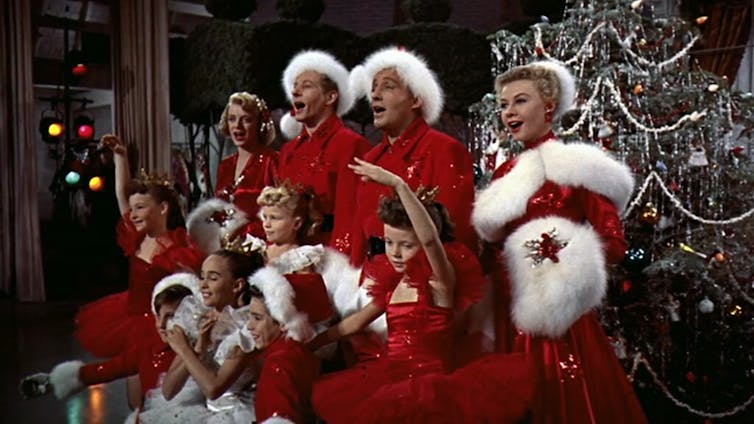
The cast of 'White Christmas' in front of a Christmas tree.
A still from the film ‘White Christmas’. Classic Film/Flickr, CC BY-NC

The movie hasn’t endured as a classic. But Bing Crosby’s song “White Christmas,” which appeared in it, quickly became etched in the holiday consciousness of many Americans, and a 1954 film called “White Christmas” became better known.

As historian Penne Restad puts it in her 1995 book “Christmas in America,” Crosby’s crooning offers the “quintessential expression” of the holidays, a world which “has no dark side” – one in which “war is forgotten.”

[Get the best of The Conversation, every weekend. Sign up for our weekly newsletter.]

In subsequent Christmas movies, the main plots have not been set in the context of war, yet there is nonetheless often a battle: that of overcoming a materialistic, gift-buying and gift-giving kind of holiday.

Movies like “Jingle all the Way,” “Deck the Halls” and “How the Grinch Stole Christmas!” center around the idea that the true meaning of Christmas is not in rampant consumerism but in goodwill and family love.

Dr. Seuss’ famously grouchy Grinch thinks he can ruin Christmas by taking all the gifts away. But as the people gather together, giftless, they join hands and sing while the narrator tells viewers, “Christmas came anyway.”

A scene from the 1966 TV movie ‘How the Grinch Stole Christmas!’

‘All’s right with the world’

Though Christmas is a Christian holiday, most holiday films are not religious in the traditional sense. There is hardly ever a mention of Jesus or the biblical setting of his birth.

As media studies scholar John Mundy writes in a 2008 essay “Christmas and the Movies,” “Hollywood movies continue to construct Christmas as an alternative reality.”

These movies create on-screen worlds that kindle positive emotions while offering a few laughs.

“A Christmas Story,” from 1983, waxes nostalgic for childhood holidays when life seemed simpler and the desire for a Red Ryder air rifle was the most important thing in the world. The plot of 2003’s “Elf” centers on the quest to reunite with a lost father.

In the end, as the narrator says late in “A Christmas Story” – after the family has overcome a serious of risible mishaps, the presents have been unwrapped and they’ve gathered for Christmas goose – these are times when “all’s right with the world.”

At the end of a troubled 2020, and as so many families are physically isolated from their loved ones, people need to believe in worlds in which all’s right. Holiday movies allow a glimpse of such a place.

This is an updated version of an article first published on Dec. 6, 2019.The Conversation

S. Brent Rodriguez-Plate, Professor of Religious Studies and Cinema and Media Studies, by special appointment, Hamilton College

This article is republished from The Conversation under a Creative Commons license.
As heavenly bodies converge, many ask: Is the Star of Bethlehem making a comeback?

A Nativity presentation showing the three wise men being led by the Star of Bethlehem. Steve Russell/Toronto Star via Getty Images

On Dec. 21, 2020, Jupiter and Saturn will cross paths in the night’s sky and for a brief moment, they will appear to shine together as one body. While planetary conjunctions like this are not everyday events, they also are not particularly rare.

This year’s conjunction is different for at least two reasons. The first is the degree to which the two planets will be aligned. Experts predict that they will appear closer during this conjunction than they have in nearly eight centuries and also brighter.

But the second factor, and the one that has thrust this event into the spotlight, is that it will occur on the winter solstice, just before the Christmas holiday. The timing has led to a speculation whether this could be the same astronomical event that the Bible reports led the wise men to Joseph, Mary and the newly born Jesus – the Star of Bethlehem.

As a scholar of early Christian literature writing a book on the three wise men, I argue that the upcoming planetary conjunction is likely not the fabled Star of Bethlehem. The biblical story of the star is intended to convey theological rather than historical or astronomical truths.

Leading light

The story of the star has long fascinated readers, both ancient and modern. Within the New Testament, it is found only in the Gospel of Matthew, a first-century account of Jesus’ life that begins with the story of his birth.

In this account, wise men arrive in Jerusalem and say to Herod, the king of Judea: “Where is the child who has been born king of the Jews? For we observed his star at its rising and have come to pay him homage.” The star then leads them to Bethlehem and stops over the house of Jesus and his family.

Many have read this story with the presupposition that Matthew must have been referencing an actual astronomical event that occurred around the time of Jesus’ birth. The astronomer Michael R. Molnar, for example, has argued that the Star of Bethlehem was an eclipse of Jupiter within the constellation Ares.

There are at least two issues involved in associating a specific event with Matthew’s star. The first is that scholars are not certain exactly when Jesus was born. The traditional date of his birth may be off by as many as six years.

The second is that measurable, predictable astronomical events occur with relative frequency. The quest to discover which event, if any, Matthew might have had in mind is therefore a complicated one.

Beliefs about the star

The theory that the conjunction of Jupiter and Saturn may be the Star of Bethlehem is not new. It was proposed in the early 17th century by Johannes Kepler, a German astronomer and mathematician. Kepler argued that this same planetary conjunction in or around 6 B.C. could have served as inspiration for Matthew’s story of the star.

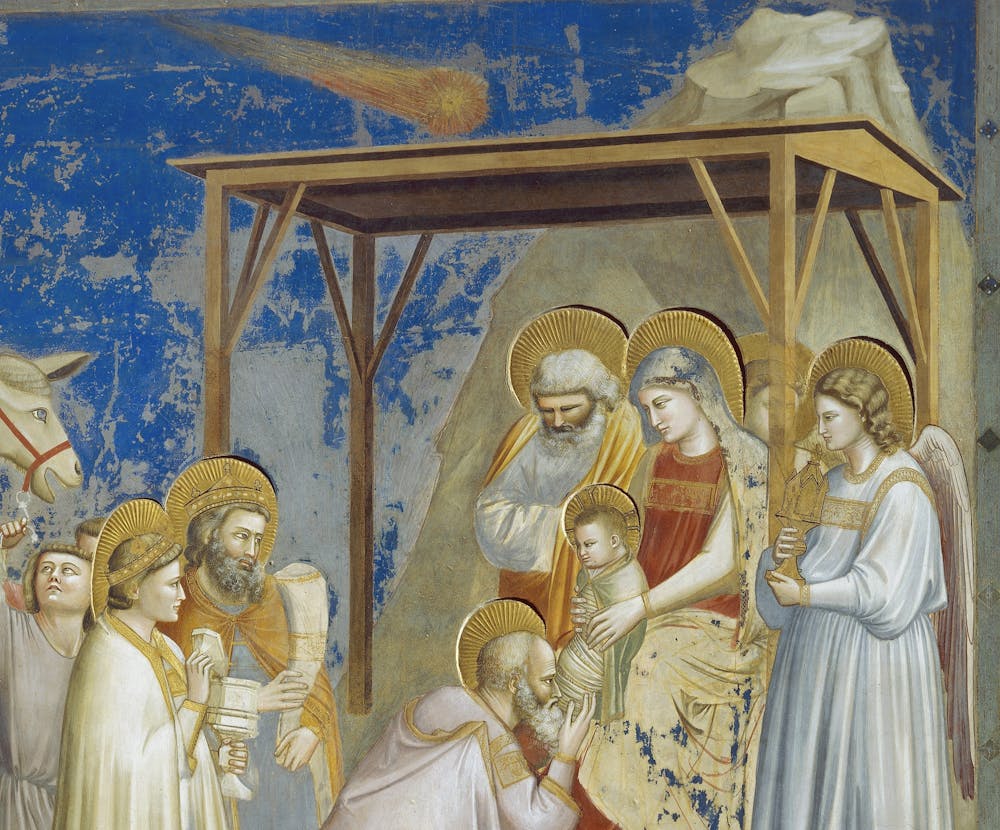
Kepler was not the first to suggest that the Star of Bethlehem may have been a recognizable astronomical event. Four hundred years prior to Kepler, between 1303 and 1305, the Italian artist Giotto painted the star as a comet on the walls of the Scrovegni Chapel in Padua, Italy.

Painting ‘Adoration of the Magi,’ by Giotto, showing the comet in Scrovegni Chapel, Padua, Veneto, Italy. DEA / A. Dagli Orti/De Agostini via Getty Images

Scholars have suggested that Giotto did this as an homage to Halley’s Comet, which astronomers have determined was visible in 1301, on one of its regular flights past the Earth. Astronomers have also determined that Halley’s Comet passed by the Earth in or around 12 B.C., between five and 10 years before most scholars argue that Jesus was born. It is possible that Giotto believed Matthew was referencing Halley’s Comet in his story of the star.

Attempts to discover the identity of Matthew’s star are often creative and insightful, but I would argue that they are also misguided.

The star in Matthew’s story may not be a “normal” natural phenomenon, and Matthew suggests as much in the way that he describes it. Matthew says that the wise men come to Jerusalem “from the East.” The star then leads them to Bethlehem, south of Jerusalem. The star therefore makes a sharp left turn. And astronomers will agree that stars do not make sharp turns.

Moreover, when the wise men arrive in Bethlehem, the star is low enough in the sky to lead them to a specific house. As physicist Aaron Adair puts it: “the Star is said to stop in place and hover over a particular lodging, acting as an ancient GPS unit.” The “description of the movements of the Star,” he noted, was “outside what is physically possible for any observable astronomical object.”

Theological underpinning

In short, there appears to be nothing “normal” or “natural” about the phenomenon that Matthew describes. Perhaps the point that Matthew is trying to make is a different one.

Matthew’s story of the star draws from a body of tradition in which stars are connected to rulers. The rising of a star signifies that a ruler has come to power.

In the biblical book of Numbers, for example, which dates to 5th century B.C., the prophet Balaam predicts the arrival of a ruler who will defeat the enemies of Israel. “A star shall come out of Jacob, [meaning Israel]…it shall crush the borderlands of Moab.”

One of the most well-known examples of this tradition from antiquity is the so-called “Sidus Iulium,” or “Julian Star,” a comet that appeared a few months after the assassination of Julius Caesar in 44 B.C. Roman authors Suetonius and Pliny the Elder report that the comet was so bright that it was visible in the late afternoon, and that many Romans interpreted the spectacle as evidence that Julius Caesar was now a god.

In light of such traditions, I believe Matthew’s story of the star exists not to inform readers about a specific astronomical event, but to support claims that he is making about the character of Jesus.

Put another way, I argue that Matthew’s goal in telling this story is more theological than it is historical.

The upcoming conjunction of Jupiter and Saturn is therefore likely not a return of the Star of Bethlehem, but Matthew would likely be pleased with the awe it inspires in those who anticipate it.The Conversation

Eric M. Vanden Eykel, Associate Professor of Religion, Ferrum College

This article is republished from The Conversation under a Creative Commons license.