Sunday, September 26, 2021

Why our dislikes should be celebrated as much as our likes


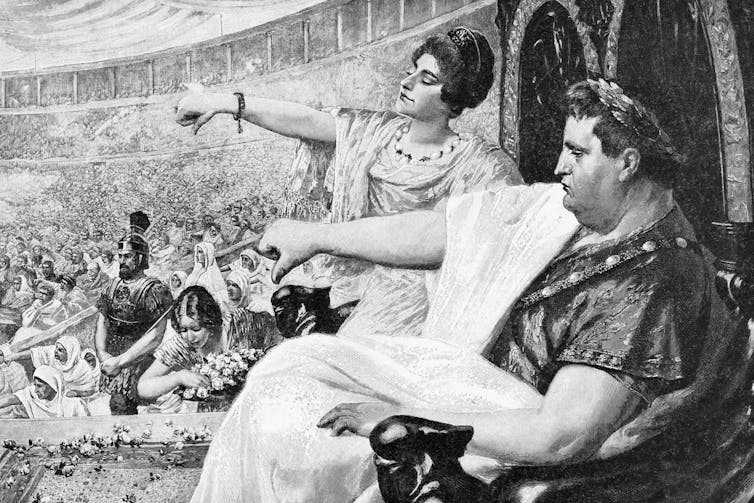
Reveling in dislike can give us a modicum of control in a world that inundates us with content. Bettmann via Getty Images

Millions might tune into the Oscars every year, but I’m always interested in the Razzies, which recognize spectacular cinematic underachievement.

I’m not the only one who thinks dislikes can be every bit as interesting as likes, either: While the internet and social media are full of praise for fandoms and stans, there’s a deep well of content honoring profound dislikes.

Why do deep dislikes matter, and why might it matter, for instance, whether “Dolittle” or “Absolute Proof” wins the Razzie for Worst Picture?

For several years I’ve been trying to answer these questions. Many dislikes of media content are simple and fleeting: Change the channel and they’re gone. But my forthcoming book “Dislike-Minded: Media, Audiences, and the Dynamics of Taste” aims to explore when and why dislikes can weigh more heavily upon us.

For all the attention heaped on what we like, what we dislike can be just as important, interesting and empowering.

Dislike as snobbery

Among academics who have explored dislike – yes, that’s a thing – the most cited work comes from French sociologist Pierre Bourdieu, who saw dislike as snobbery. More specifically, he saw all judgments of taste, favorable or not, as performances of class. The rich could justify their place in society, he argued, by claiming to have more refined tastes. Knowing which literature, music or art to praise could signal to others their rightful place at the top of society.

I’d argue that Bourdieu oversimplified in seeing all dislike as snobbery and all snobbery as class-based. But he’s not entirely wrong. In fact, dislikes often scream out elitism, sexism and racism.

Media associated with women – romance or soap operas – might be sneered at as “chick flicks” or “chick lit.” Music associated with people of color, like rap, is still dismissed as obscene, while country music songs are often derided as all sounding alike.

So many -isms do their work in and through dislikes.

Furthermore, dislikes are often used as a way not to stand apart but to fit in. It means learning the unspoken rules of what’s OK to like or dislike, and to proclaim those likes or dislikes loudly for others to hear. When some of us do swim against the social tide, we might be savvy enough to label our likes as “guilty pleasures,” which both acknowledges the rules and apologizes for violating them.

Spitting out what you’re force-fed

In my research, though, I found that dislike isn’t just a form of snobbery.

My research assistants conducted hourlong interviews with more than 200 people over the course of several years. The interviewees were a diverse group in terms of race and gender. Their ages ranged from the 20s to the 70s. Some were working class, while others were upper class. Yet all tended to actively dislike media content far more when they felt they couldn’t escape it.

Sometimes simply changing the channel isn’t possible. Many people can’t choose the radio station that’s playing at work, the playlist in a grocery store, what’s on the TV at the bar or what’s blaring out of someone’s car window. And certain programs or movies creep into other aspects of people’s lives – think “Star Wars” BB-8 branded oranges or “Frozen” toothpaste.

For all the chatter about cancel culture, many consumers are powerless to cancel or even to escape. So when people can’t stand what an item of media represents, its ubiquity can invite criticism or dislike.

A stressed woman pushes a cart down a supermarket aisle.
Much of the media we’re exposed to is out of our control. Andy Sacks via Getty Images

Surely we are all annoyed at least some of the time by some media. But some of us are subjected to more annoyance than others.

A less discussed privilege is the power to control what media is seen or heard, even if only by being “the type of audience” many producers and their funders want to address.

Remote controls, for instance, have long been envisioned as an appendage of dads everywhere, with women and kids being given less power to change the channel. Store playlists are regularly chosen with middle-class customers’ tastes in mind. And people of color are still often regarded as niche audiences for much media, with white preferences and interests acting as the default.

Those without as much power in society might be expected to be more actively annoyed, haunted and hounded by media. Everyone turns to media hoping for specific needs and desires to be met, but those who have those needs and desires realized less often are those who might be expected to dislike with passion more often.

Seen this way, speaking about dislikes is an act of resistance – it’s a refusal to allow public space to be conquered by the ads, merchandise and buzz for media that doesn’t connect.

Whatever the reason, to dislike is to acknowledge that much of our media diet is force-fed.

Keep your likes close – and your dislikes closer

Dislike can certainly transform into anger or hate, but it may also take a more playful form. Many reviewers strive for a poetry of putrescence in how they excoriate their objects of dislike.

Three of Roger Ebert’s books, for example, collect only his most damning criticism. Parents sharing their disdain with me for Caillou – the whiny children’s character – did so while laughing, not raging. And “hate-watching,” or watching something to revel in all the ways you despise it, has become a common form of viewing.

Instead of tuning out and turning off, why would someone gleefully watch the object of their dislike and offer a running commentary of damnation?
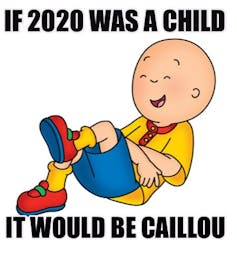
The children's character Caillou sits accompanied by the text 'If 2020 was a child, it would be Caillou.'
A meme features the much-derided Caillou. https://www.memecreator.org/meme/if-2020-was-a-child-it-would-be-caillou/

Reveling in dislike can reassert control in a world that inundates everyone with content. Keeping the shows, songs and movies the hate-watcher despises close at hand – rather than trying to avoid or repel them – can make them better prosecutors in the court of public opinion. If popular media regularly produce discussion, the hate-watcher is better equipped to poison that well.

Or some dislikers might enjoy their dislikes as a way to avoid their corroding certain relationships. Many of us can probably relate to the experience of having a friend, partner or family member who insists we watch something against our will.

What if, rather than resenting the show or the person, we simply embrace it in all of its cringeworthy glory?

Impassioned dislike can be too easily mistaken for hate and anger, but it is a distinct reaction: Nobody at the Razzies will be pounding their fists, red-faced, on the podium as they present.

By all means, heed the colloquial advice to “ignore the haters.” But a lot can be learned by listening to the dislikers.The Conversation

Jonathan Gray, Professor of Media and Cultural Studies, University of Wisconsin-Madison

This article is republished from The Conversation under a Creative Commons license.

Tattoos have a long history going back to the ancient world – and also to colonialism


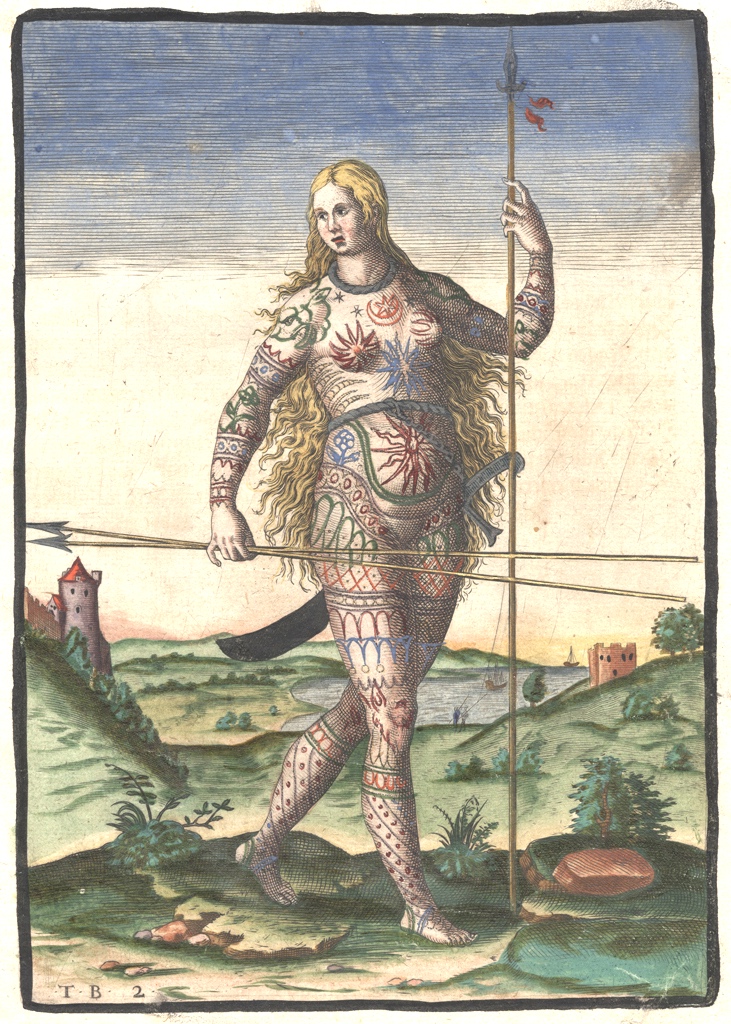
The Picts, the indigenous people of what is today northern Scotland, were documented by Roman historians as having complex tattoos. Theodor de Bry, via Wikimedia Commons

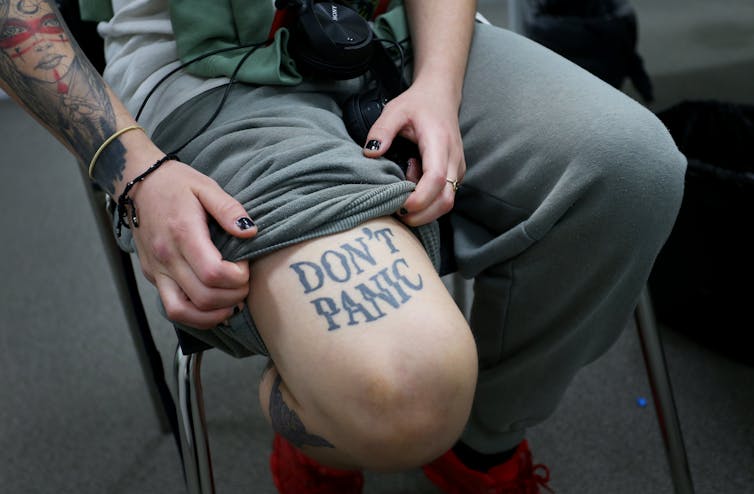
While most of us would likely care to forget the pandemic as soon as is possible, a few have opted for a permanent reminder of the health crisis – in the shape of a tattoo. Some of these tattoos are meant to serve as a reminder of the year gone by, depicting motifs around toilet paper shortages, social distancing and other pandemic-related messages. But those who lost loved ones to the disease are also using tattoos to create memorials.

A woman shows off her pandemic tattoo that says, 'Don't Panic.'
Some people in the U.S. and other parts of the world are getting pandemic tattoos. Lisa Maree Williams/Getty Images

This is not a recent phenomenon – tattoos have long served as a way for people to express their emotions.

As a tattoo historian, I often enjoy asking people where they think tattoos originated. I hear the mention of countries such as China, Japan, “somewhere in Africa or South America,” or Polynesia. What is interesting is that in the past five years of holding these conversations, no one thus far has answered that tattoos could have originated in Europe or North America.

What geographical areas these answers include, and what they miss, speak to a deeper truth about the history of tattoos: What we know and think about tattoos is heavily influenced by oppression, racism and colonialism.

History of tattoos

Tattooing practices were common in many parts of the ancient world.

There were tattoos in both ancient Japan and Egypt. The Māori of New Zealand have been practicing sacred Ta Mōko tattooing for centuries as a way to indicate who they are as individuals as well as who their community is.

A Japanese tattoo artist at work on a design on a woman's back in Japan in 1955.
Tattooing practices were common in most parts of the ancient world. FPG/Getty Images

However, no one culture can lay the claim to first inventing the art form. Tattooing practices were known in Europe and North America since times of antiquity. The Greeks depicted their tattooed Thracian neighbors, the Indo-European-speaking people, on their pottery. The Picts, the indigenous people of what is today northern Scotland, were documented by Roman historians as having complex tattoos.

The oldest preserved tattoos come from Ötzi the Iceman, a 5,300-year-old mummified body frozen in ice discovered in the mountains of Italy in 1991. In 2019, researchers identified 2,000-year-old tattoo needles from southeastern Utah’s Pueblo archaeological sites. The cactus spines bound with yucca leaves still had the remnants of tattoo ink on them.

Colonization and tattoos

Tattoo historian Steve Gilbert explains that the word “tattoo” itself is a combination of Marquesan and Samoan words – tatau and tatu – to describe these practices. The sailors who explored these Polynesian islands combined the words as they traded stories of their experiences.

The question then arises, if tattoos existed in Europe and North America since times of antiquity, why did Western cultures appropriate and combine these two words instead of using words that already existed in their own?

As I found in my research, somewhere around the 1400s tattoos became an easy way to draw a line between European colonizers and those colonized, who were seen as “uncivilized.”

Tattooing was still being practiced in Europe and North America, but many of those tattooing practices had been driven underground by the time European colonization was in full swing.

That was in part the result of attempts to “Christianize” parts of Europe by purging towns and villages of “pagan” and nonconformist, nonreligious practices – including tattooing. As Catholic churches expanded their influence via missionaries and campaigns of assimilation beginning in A.D. 391, tattoos were frowned upon as “un-Christian.”

Not like us

As Western colonizers pushed into places like Africa, the Pacific Islands and North and South America in the 1400s and 1500s, they found entire groups of native peoples who were tattooed.

These tattooed individuals were often pointed to as proof that the “untamed natives” needed the help of “good, God-fearing” Europeans to become fully human. Tattooed individuals from these cultures were even brought back and paraded through Europe for profit.

A tattooed Indigenous mother and son, kidnapped by explorers in the late 1600s from an unknown location in Canada, were two such victims. An advertisement handbill of the time read: “Let us thank Almighty God for this beneficence, that he has declared himself to us by his Word, so that we are not like these savages and man-eaters.”

People would pay to gawk at these enslaved human beings, making their captors a healthy profit and reaffirming in the minds of the audience the need for European expansion, whatever the human cost.

This kidnapping of tattooed persons had destructive effects on the cultures they were taken from, as often the most tattooed individuals, and therefore the most likely to be taken, were the leaders and holy persons.

It is worth noting that most captives did not live longer than a few months after arriving in Europe, succumbing to foreign illness or malnourishment when their slavers did not feed them.

This “tattooed savage” narrative was pushed even further as tattooed individuals began to display themselves in carnival and circus “freak shows.”

These performers not only pushed the narrative of tattoos being “savage” or “othering” by performing as freaks, they also invented tragic backstories. The performers claimed they were attacked and forcibly tattooed by marginalized people, such as Native Americans, whom the public at large regarded as “savages.”

One such performer was the American Nora Hildebrandt. Nora weaved an account of being captured by Native Americans who forcibly tattooed her.

This was a more harrowing tale than the reality that her longtime partner, Martin Hildebrandt, had been her tattoo artist. Her tale was particularly baffling, as Nora Hildebrandt’s tattoos were mostly of patriotic symbols, like the American flag.

The voices of colonizers echo into the present. Tattoos carry a certain amount of stigma in Western societies. They can often end up being called a “poor life choice” or “trashy.” Studies as recent as 2014 discuss the persistence of the stigma.

I see tattoos as art and a way of communicating identity. In answering the question “where do tattoos come from?” I would argue that they come from all of us, regardless of what early colonizers may have wanted people to believe.The Conversation

Allison Hawn, Instructional Faculty, Arizona State University

This article is republished from The Conversation under a Creative Commons license.

Preliminary research finds that even mild cases of COVID-19 leave a mark on the brain – but it’s not yet clear how long it lasts


The new findings, although preliminary, are raising concerns about the potential long-term effects of COVID-19. Yuichiro Chino via Getty Images

With more than 18 months of the pandemic in the rearview mirror, researchers have been steadily gathering new and important insights into the effects of COVID-19 on the body and brain. These findings are raising concerns about the long-term impacts that the coronavirus might have on biological processes such as aging.

As a cognitive neuroscientist, my past research has focused on understanding how normal brain changes related to aging affect people’s ability to think and move – particularly in middle age and beyond. But as more evidence came in showing that COVID-19 could affect the body and brain for months or longer following infection, my research team became interested in exploring how it might also impact the natural process of aging.

Peering in at the brain’s response to COVID-19

In August 2021, a preliminary but large-scale study investigating brain changes in people who had experienced COVID-19 drew a great deal of attention within the neuroscience community.

In that study, researchers relied on an existing database called the UK Biobank, which contains brain imaging data from over 45,000 people in the U.K. going back to 2014. This means – crucially – that there was baseline data and brain imaging of all of those people from before the pandemic.

The research team analyzed the brain imaging data and then brought back those who had been diagnosed with COVID-19 for additional brain scans. They compared people who had experienced COVID-19 to participants who had not, carefully matching the groups based on age, sex, baseline test date and study location, as well as common risk factors for disease, such as health variables and socioeconomic status.

The team found marked differences in gray matter – which is made up of the cell bodies of neurons that process information in the brain – between those who had been infected with COVID-19 and those who had not. Specifically, the thickness of the gray matter tissue in brain regions known as the frontal and temporal lobes was reduced in the COVID-19 group, differing from the typical patterns seen in the group that hadn’t experienced COVID-19.

In the general population, it is normal to see some change in gray matter volume or thickness over time as people age, but the changes were larger than normal in those who had been infected with COVID-19.

Interestingly, when the researchers separated the individuals who had severe enough illness to require hospitalization, the results were the same as for those who had experienced milder COVID-19. That is, people who had been infected with COVID-19 showed a loss of brain volume even when the disease was not severe enough to require hospitalization.

Finally, researchers also investigated changes in performance on cognitive tasks and found that those who had contracted COVID-19 were slower in processing information, relative to those who had not.

While we have to be careful interpreting these findings as they await formal peer review, the large sample, pre- and post-illness data in the same people and careful matching with people who had not had COVID-19 have made this preliminary work particularly valuable.

What do these changes in brain volume mean?

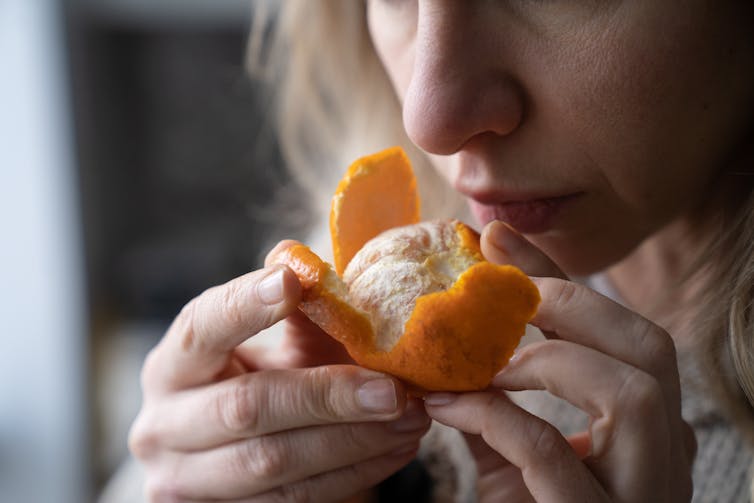
Early on in the pandemic, one of the most common reports from those infected with COVID-19 was the loss of sense of taste and smell.

A woman with COVID-19 symptoms tries to sense the smell of a fresh tangerine.
Some COVID-19 patients have experienced either the loss of, or a reduction in, their sense of smell. Dima Berlin via Getty Images

Strikingly, the brain regions that the U.K. researchers found to be impacted by COVID-19 are all linked to the olfactory bulb, a structure near the front of the brain that passes signals about smells from the nose to other brain regions. The olfactory bulb has connections to regions of the temporal lobe. We often talk about the temporal lobe in the context of aging and Alzheimer’s disease because it is where the hippocampus is located. The hippocampus is likely to play a key role in aging, given its involvement in memory and cognitive processes.

The sense of smell is also important to Alzheimer’s research, as some data has suggested that those at risk for the disease have a reduced sense of smell. While it is far too early to draw any conclusions about the long-term impacts of these COVID-related changes, investigating possible connections between COVID-19-related brain changes and memory is of great interest – particularly given the regions implicated and their importance in memory and Alzheimer’s disease.

Looking ahead

These new findings bring about important yet unanswered questions: What do these brain changes following COVID-19 mean for the process and pace of aging? And, over time does the brain recover to some extent from viral infection?

These are active and open areas of research, some of which we are beginning to do in my own laboratory in conjunction with our ongoing work investigating brain aging.

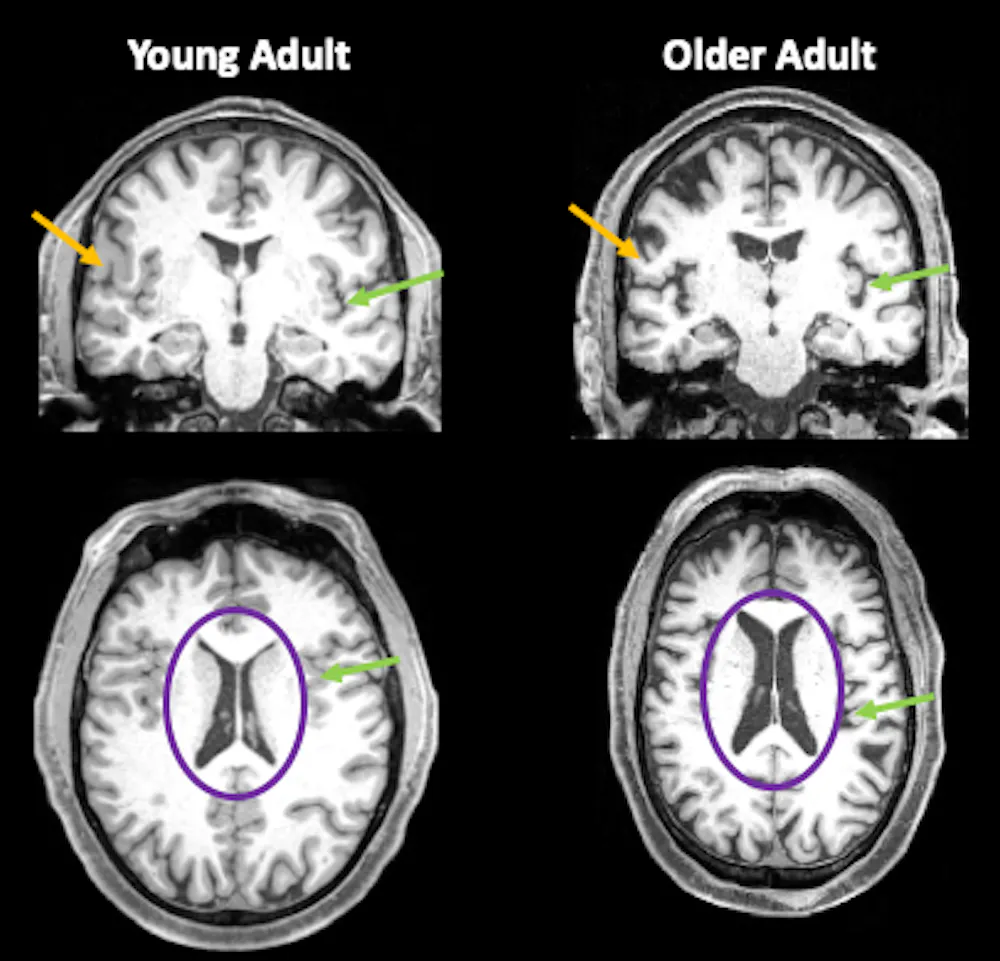
Brain scans from a person in their 30s and a person in their 80s, showing reduced brain volume in the older adult brain
Brain images from a 35-year-old and an 85-year-old. Orange arrows show the thinner gray matter in the older individual. Green arrows point to areas where there is more space filled with cerebrospinal fluid (CSF) due to reduced brain volume. The purple circles highlight the brains’ ventricles, which are filled with CSF. In older adults, these fluid-filled areas are much larger. Jessica Bernard, CC BY-ND

Our lab’s work demonstrates that as people age, the brain thinks and processes information differently. In addition, we’ve observed changes over time in how peoples’ bodies move and how people learn new motor skills. Several decades of work have demonstrated that older adults have a harder time processing and manipulating information – such as updating a mental grocery list – but they typically maintain their knowledge of facts and vocabulary. With respect to motor skills, we know that older adults still learn, but they do so more slowly then young adults.

When it comes to brain structure, we typically see a decrease in the size of the brain in adults over age 65. This decrease is not just localized to one area. Differences can be seen across many regions of the brain. There is also typically an increase in cerebrospinal fluid that fills space due to the loss of brain tissue. In addition, white matter, the insulation on axons – long cables that carry electrical impulses between nerve cells – is also less intact in older adults.

As life expectancy has increased in the past decades, more individuals are reaching older age. While the goal is for all to live long and healthy lives, even in the best-case scenario where one ages without disease or disability, older adulthood brings on changes in how we think and move.

Learning how all of these puzzle pieces fit together will help us unravel the mysteries of aging so that we can help improve quality of life and function for aging individuals. And now, in the context of COVID-19, it will help us understand the degree to which the brain may recover after illness as well.


Jessica Bernard, Associate Professor, Texas A&M University

This article is republished from The Conversation under a Creative Commons license.

Saturday, August 28, 2021

Swimming gives your brain a boost – but scientists don’t know yet why it’s better than other aerobic activities


Swimming offers a host of beneficial effects on the brain. Stanislaw Pytel/Stone via Getty Images

It’s no secret that aerobic exercise can help stave off some of the ravages of aging. But a growing body of research suggests that swimming might provide a unique boost to brain health.

Regular swimming has been shown to improve memory, cognitive function, immune response and mood. Swimming may also help repair damage from stress and forge new neural connections in the brain.

But scientists are still trying to unravel how and why swimming, in particular, produces these brain-enhancing effects.

As a neurobiologist trained in brain physiology, a fitness enthusiast and a mom, I spend hours at the local pool during the summer. It’s not unusual to see children gleefully splashing and swimming while their parents sunbathe at a distance – and I’ve been one of those parents observing from the poolside plenty of times. But if more adults recognized the cognitive and mental health benefits of swimming, they might be more inclined to jump in the pool alongside their kids.

New and improved brain cells and connections

Until the 1960s, scientists believed that the number of neurons and synaptic connections in the human brain were finite and that, once damaged, these brain cells could not be replaced. But that idea was debunked as researchers began to see ample evidence for the birth of neurons, or neurogenesis, in adult brains of humans and other animals.

Now, there is clear evidence that aerobic exercise can contribute to neurogenesis and play a key role in helping to reverse or repair damage to neurons and their connections in both mammals and fish.

Research shows that one of the key ways these changes occur in response to exercise is through increased levels of a protein called brain-derived neurotrophic factor. The neural plasticity, or ability of the brain to change, that this protein stimulates has been shown to boost cognitive function, including learning and memory.

Smiling child in swimming pool
It’s tempting for adults to watch kids splash from the poolside, but research shows it’s worth jumping in alongside them. Povozniuk/iStock via Getty Images Plus

Studies in people have found a strong relationship between concentrations of brain-derived neurotrophic factor circulating in the brain and an increase in the size of the hippocampus, the brain region responsible for learning and memory. Increased levels of brain-derived neurotrophic factor have also been shown to sharpen cognitive performance and to help reduce anxiety and depression. In contrast, researchers have observed mood disorders in patients with lower concentrations of brain-derived neurotrophic factor.

Aerobic exercise also promotes the release of specific chemical messengers called neurotransmitters. One of these is serotonin, which – when present at increased levels – is known to reduce depression and anxiety and improve mood.

In studies in fish, scientists have observed changes in genes responsible for increasing brain-derived neurotrophic factor levels as well as enhanced development of the dendritic spines – protrusions on the dendrites, or elongated portions of nerve cells – after eight weeks of exercise compared with controls. This complements studies in mammals where brain-derived neurotrophic factor is known to increase neuronal spine density. These changes have been shown to contribute to improved memory, mood and enhanced cognition in mammals. The greater spine density helps neurons build new connections and send more signals to other nerve cells. With the repetition of signals, connections can become stronger.

But what’s special about swimming?

Researchers don’t yet know what swimming’s secret sauce might be. But they’re getting closer to understanding it.

Swimming has long been recognized for its cardiovascular benefits. Because swimming involves all of the major muscle groups, the heart has to work hard, which increases blood flow throughout the body. This leads to the creation of new blood vessels, a process called angiogenesis. The greater blood flow can also lead to a large release of endorphins – hormones that act as a natural pain reducer throughout the body. This surge brings about the sense of euphoria that often follows exercise.

Most of the research to understand how swimming affects the brain has been done in rats. Rats are a good lab model because of their genetic and anatomic similarity to humans.

White rat in water maze
Rats serve as a useful laboratory model for understanding the effects of swimming on memory formation and brain health. irin717/iStock via Getty Images Plus

In one study in rats, swimming was shown to stimulate brain pathways that suppress inflammation in the hippocampus and inhibit apoptosis, or cell death. The study also showed that swimming can help support neuron survival and reduce the cognitive impacts of aging. Although researchers do not yet have a way to visualize apoptosis and neuronal survival in people, they do observe similar cognitive outcomes.

One of the more enticing questions is how, specifically, swimming enhances short- and long-term memory. To pinpoint how long the beneficial effects may last, researchers trained rats to swim for 60 minutes daily for five days per week. The team then tested the rats’ memory by having them swim through a radial arm water maze containing six arms, including one with a hidden platform.

Rats got six attempts to swim freely and find the hidden platform. After just seven days of swim training, researchers saw improvements in both short- and long-term memories, based on a reduction in the errors rats made each day. The researchers suggested that this boost in cognitive function could provide a basis for using swimming as a way to repair learning and memory damage caused by neuropsychiatric diseases in humans.

Although the leap from studies in rats to humans is substantial, research in people is producing similar results that suggest a clear cognitive benefit from swimming across all ages. For instance, in one study looking at the impact of swimming on mental acuity in the elderly, researchers concluded that swimmers had improved mental speed and attention compared with nonswimmers. However, this study is limited in its research design, since participants were not randomized and thus those who were swimmers prior to the study may have had an unfair edge.

Another study compared cognition between land-based athletes and swimmers in the young adult age range. While water immersion itself did not make a difference, the researchers found that 20 minutes of moderate-intensity breaststroke swimming improved cognitive function in both groups.

Kids get a boost from swimming too

The brain-enhancing benefits from swimming appear to also boost learning in children.

Another research group recently looked at the link between physical activity and how children learn new vocabulary words. Researchers taught children age 6-12 the names of unfamiliar objects. Then they tested their accuracy at recognizing those words after doing three activities: coloring (resting activity), swimming (aerobic activity) and a CrossFit-like exercise (anaerobic activity) for three minutes.

They found that children’s accuracy was much higher for words learned following swimming compared with coloring and CrossFit, which resulted in the same level of recall. This shows a clear cognitive benefit from swimming versus anaerobic exercise, though the study does not compare swimming with other aerobic exercises. These findings imply that swimming for even short periods of time is highly beneficial to young, developing brains.

The details of the time or laps required, the style of swim and what cognitive adaptations and pathways are activated by swimming are still being worked out. But neuroscientists are getting much closer to putting all the clues together.

For centuries, people have been in search of a fountain of youth. Swimming just might be the closest we can get.The Conversation

Seena Mathew, Assistant Professor of Biology, University of Mary Hardin-Baylor

This article is republished from The Conversation under a Creative Commons license.