Sunday, September 17, 2023

Why humans can’t trust AI: You don’t know how it works, what it’s going to do or whether it’ll serve your interests


Do you trust AI systems, like this driverless taxi, to behave the way you expect them to? AP Photo/Terry Chea

There are alien minds among us. Not the little green men of science fiction, but the alien minds that power the facial recognition in your smartphone, determine your creditworthiness and write poetry and computer code. These alien minds are artificial intelligence systems, the ghost in the machine that you encounter daily.

But AI systems have a significant limitation: Many of their inner workings are impenetrable, making them fundamentally unexplainable and unpredictable. Furthermore, constructing AI systems that behave in ways that people expect is a significant challenge.

If you fundamentally don’t understand something as unpredictable as AI, how can you trust it?

Why AI is unpredictable

Trust is grounded in predictability. It depends on your ability to anticipate the behavior of others. If you trust someone and they don’t do what you expect, then your perception of their trustworthiness diminishes.
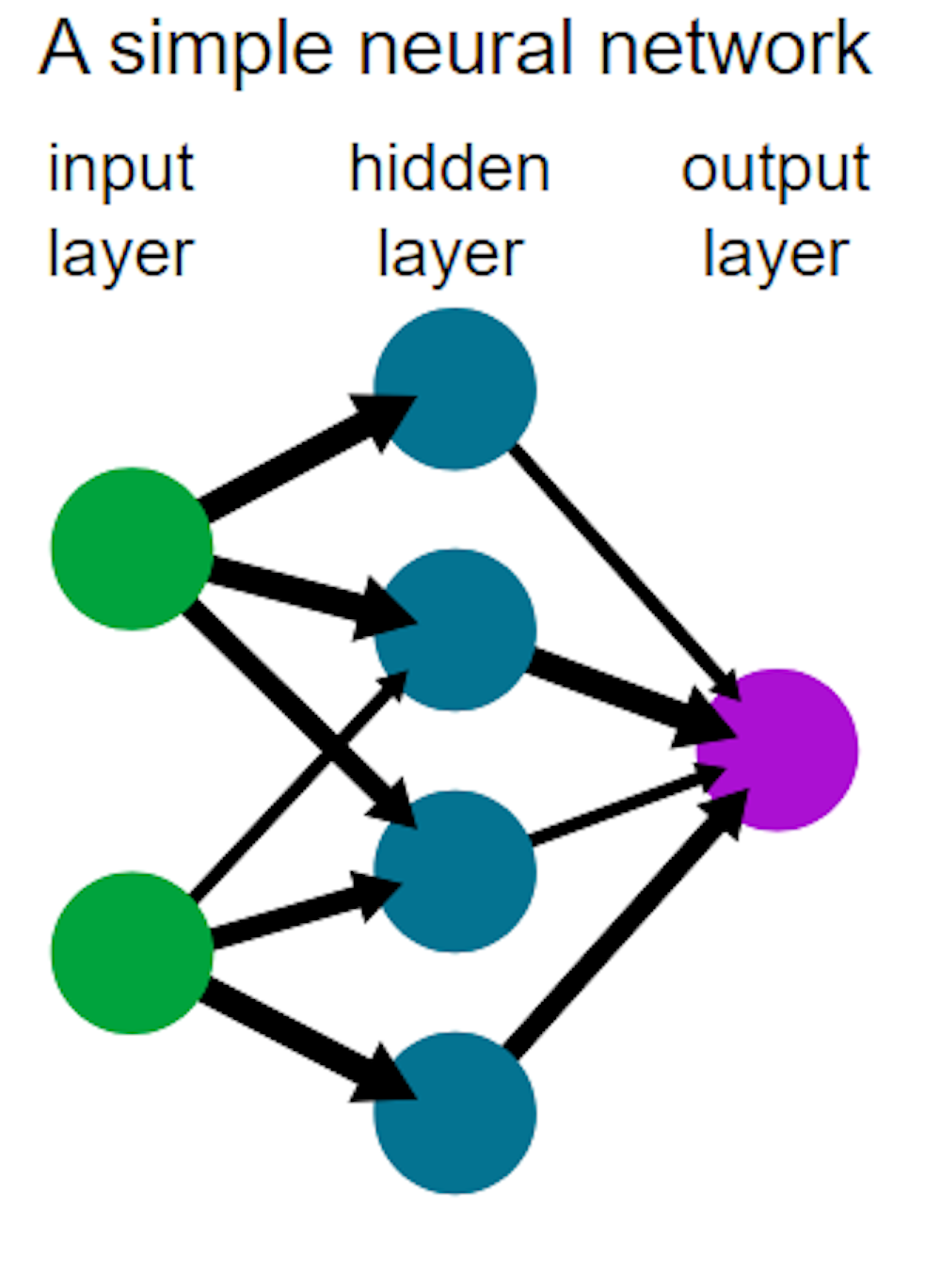
A diagram with three columns of dots, two on the left, four in the center and one on the right, with arrows connecting the dots from left to right
In neural networks, the strength of the connections between ‘neurons’ changes as data passes from the input layer through hidden layers to the output layer, enabling the network to ‘learn’ patterns. Wiso via Wikimedia Commons

Many AI systems are built on deep learning neural networks, which in some ways emulate the human brain. These networks contain interconnected “neurons” with variables or “parameters” that affect the strength of connections between the neurons. As a naïve network is presented with training data, it “learns” how to classify the data by adjusting these parameters. In this way, the AI system learns to classify data it hasn’t seen before. It doesn’t memorize what each data point is, but instead predicts what a data point might be.

Many of the most powerful AI systems contain trillions of parameters. Because of this, the reasons AI systems make the decisions that they do are often opaque. This is the AI explainability problem – the impenetrable black box of AI decision-making.

Consider a variation of the “Trolley Problem.” Imagine that you are a passenger in a self-driving vehicle, controlled by an AI. A small child runs into the road, and the AI must now decide: run over the child or swerve and crash, potentially injuring its passengers. This choice would be difficult for a human to make, but a human has the benefit of being able to explain their decision. Their rationalization – shaped by ethical norms, the perceptions of others and expected behavior – supports trust.

In contrast, an AI can’t rationalize its decision-making. You can’t look under the hood of the self-driving vehicle at its trillions of parameters to explain why it made the decision that it did. AI fails the predictive requirement for trust.

AI behavior and human expectations

Trust relies not only on predictability, but also on normative or ethical motivations. You typically expect people to act not only as you assume they will, but also as they should. Human values are influenced by common experience, and moral reasoning is a dynamic process, shaped by ethical standards and others’ perceptions.

Unlike humans, AI doesn’t adjust its behavior based on how it is perceived by others or by adhering to ethical norms. AI’s internal representation of the world is largely static, set by its training data. Its decision-making process is grounded in an unchanging model of the world, unfazed by the dynamic, nuanced social interactions constantly influencing human behavior. Researchers are working on programming AI to include ethics, but that’s proving challenging.

The self-driving car scenario illustrates this issue. How can you ensure that the car’s AI makes decisions that align with human expectations? For example, the car could decide that hitting the child is the optimal course of action, something most human drivers would instinctively avoid. This issue is the AI alignment problem, and it’s another source of uncertainty that erects barriers to trust.

AI expert Stuart Russell explains the AI alignment problem.

Critical systems and trusting AI

One way to reduce uncertainty and boost trust is to ensure people are in on the decisions AI systems make. This is the approach taken by the U.S. Department of Defense, which requires that for all AI decision-making, a human must be either in the loop or on the loop. In the loop means the AI system makes a recommendation but a human is required to initiate an action. On the loop means that while an AI system can initiate an action on its own, a human monitor can interrupt or alter it.

While keeping humans involved is a great first step, I am not convinced that this will be sustainable long term. As companies and governments continue to adopt AI, the future will likely include nested AI systems, where rapid decision-making limits the opportunities for people to intervene. It is important to resolve the explainability and alignment issues before the critical point is reached where human intervention becomes impossible. At that point, there will be no option other than to trust AI.

Avoiding that threshold is especially important because AI is increasingly being integrated into critical systems, which include things such as electric grids, the internet and military systems. In critical systems, trust is paramount, and undesirable behavior could have deadly consequences. As AI integration becomes more complex, it becomes even more important to resolve issues that limit trustworthiness.

Can people ever trust AI?

AI is alien – an intelligent system into which people have little insight. Humans are largely predictable to other humans because we share the same human experience, but this doesn’t extend to artificial intelligence, even though humans created it.

If trustworthiness has inherently predictable and normative elements, AI fundamentally lacks the qualities that would make it worthy of trust. More research in this area will hopefully shed light on this issue, ensuring that AI systems of the future are worthy of our trust.The Conversation

Mark Bailey, Faculty Member and Chair, Cyber Intelligence and Data Science, National Intelligence University

This article is republished from The Conversation under a Creative Commons license.

Wednesday, August 16, 2023

How climate change might trigger more earthquakes and volcanic eruptions


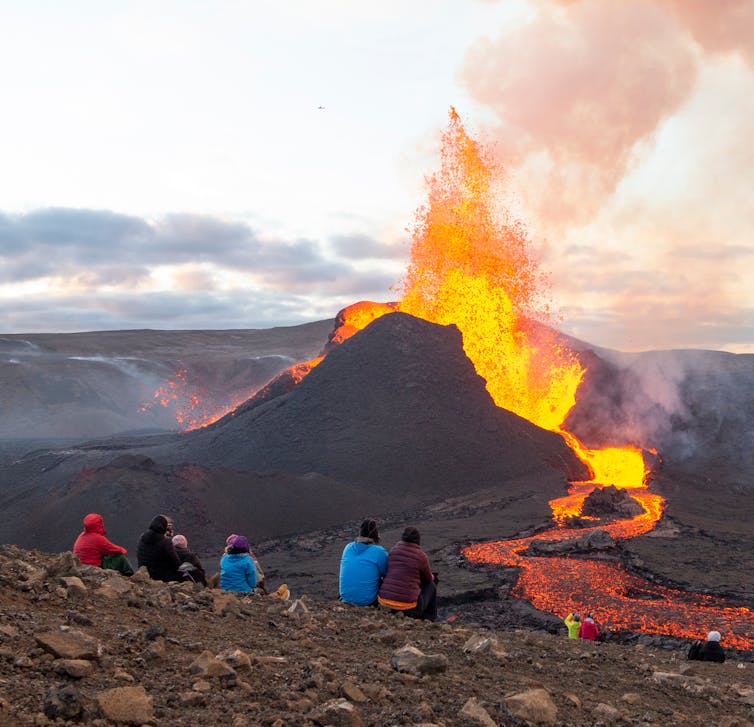
A volcanic eruption at the Reykjanes peninsula in Iceland in May 2021. Thorir Ingvarsson/Shutterstock

Earth’s climate is changing rapidly. In some areas, escalating temperatures are increasing the frequency and likelihood of wildfires and drought. In others, they are making downpours and storms more intense or accelerating the pace of glacial melting.

The past month is a stark illustration of exactly this. Parts of Europe and Canada are being devastated by wildfires, while Beijing has recorded its heaviest rainfall in at least 140 years. Looking back further, between 2000 and 2019 the world’s glaciers lost around 267 gigatonnes of ice per year. Melting glaciers contribute to rising sea levels (currently rising by about 3.3mm per year) and more coastal hazards such as flooding and erosion.

But research suggests that our changing climate may not solely influence hazards at the Earth’s surface. Climate change – and specifically rising rainfall rates and glacial melting – could also exacerbate dangers beneath the Earth’s surface, such as earthquakes and volcanic eruptions.

Drought in Europe and North America has received a lot of recent media coverage. But the Intergovernmental Panel on Climate Change’s Sixth Assessment Report in 2021 revealed that average rainfall has actually increased in many world regions since 1950. A warmer atmosphere can retain more water vapour, subsequently leading to higher levels of precipitation.

Interestingly, geologists have long identified a relationship between rainfall rates and seismic activity. In the Himalayas, for example, the frequency of earthquakes is influenced by the annual rainfall cycle of the summer monsoon season. Research reveals that 48% of Himalayan earthquakes strike during the drier pre-monsoon months of March, April and May, while just 16% occur in the monsoon season.

During the summer monsoon season, the weight of up to 4 metres of rainfall compresses the crust both vertically and horizontally, stabilising it. When this water disappears in the winter, the effective “rebound” destabilises the region and increases the number of earthquakes that occur.

The number of earthquakes that occurred seasonally from 2003-2020

A graph showing the seasonal fluctuation in earthquake occurrence with more earthquakes happening pre-monsoon.
In the pre-monsoon period, the number of earthquakes increases. Shashikant Nagale et al. (2022)/Geodesy and Geodynamics, CC BY-NC-ND

Climate change could intensify this phenomenon. Climate models project that the intensity of monsoon rainfall in southern Asia will increase in the future as a result of climate change. This could feasibly enhance the winter rebound and cause more seismic events.

The impact of water’s weight on the Earth’s crust goes beyond just precipitation; it extends to glacial ice as well. As the last ice age came to an end roughly 10,000 years ago, the thawing of heavy glacial ice masses caused parts of the Earth’s crust to rebound upwards. This process, called isostatic rebound, is evidenced by raised beaches in Scotland – some of which are up to 45 metres above current sea level.

Evidence from Scandinavia suggests that such uplift, coupled with the destabilisation of the region’s tectonics, triggered numerous earthquake events between 11,000 and 7,000 years ago. Some of these earthquakes even exceeded a magnitude of 8.0 which indicates severe destruction and loss of life. The concern is that the continued melting of glacial ice today could result in similar effects elsewhere.

Raised beaches at Tongue Bay, Scotland.
Raised beaches at Tongue Bay in Scotland. Patrick Bailey/Royal Scottish Geographical Society, CC BY-NC-ND

How about volcanic activity?

Research has also found a correlation between glacial-load changes on the Earth’s crust and the occurrence of volcanic activity. Approximately 5,500–4,500 years ago, Earth’s climate briefly cooled and glaciers began to expand in Iceland. Analysis of volcanic ash deposits spread throughout Europe suggest that volcanic activity in Iceland markedly reduced during this period.

There was a subsequent increase in volcanic activity following the end of this cool period, albeit with a delay of several hundred years.

This phenomenon can be explained by the weight of glaciers compressing both the Earth’s crust and the underlying mantle (the mostly solid bulk of Earth’s interior). This kept the material that makes up the mantle under higher pressure, preventing it from melting and forming the magma required for volcanic eruptions.

However, deglaciation and the associated loss of weight on the Earth’s surface allowed a process called decompression melting to occur, where lower pressure facilitates melting in the mantle. Such melting resulted in the formation of the liquid magma that fuelled the subsequent volcanic activity in Iceland.

Even today, this process is responsible for driving some volcanic activity in Iceland. Eruptions at two volcanoes, Grímsvötn and Katla, consistently occur during the summer period when glaciers retreat.

It is therefore feasible that ongoing glacial retreat due to global warming could potentially increase volcanic activity in the future. However, the time lag between glacial changes and the volcanic response is reassuring for now.

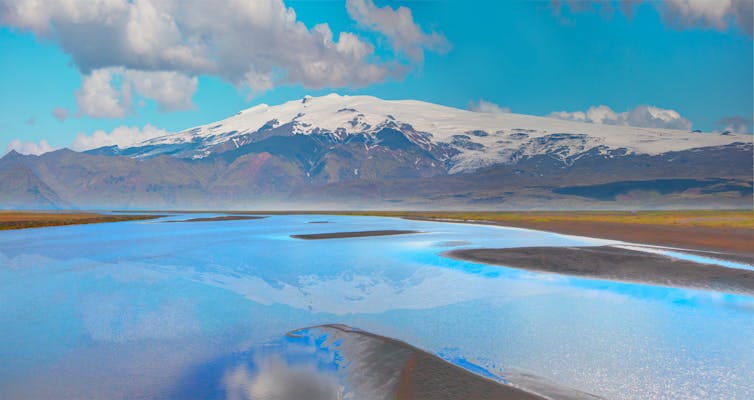
The Katla volcano covered by the Mýrdalsjökull glacier.
The Katla volcano covered by the Mýrdalsjökull glacier. muratart/Shutterstock

The impacts of a changing climate are becoming more evident, with unusual weather events having become the norm rather than the exception. However, the indirect impacts of climate change on the ground beneath our feet are neither widely known or discussed.

This must change if we are to minimise the effects of the changing climate that have already been set firmly in motion.


Imagine weekly climate newsletter

Don’t have time to read about climate change as much as you’d like?
Get a weekly roundup in your inbox instead. Every Wednesday, The Conversation’s environment editor writes Imagine, a short email that goes a little deeper into just one climate issue. Join the 20,000+ readers who’ve subscribed so far.The Conversation


Matthew Blackett, Reader in Physical Geography and Natural Hazards, Coventry University

This article is republished from The Conversation under a Creative Commons license.

Sunday, July 23, 2023

Half of all South Africans are overweight or obese. Warning labels on unhealthy foods help change that


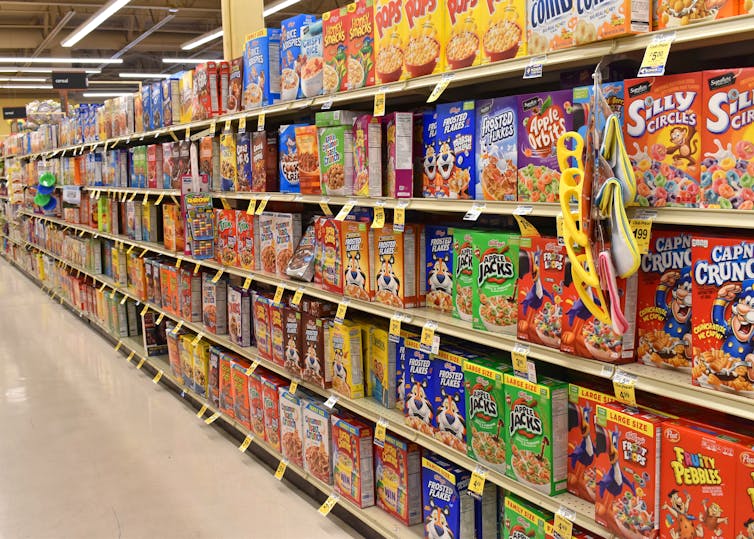
Unhealthy diets are a major risk factor for diseases like cancers, diabetes. Sheila Fitzgerald/Shutterstock

South Africa’s national health department recently invited public comment on regulations for warning labels on food packaging. The regulations specify how pre-packaged food should be labelled. Broadly speaking, “front-of-pack” labels provide information about the overall nutritional quality of foods and beverages.

The aim is to allow consumers to make healthier food choices. The proposed rule is that food products containing added saturated fat, added sugar, or added sodium, and which exceed prescribed cut-off values, must have a warning label.

An example of the warning label proposed for food containing high sugar, fat or salt.

Globally there’s been an increase in the availability and consumption of unhealthy food. This has contributed to bad health outcomes, including a rise in overweight and obesity.

Unhealthy diet is a major risk factor for noncommunicable diseases such as heart attacks, cancers and diabetes. People who are overweight or obese are at greater risk of developing these conditions.

The figures in South Africa are especially worrying. Half of all adults are either overweight (23%) or obese (27%). Noncommunicable diseases account for 59.3% of reported deaths in the country.

The effectiveness of front-of-pack warning labels is supported by international evidence. The adoption of these nutrition warnings can help combat obesity, cardiovascular disease, type 2 diabetes and some cancers. Several countries have introduced them, including Singapore (1998), Thailand (2007), Chile (approved in 2012, implemented in 2016), Ecuador (2013), Indonesia (2014), Mexico (2016) and Colombia (2022).

Local evidence has supported international evidence and found that South African consumers have a positive attitude towards warning labels on ultra-processed foods and drinks. When asked if they would be open to having warning labels on food, study participants said that warning labels were easy to understand and would assist them in quickly identifying unhealthy products.

The content of the regulations

In addition to the warning labels, the regulations also introduce marketing restrictions.

Regulation 52 relates to any packaged food with front-of-pack warning labels. The regulation limits the advertisement of these foods in various ways. It prohibits the use of celebrities and cartoon characters, competitions, gifts, collectable items and other items that may appeal to children. The abuse of positive family values to encourage consumption of unhealthy food is also prohibited. The advertisements are also required to have a warning.

This is line with the World Health Organisation’s (WHO) recommendations to implement evidence-based policies, which include mandatory front-of-pack warning labels and marketing restrictions on unhealthy foods and beverages. In particular, the WHO has noted that an unhealthy food environment includes the promotion or marketing of unhealthy foods and has linked this to the undermining of children’s rights.

In my opinion as a public health law and policy researcher, some aspects of the regulations deserve commendation.

The first is the fact that the front-of-pack warning labels are mandatory. This allows for the regulation of unhealthy products that play a role in noncommunicable disease development.

The second relates to the inclusion of a mandatory warning icon for sweeteners alongside sugar, salt and saturated fat. These are important food components to regulate, considering the noncommunicable disease and obesity crisis in South Africa.

In addition, the limitations and prohibitions on when nutrition and health claims can be made are beneficial. In particular, section 50 states that products required to have a warning label may not include any health claims.

Another noteworthy inclusion is the fact that exceptions have been made for small-scale producers. This removes a potential barrier to South Africa’s informal food economy and small and micro food businesses.

What’s missing

There are a few areas of the regulations that could potentially be strengthened.

To give effect to the purpose of the marketing restrictions, the regulations should define advertising or advertisements. We, at the SAMRC/Centre for Health Economics and Decision Science, propose looking at the law in Chile. It defines advertising to include all forms of promotion, communication, recommendation, propaganda, information or action aimed at promoting the consumption of a certain product.

The section that restricts the use of competitions, tokens, gifts or collectable items which appeal to children is a great addition. This section should be clarified to ensure that in this context children are understood as persons under 18. This will align with the Constitution of South Africa and the Children’s Act 38 of 2005.

The regulations should prohibit depicting children on products which carry a front-of-pack warning label. Any advertising in places where children gather, like schools and clinics, should also be prohibited. These are both restrictions suggested by the WHO to protect children from the harms of marketing.

To ensure that this regulation is effective, the Department of Communications and Digital Technologies and the Department of Education need to extend the protection of children from unhealthy foods and beverages as part of their mandate. This will allow for more comprehensive restrictions.The Conversation

Sameera Mahomedy, Researcher in Law and Policy, SAMRC/Centre for Health Economics and Decision Science - PRICELESS SA, University of the Witwatersrand

This article is republished from The Conversation under a Creative Commons license.
Wednesday, May 3, 2023

Generative AI: 5 essential reads about the new era of creativity, job anxiety, misinformation, bias and plagiarism


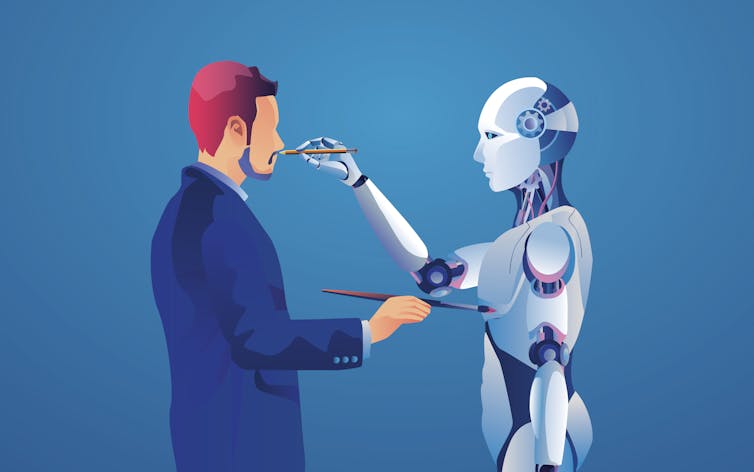
What does generative AI mean for the human need to create, work and seek the truth? Krerksak Woraphoomi/iStock via Getty Images

The light and dark sides of AI have been in the public spotlight for many years. Think facial recognition, algorithms making loan and sentencing recommendations, and medical image analysis. But the impressive – and sometimes scary – capabilities of ChatGPT, DALL-E 2 and other conversational and image-conjuring artificial intelligence programs feel like a turning point.

The key change has been the emergence within the last year of powerful generative AI, software that not only learns from vast amounts of data but also produces things – convincingly written documents, engaging conversation, photorealistic images and clones of celebrity voices.

Generative AI has been around for nearly a decade, as long-standing worries about deepfake videos can attest. Now, though, the AI models have become so large and have digested such vast swaths of the internet that people have become unsure of what AI means for the future of knowledge work, the nature of creativity and the origins and truthfulness of content on the internet.

Here are five articles from our archives that take the measure of this new generation of artificial intelligence.

1. Generative AI and work

A panel of five AI experts discussed the implications of generative AI for artists and knowledge workers. It’s not simply a matter of whether the technology will replace you or make you more productive.

University of Tennessee computer scientist Lynne Parker wrote that while there are significant benefits to generative AI, like making creativity and knowledge work more accessible, the new tools also have downsides. Specifically, they could lead to an erosion of skills like writing, and they raise issues of intellectual property protections given that the models are trained on human creations.

University of Colorado Boulder computer scientist Daniel Acuña has found the tools to be useful in his own creative endeavors but is concerned about inaccuracy, bias and plagiarism.

University of Michigan computer scientist Kentaro Toyama wrote that human skill is likely to become costly and extraneous in some fields. “If history is any guide, it’s almost certain that advances in AI will cause more jobs to vanish, that creative-class people with human-only skills will become richer but fewer in number, and that those who own creative technology will become the new mega-rich.”

Florida International University computer scientist Mark Finlayson wrote that some jobs are likely to disappear, but that new skills in working with these AI tools are likely to become valued. By analogy, he noted that the rise of word processing software largely eliminated the need for typists but allowed nearly anyone with access to a computer to produce typeset documents and led to a new class of skills to list on a resume.

University of Colorado Anschutz biomedical informatics researcher Casey Greene wrote that just as Google led people to develop skills in finding information on the internet, AI language models will lead people to develop skills to get the best output from the tools. “As with many technological advances, how people interact with the world will change in the era of widely accessible AI models. The question is whether society will use this moment to advance equity or exacerbate disparities.”

2. Conjuring images from words

Generative AI can seem like magic. It’s hard to imagine how image-generating AIs can take a few words of text and produce an image that matches the words.

A gloved hand in the foreground partially obscures a computer screen displaying four panels of similar images of a young man in profile with pink hair
A few keywords – pink hair, Asian boy, cyberpunk, stadium jacket, Manga – yield striking and believable images of a person who never existed. Richard A. Brooks/AFP via Getty Images

Hany Farid, a University of California, Berkeley computer scientist who specializes in image forensics, explained the process. The software is trained on a massive set of images, each of which includes a short text description.

“The model progressively corrupts each image until only visual noise remains, and then trains a neural network to reverse this corruption. Repeating this process hundreds of millions of times, the model learns how to convert pure noise into a coherent image from any caption,” he wrote.

3. Marking the machine

Many of the images produced by generative AI are difficult to distinguish from photographs, and AI-generated video is rapidly improving. This raises the stakes for combating fraud and misinformation. Fake videos of corporate executives could be used to manipulate stock prices, and fake videos of political leaders could be used to spread dangerous misinformation.

Farid explained how it’s possible to produce AI-generated photos and video that contain watermarks verifying that they are synthetic. The trick is to produce digital watermarks that can’t be altered or removed. “These watermarks can be baked into the generative AI systems by watermarking all the training data, after which the generated content will contain the same watermark,” he wrote.

4. Flood of ideas

For all the legitimate concern about the downsides of generative AI, the tools are proving to be useful for some artists, designers and writers. People in creative fields can use the image generators to quickly sketch out ideas, including unexpected off-the-wall material.

AI as an idea generator for designers.

Rochester Institute of Technology industrial designer and professor Juan Noguera and his students use tools like DALL-E or Midjourney to produce thousands of images from abstract ideas – a sort of sketchbook on steroids.

“Enter any sentence – no matter how crazy – and you’ll receive a set of unique images generated just for you. Want to design a teapot? Here, have 1,000 of them,” he wrote. “While only a small subset of them may be usable as a teapot, they provide a seed of inspiration that the designer can nurture and refine into a finished product.”

5. Shortchanging the creative process

However, using AI to produce finished artworks is another matter, according to Nir Eisikovits and Alec Stubbs, philosophers at the Applied Ethics Center at University of Massachusetts Boston. They note that the process of making art is more than just coming up with ideas.

The hands-on process of producing something, iterating the process and making refinements – often in the moment in response to audience reactions – are indispensable aspects of creating art, they wrote.

“It is the work of making something real and working through its details that carries value, not simply that moment of imagining it,” they wrote. “Artistic works are lauded not merely for the finished product, but for the struggle, the playful interaction and the skillful engagement with the artistic task, all of which carry the artist from the moment of inception to the end result.”

Editor’s note: This story is a roundup of articles from The Conversation’s archives.The Conversation

Eric Smalley, Science + Technology Editor, The Conversation

This article is republished from The Conversation under a Creative Commons license.