Monday, June 24, 2024

Records of Pompeii’s survivors have been found – and archaeologists are starting to understand how they rebuilt their lives


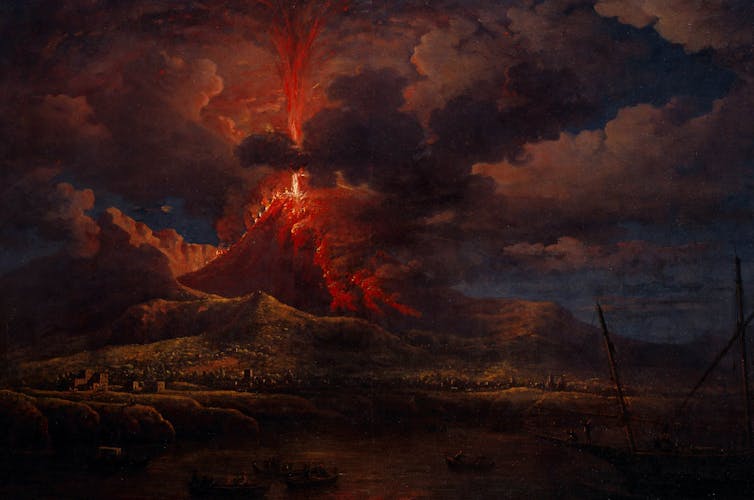
In popular culture, the eruption is usually depicted as an apocalyptic event. Photo 12/Universal Images Group via Getty Images

On Aug. 24, in A.D. 79, Mount Vesuvius erupted, shooting over 3 cubic miles of debris up to 20 miles (32.1 kilometers) in the air. As the ash and rock fell to Earth, it buried the ancient cities of Pompeii and Herculaneum.

According to most modern accounts, the story pretty much ends there: Both cities were wiped out, their people frozen in time.

It only picks up with the rediscovery of the cities and the excavations that started in earnest in the 1740s.

But recent research has shifted the narrative. The story of the eruption of Mount Vesuvius is no longer one about annihilation; it also includes the stories of those who survived the eruption and went on to rebuild their lives.

The search for survivors and their stories has dominated the past decade of my archaeological fieldwork, as I’ve tried to figure out who might have escaped the eruption. Some of my findings are featured in an episode of the new PBS documentary, “Pompeii: The New Dig.”

‘Pompeii: The New Dig’ highlights recent discoveries that have helped historians better understand life before and after the eruption of Mount Vesuvius.

Making it out alive

Pompeii and Herculaneum were two wealthy cities on the coast of Italy just south of Naples. Pompeii was a community of about 30,000 people that hosted thriving industry and active political and financial networks. Herculaneum, with a population of about 5,000, had an active fishing fleet and a number of marble workshops. Both economies supported the villas of wealthy Romans in the surrounding countryside.

In popular culture, the eruption is usually depicted as an apocalyptic event with no survivors: In episodes of the TV series “Doctor Who” and “Loki,” everyone in Pompeii and Herculaneum dies.

But the evidence that people could have escaped was always there.

The eruption itself continued for over 18 hours. The human remains found in each city account for only a fraction of their populations, and many objects you might have expected to have remained and be preserved in ash are missing: Carts and horses are gone from stables, ships missing from docks, and strongboxes cleaned out of money and jewelry.

All of this suggests that many – if not most – of the people in the cities could have escaped if they fled early enough.

Some archaeologists have always assumed that some people escaped. But searching for them has never been a priority.

So I created a methodology to determine if survivors could be found. I took Roman names unique to Pompeii or Herculaneum – such as Numerius Popidius and Aulus Umbricius – and searched for people with those names who lived in surrounding communities in the period after the eruption. I also looked for additional evidence, such as improved infrastructure in neighboring communities to accommodate migrants.

After eight years of scouring databases of tens of thousands of Roman inscriptions on places ranging from walls to tombstones, I found evidence of over 200 survivors in 12 cities. These municipalities are primarily in the general area of Pompeii. But they tended to be north of Mount Vesuvius, outside the zone of the greatest destruction.

It seems as though most survivors stayed as close as they could to Pompeii. They preferred to settle with other survivors, and they relied on social and economic networks from their original cities as they resettled.

Some migrants prosper

Some of the families that escaped apparently went on to thrive in their new communities.

The Caltilius family resettled in Ostia – what was then a major port city to the north of Pompeii, 18 miles from Rome. There, they founded a temple to the Egyptian deity Serapis. Serapis, who wore a basket of grain on his head to symbolize the bounty of the earth, was popular in harbor cities like Ostia dominated by the grain trade. Those cities also built a grand, expensive tomb complex decorated with inscriptions and large portraits of family members.

Members of the Caltilius family married into another family of escapees, the Munatiuses. Together, they created a wealthy, successful extended family.
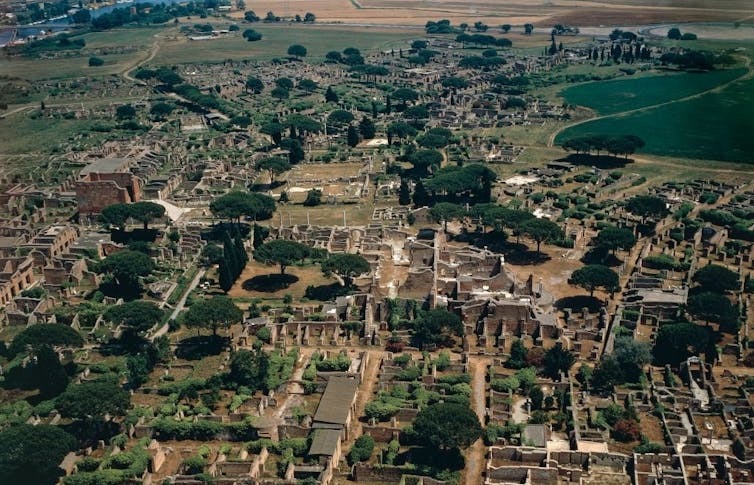
Aerial view depicting the ruins of a city discovered during archaeological excavations.
Some of the survivors resettled in Ostia, a port city north of Pompeii. DEA Picture Library/Getty Images

The second-busiest port city in Roman Italy, Puteoli – what’s known as Pozzuoli today – also welcomed survivors from Pompeii. The family of Aulus Umbricius, who was a merchant of garum, a popular fermented fish sauce, resettled there. After reviving the family garum business, Aulus and his wife named their first child born in their adopted city Puteolanus, or “the Puteolanean.”

Others fall on hard times

Not all the survivors of the eruption were wealthy or went on to find success in their new communities. Some had already been poor to begin with. Others seemed to have lost their family fortunes, perhaps in the eruption itself.

Fabia Secundina from Pompeii – apparently named for her grandfather, a wealthy wine merchant – also ended up in Puteoli. There, she married a gladiator, Aquarius the retiarius, who died at the age of 25, leaving her in dire financial straits.

Three other very poor families from Pompeii – the Avianii, Atilii and Masuri families – survived and settled in a small, poorer community called Nuceria, which goes by Nocera today and is about 10 miles (16.1 kilometers) east of Pompeii.

According to a tombstone that still exists, the Masuri family took in a boy named Avianius Felicio as a foster son. Notably, in the 160 years of Roman Pompeii, there was no evidence of any foster children, and extended families usually took in orphaned children. For this reason, it’s likely that Felicio didn’t have any surviving family members.

This small example illustrates the larger pattern of the generosity of migrants – even impoverished ones – toward other survivors and their new communities. They didn’t just take care of each other; they also donated to the religious and civic institutions of their new homes.

For example, the Vibidia family had lived in Herculaneum. Before it was destroyed by the eruption of Vesuvius, they had given lavishly to help fund various institutions, including a new temple of Venus, the Roman goddess of love, beauty and fertility.

One female family member who survived the eruption appears to have continued the family’s tradition: Once settled in her new community, Beneventum, she donated a very small, poorly made altar to Venus on public land given by the local city council.

How would survivors be treated today?

While the survivors resettled and built lives in their new communities, government played a role as well.

The emperors in Rome invested heavily in the region, rebuilding properties damaged by the eruption and building new infrastructure for displaced populations, including roads, water systems, amphitheaters and temples.

This model for post-disaster recovery can be a lesson for today. The costs of funding the recovery never seems to have been debated. Survivors were not isolated into camps, nor were they forced to live indefinitely in tent cities. There’s no evidence that they encountered discrimination in their new communities.

Instead, all signs indicate that communities welcomed the survivors. Many of them went on to open their own businesses and hold positions in local governments. And the government responded by ensuring that the new populations and their communities had the resources and infrastructure to rebuild their lives.The Conversation

Steven L. Tuck, Professor of Classics, Miami University

This article is republished from The Conversation under a Creative Commons license.

Sunday, June 16, 2024

Sunzi, ‘shì’ and strategy: How to read ‘Art of War’ the way its author intended


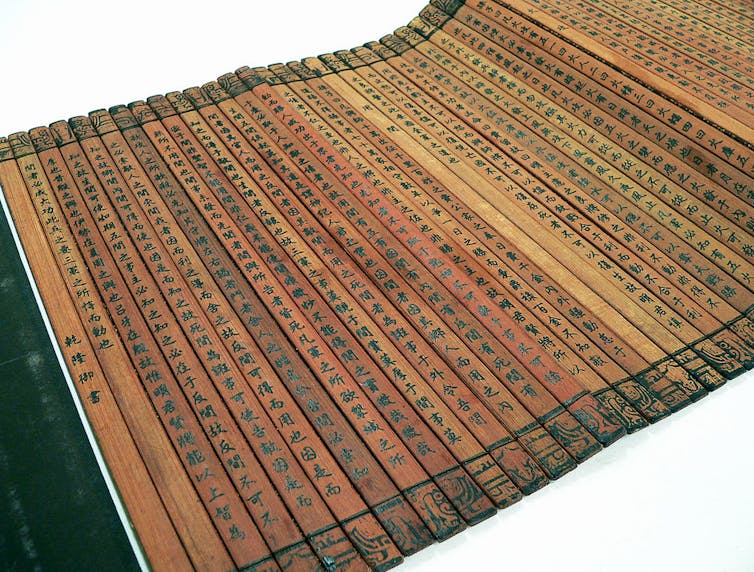
A copy of the ‘Art of War’ from a collection at the University of California, Riverside. vlasta2/Flickr, CC BY-NC-ND

In the mid-1990s, I picked up the military classic “Art of War” hoping to find insight into my new career as an officer in the United States Marine Corps.

I was not the only one looking for insights from the sage Sunzi, also known as Sun Tzu, who died over 2,500 years ago. “Art of War” has long been mined for an understanding of China’s strategic tradition and universal military truths. The book’s maxims, such as “know the enemy and know yourself,” are routinely quoted in military texts, as well as business and management books.

Initially, I was disappointed. It seemed Sunzi’s advice was either common sense or in agreement with Western military classics. However, a few years later the Marine Corps trained me as a China scholar, and I spent much of my career working on U.S. policy in the Indo-Pacific region. This deepened my desire to understand how leaders in the People’s Republic of China see the world and choose strategies. Looking for insight, I turned to classical Chinese philosophy and finally encountered concepts that helped illuminate the unique perspective of Sunzi’s “Art of War.”

Today, I am an academic researching how Chinese philosophy and foreign policy intersect. To comprehend “Art of War,” it helps readers to approach the text from the worldview of its author. That means reading Sunzi’s advice through the prism of classical Chinese metaphysics, which is deeply shaped by the philosophy of Daoism.

Daoist roots

China’s intellectual tradition is rooted in the Warring States period from the 5th to 3rd century B.C.E., the era during which Sunzi is thought to have lived. Though a time of conflict, it was also a time of cultural and intellectual development that led to the rise of Daoism and Confucianism.

A weathered painting of an Asian man with a small beard and mustache, wearing a yellow and black robe.
Sunzi’s writing has had a significant impact on both Chinese and foreign politics. Pictures From History/Universal Images Group via Getty Images

Confucian philosophy focuses on maintaining proper social relationships as the key to moral behavior and and social harmony. Daoism, on the other hand, is more concerned with metaphysics: trying to understand the workings of the natural world and drawing analogies about how humans should act.

Daoism views existence as composed of constant cycles of change, in which power ebbs and flows. Meanwhile, the “Dào,” or “the way,” directs all things in nature toward fulfilling their inherent potential, like water flowing downhill.

Helping nature take its course

The Chinese word for this concept of “situational potential” is 勢, or “shì” – the name of Chapter Five in “Art of War.” Almost every Western version translates it differently, but it is key to the military concepts Sunzi employs.

For example, Chapter Five explains how those who are “expert at war” are not overly concerned with individual soldiers. Instead, effective leaders are able to determine the potential in the situation and put themselves in position to take advantage of it.

This is why later chapters spend so much time discussing geography and deployment of forces, rather than fighting techniques. One does more to damage an opponent’s potential by undermining their scheme than by merely killing their soldiers. Sunzi is concerned about long supply lines, because they lower an army’s potential by making it harder to move and vulnerable to disruption. A general who understands potential can evaluate troops, terrain and scheme, then arrange the battlefield to “subdue the enemy without fighting.”

A Chinese painting of a battle scene, with soldiers in blue outfits, and some text in the upper-right corner.
Painting of a battle between Chinese and Vietnamese forces during the Qing invasion of Vietnam in 1788. Pictures From History/Universal Images Group via Getty Images

In Daoist thought, the correct way to manage each situation’s potential is to act with 無為, “wúwéi,” which literally translates as “nonaction.” However, the key idea is to disturb the natural order as little as possible, taking the minimum action needed to allow the situation’s potential to be fulfilled. The term does not appear in “Art of War,” but a contemporary reader of Sunzi’s would have been familiar with the connection between nurturing “shì” and acting with “wúwéi.”

The importance of acting with “wúwéi” is illustrated by the Confucian philosopher Mengzi’s story about a farmer who pulled on his corn stalks in an attempt to help them grow tall, but killed the crop instead. One does not help corn grow by forcing it but by understanding its natural potential and acting accordingly: ensuring the soil is good, weeds are removed and water is sufficient. Actions are most effective when they nurture potential, not when they try to force it.

From the battlefield to the UN

In a Daoist understanding, leaders hoping to chart an effective strategy must read the situation, discover its potential, and position their armies or states in the best position to take advantage of “shì.” They act with “wúwéi” to nurture situations, rather than force, which could disturb the situation and cause chaos.

Therefore, in foreign policy, a decision-maker should attempt to make small policy adjustments as early as possible to slowly manage the development of the international environment. This approach is evident in Beijing’s use of “guānxì.” Meaning “relationships,” the Chinese term carries a strong sense of mutual obligation.

For example, the PRC waged a decadeslong effort to take over the United Nations “China seat” from Taiwan, where the Republic of China government had fled after Communists’ victory in the civil war. Beijing accomplished that by slowly building friendships, identifying shared strategic interests and accruing owed favors with many small states around the world, until in 1971 it had enough votes in the General Assembly.

Trend-watching today

The concept of “shì” also provides a lens for understanding the PRC’s increasing pressure on Taiwan, a self-ruled island that Beijing claims is its own territory.

A night scene of a silhouetted tank with lit-up skyscrapers in the distance.
A Taiwanese tank used in previous conflicts and on display for tourists in Kinmen, Taiwan, is seen silhouetted against the skyline of the mainland city of Xiamen. Chris McGrath/Getty Images

Sunzi might say that discerning the current trend in the Taiwan Strait is more essential than conventional questions about comparative military strength. Several factors could push Taiwan closer to Beijing, including the island’s loss of diplomatic allies and the pull of the PRC’s massive economy – not to mention Beijing’s growing global clout vis-à-vis the U.S. If so, shì is in Beijing’s favor, and a nudge to persuade the U.S. to stay out is all that is needed to keep the situation developing to the PRC’s advantage.

Or is the potential developing in the other direction? Such factors as a growing sense of a unique Taiwanese identity and the PRC’s troubled economic model may make closer ties with the mainland less and less appealing in Taiwan. In that case, Beijing may see a need to appear strong and dominant so Taiwan will not be lulled into counting on support from Washington, D.C.

A surface reading of Sunzi can easily support an emphasis on troop deployments, intelligence and logistics. However, an understanding of “shì” highlights Sunzi’s emphasis on evaluating and nurturing situational potential. It is not that the former are unimportant, but a decision-maker will use them differently if the goal is to manage situational trends rather than seek decisive battle.

That “Art of War” continues to top sales lists demonstrates its lasting appeal. However, to be useful as a guide to understanding security policy and strategy, my experience in the Indo-Pacific region suggests one must dig into the principles that shaped Sunzi’s view of the world and continue to shape the view of leaders in Beijing.The Conversation

Scott D. McDonald, Non-resident Fellow, Asia-Pacific Center for Security Studies; PhD Candidate, The Fletcher School, Tufts University

This article is republished from The Conversation under a Creative Commons license.

Are older adults more vulnerable to scams? What psychologists have learned about who’s most susceptible, and when


Financial exploitation takes many forms, and it often comes from people within an older person’s social circle. prpicturesproduction/iStock via Getty Images Plus

About 1 in 6 Americans are age 65 or older, and that percentage is projected to grow. Older adults often hold positions of power, have retirement savings accumulated over the course of their lifetimes, and make important financial and health-related decisions – all of which makes them attractive targets for financial exploitation.

In 2021, there were more than 90,000 older victims of fraud, according to the FBI. These cases resulted in US$1.7 billion in losses, a 74% increase compared with 2020. Even so, that may be a significant undercount, since embarrassment or lack of awareness keeps some victims from reporting.

Financial exploitation represents one of the most common forms of elder abuse. Perpetrators are often individuals in the victims’ inner social circles – family members, caregivers or friends – but can also be strangers.

When older adults experience financial fraud, they typically lose more money than younger victims. Those losses can have devastating consequences, especially since older adults have limited time to recoup – dramatically reducing their independence, health and well-being.

But older adults have been largely neglected in research on this burgeoning type of crime. We are psychologists who study social cognition and decision-making, and our research lab at the University of Florida is aimed at understanding the factors that shape vulnerability to deception in adulthood and aging.

Defining vulnerability

Financial exploitation involves a variety of exploitative tactics, such as coercion, manipulation, undue influence and, frequently, some sort of deception.

The majority of current research focuses on people’s ability to distinguish between truth and lies during interpersonal communication. However, deception occurs in many contexts – increasingly, over the internet.

Our lab conducts laboratory experiments and real-world studies to measure susceptibility under various conditions: investment games, lie/truth scenarios, phishing emails, text messages, fake news and deepfakes – fabricated videos or images that are created by artificial intelligence technology.

To study how people respond to deception, we use measures like surveys, brain imaging, behavior, eye movement and heart rate. We also collect health-related biomarkers, such as being a carrier of gene variants that increase risk for Alzheimer’s disease, to identify individuals with particular vulnerability.

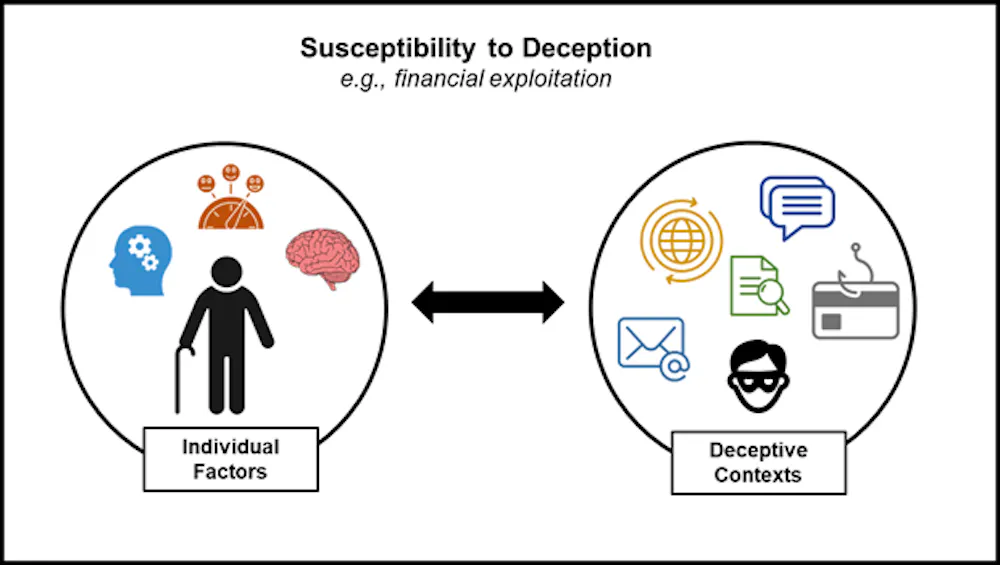
And our work shows that an older adult’s ability to detect deception is not just about their individual characteristics. It also depends on how they are being targeted.

A figure with two circles and an arrow between them. One circle shows icons that symbolize individual susceptibility to deception -- like a brain, and a walking cane -- while the other has icons of types of deception, like mail or a text message.
Vulnerability depends not only on the person, but also the type of fraud being used. Natalie Ebner and Didem Pehlivanoglu

Individual risk factors

Better cognition, social and emotional capacities, and brain health are all associated with less susceptibility to deception.

Cognitive functions, such as how quickly our brain processes information and how well we remember it, decline with age and impact decision-making. For example, among people around 70 years of age or older, declines in analytical thinking are associated with reduced ability to detect false news stories.

Additionally, low memory function in aging is associated with greater susceptibility to email phishing. Further, according to recent research, this correlation is specifically pronounced among older adults who carry a gene variant that is a genetic risk factor for developing Alzheimer’s disease later in life. Indeed, some research suggests that greater financial exploitability may serve as an early marker of disease-related cognitive decline.

Social and emotional influences are also crucial. Negative mood can enhance somebody’s ability to detect lies, while positive mood in very old age can impair a person’s ability to detect fake news.

Lack of support and loneliness exacerbate susceptibility to deception. Social isolation during the COVID-19 pandemic has led to increased reliance on online platforms, and older adults with lower digital literacy are more vulnerable to fraudulent emails and robocalls.

An older woman and man sit at a table outside, with a laptop open in front of them.
Isolation during the COVID-19 pandemic has increased aging individuals’ vulnerability to online scams. ilkercelik/E+ via Getty Images

Finally, an individual’s brain and body responses play a critical role in susceptibility to deception. One important factor is interoceptive awareness: the ability to accurately read our own body’s signals, like a “gut feeling.” This awareness is correlated with better lie detection in older adults.

According to a first study, financially exploited older adults had a significantly smaller size of insula – a brain region key to integrating bodily signals with environmental cues – than older adults who had been exposed to the same threat but avoided it. Reduced insula activity is also related to greater difficulty picking up on cues that make someone appear less trustworthy.

Types of effective fraud

Not all deception is equally effective on everyone.

Our findings show that email phishing that relies on reciprocation – people’s tendency to repay what another person has provided them – was more effective on older adults. Younger adults, on the other hand, were more likely to fall for phishing emails that employed scarcity: people’s tendency to perceive an opportunity as more valuable if they are told its availability is limited. For example, an email might alert you that a coin collection from the 1950s has become available for a special reduced price if purchased within the next 24 hours.

There is also evidence that as we age, we have greater difficulty detecting the “wolf in sheep’s clothing”: someone who appears trustworthy, but is not acting in a trustworthy way. In a card-based gambling game, we found that compared with their younger counterparts, older adults are more likely to select decks presented with trustworthy-looking faces, even though those decks consistently resulted in negative payouts. Even after learning about untrustworthy behavior, older adults showed greater difficulty overcoming their initial impressions.

Reducing vulnerability

Identifying who is especially at risk for financial exploitation in aging is crucial for preventing victimization.

We believe interventions should be tailored, instead of a one-size-fits-all approach. For example, perhaps machine learning algorithms could someday determine the most dangerous types of deceptive messages that certain groups encounter – such as in text messages, emails or social media platforms – and provide on-the-spot warnings. Black and Hispanic consumers are more likely to be victimized, so there is also a dire need for interventions that resonate with their communities.

Prevention efforts would benefit from taking a holistic approach to help older adults reduce their vulnerability to scams. Training in financial, health and digital literacy are important, but so are programs to address loneliness.

People of all ages need to keep these lessons in mind when interacting with online content or strangers – but not only then. Unfortunately, financial exploitation often comes from individuals close to the victim.The Conversation

Natalie C. Ebner, Professor of Psychology, University of Florida and Didem Pehlivanoglu, Postdoctoral Researcher, Psychology, University of Florida

This article is republished from The Conversation under a Creative Commons license.
Monday, June 10, 2024

An American flag, a pencil sharpener − and the 10 Commandments: Louisiana’s new bill to mandate biblical displays in classrooms is the latest to push limits of religion in public schools


Controversy over displays of the Ten Commandments on government property is nothing new, but only one case about schools has reached the Supreme Court. AP Photo/Dave Martin

Louisiana is not a stranger to controversy over religion in schools. In 2023, it joined almost 20 states that require or allow officials in public schools to post the national motto, “In God We Trust.”

Now, the Bayou State could become the first in the nation to require the posting of the Ten Commandments in classrooms in public schools, colleges and universities.

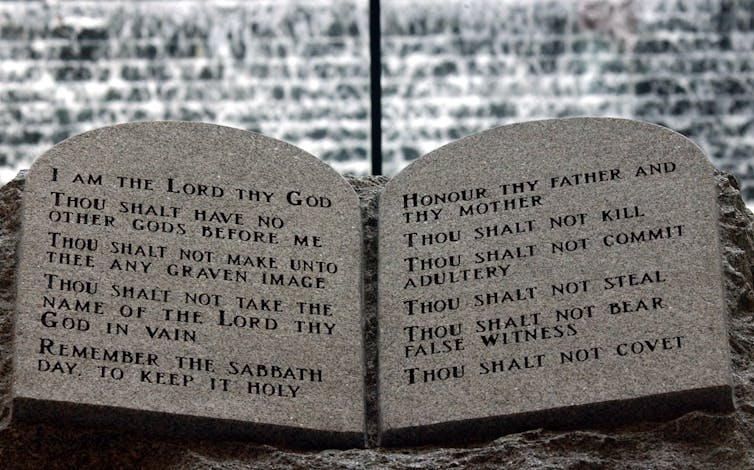
Lawmakers approved House Bill 71 on May 28, 2024, though Gov. Jeff Landry has not yet signed it into law. The bill would require officials in public schools, including colleges and universities, to post a specific version of the Ten Commandments. The text is similar to the King James translation of the Bible used in many Protestant churches.

Officials must post a context statement highlighting the role of the Ten Commandments in American history and may also display the Pilgrims’ Mayflower Compact, the Declaration of Independence and the Northwest Ordinance of 1787, a federal enactment to settle the frontier – and the earliest congressional document encouraging the creation of schools.

One of the bill’s supporters, state Sen. J. Adam Bass, defended it on the grounds that its “purpose is not solely religious.” He told fellow lawmakers that the Ten Commandments are important because of their “historical significance, which is simply one of many documents that display the history of our country and foundation of our legal system.”

As someone who teaches and researches law around religion and education, I believe the bill is problematic. It is likely to invite litigation at a time when the Supreme Court’s thinking on religion and state is shifting.

How SCOTUS has ruled before

Litigation over the Ten Commandments is not new. More than 40 years ago, in Stone v. Graham, the Supreme Court rejected a Kentucky statute that mandated displays of the Ten Commandments in classrooms.

The court reasoned that the underlying law violated the First Amendment’s establishment clause – “Congress shall make no law respecting an establishment of religion” – because the mandate lacked a secular purpose.

The justices were not persuaded by a small notation on posters that described the Ten Commandments as the “fundamental legal code of Western Civilization and the Common Law of the United States.”

Twenty-five years later, the Supreme Court again took up cases challenging public displays of the Ten Commandments, although not in schools. This time, the justices reached mixed results.

The first arose in Kentucky, where officials had erected a county courthouse display about texts including the Ten Commandments, the Magna Carta, the Declaration of Independence and a biblical citation. In a 2005 ruling in McCreary County, Kentucky v. American Civil Liberties Union of Kentucky, the five-person majority agreed that display of the Ten Commandments violated the establishment clause, largely because it lacked a secular legislative purpose.

On the same day, however, the Supreme Court reached the opposite result in Van Orden v. Perry, a case from Texas. The court upheld the constitutionality of a display of the Ten Commandments on the grounds of the state capitol as one of 17 monuments and 21 historical markers commemorating Texas’ history.

Unlike the fairly new display in Kentucky, the one in Texas, which had existed since the early 1960s, was erected using private funds. The court permitted the Ten Commandments to remain because, despite their religious significance, the monument was a more passive display than in Stone: spread out across 22 acres, rather than posted on the courthouse door.

The dome of a white, ornate building rises in the background, and a gray monument with writing sits in the foreground.
The 5-foot-tall stone slab bearing the Ten Commandments near the Texas State Capitol. A challenge to the display reached the Supreme Court. AP Photo/Harry Cabluck

Louisiana’s law

Louisiana’s bill would require public school officials to display framed copies of the Ten Commandments in all public school classrooms. Posters must be at least 11-by-14 inches and be printed with a large, easily readable font. The proposal allows, but does not require, officials to use state funds to purchase these posters. Displays can also be received as donations or purchased with gifted funds.

The bill’s author, state Rep. Dodie Horton, previously sponsored Louisiana’s law mandating that “In God We Trust” be posted in public school classrooms.

In defending the Ten Commandments proposal, she said it honors the country’s religious origins.

“The Ten Commandments are the basis of all laws in Louisiana,” she told fellow lawmakers, “and given all the junk our children are exposed to in classrooms today, it’s imperative that we put the Ten Commandments back in a prominent position.”

Justifying the bill, Horton pointed to Kennedy v. Bremerton School District, a 2022 Supreme Court decision. Here, the justices held that educational officials could not prevent a football coach from praying on the field at the end of games, because he engaged in personal religious observance protected by the First Amendment.

“The landscape has changed,” she said.

New frontier

Indeed it has.

For decades, the Supreme Court used a set of criteria often called the Lemon v. Kurtzman test to assess whether a government action violated the establishment clause. Under this test, when a government action or policy intersects with religion, it had to meet three criteria. A policy had to have a secular legislative purpose; its principal or primary effect could not advance religion; and it could not result in excessive entanglement between state and religious officials.

Another test the Supreme Court sometimes applied, stemming from Lynch v. Donnelly in 1984, invalidated governmental actions appearing to endorse religion.

The majority of the current court, though, abandoned both the Lemon and endorsement tests. In the majority opinion in Kennedy v. Bremerton, Justice Neil Gorsuch wrote that “the Establishment Clause must be interpreted by ‘reference to historical practices and understandings.’” He added that the court “long ago abandoned Lemon and its endorsement test offshoot.”

What that new standard means remains to be seen.

In my view, the bill’s supporters’ reliance on Kennedy is mistaken. That decision upheld voluntary, private prayer, not mandated postings of religious statements, overlooking many students’ beliefs.

More than 80 years ago, in West Virginia State Board of Education v. Barnette the Supreme Court decided in a 6-3 opinion that students cannot be compelled to participate in saluting the American flag, including the words “under God” in the Pledge of Allegiance, if doing so goes against their religious beliefs.

Under Louisiana’s new bill, students need not recite the Ten Commandments. Yet, given their distinctly religious message, I believe House Bill 71 faces a dubious future if signed into law.The Conversation

Charles J. Russo, Joseph Panzer Chair in Education and Research Professor of Law, University of Dayton

This article is republished from The Conversation under a Creative Commons license.