Sunday, November 19, 2017

What Chinese philosophers can teach us about dealing with our own grief


File 20171030 18704 iwed0k.jpg?ixlib=rb 1.1
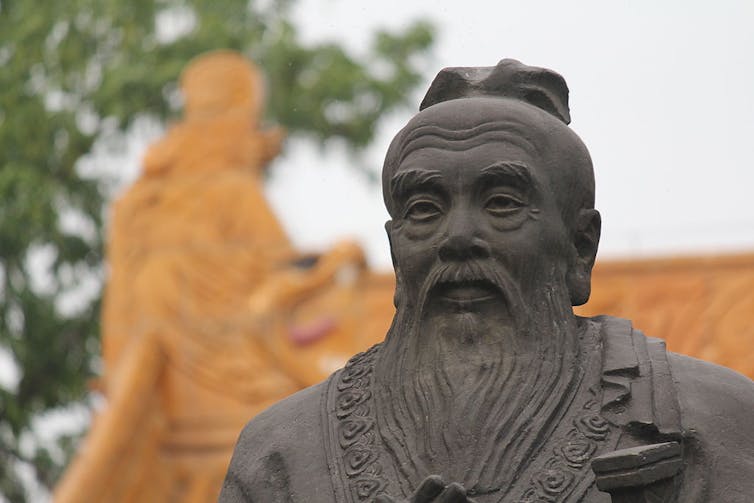
Confucius sculpture, Nanjing, China. Kevinsmithnyc, via Wikimedia Commons, CC BY-SA

November 2 is All Souls’ Day, when many Christians honor the dead. As much as we all know about the inevitability of death, we are often unable to deal with the loss of a loved one.

Our modern-day worldview could also make us believe that loss is something we should be able to quickly get over, to move on with our lives. Many of us see grieving as a kind of impediment to our ability to work, live and thrive.

As a scholar of Chinese philosophy, I spend much of my time reading, translating and interpreting early Chinese texts. It is clear that dealing with loss was a major concern for early Chinese philosophers.

So, what can we learn from them today?

Eliminating grief
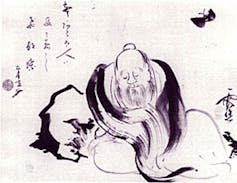

Zhuangzi butterfly dream. Ike no Taiga (Japan, 1723-1776), via Wikimedia Commons

Two influential philosophers who reflected on these issues were Zhuang Zhou and Confucius. Zhuang Zhou lived in the fourth century B.C. and is traditionally credited with writing one of the most important texts of the Daoist philosophy, “Zhuangzi.” Confucius, who lived more than a century before Zhuang Zhou, had his teachings compiled in a text written by later students, commonly known in the West as the “Analects of Confucius.”
 
On the face of it, these two philosophers offer very different responses to the “problem” of death.
Zhuang Zhou offers us a way to eliminate grief, seemingly consistent with the desire to quickly get beyond loss. In one story, Zhuang Zhou’s friend Hui Shi meets him just after Zhuang Zhou’s wife of many years has died. He finds Zhuang Zhou singing joyously and beating on a drum. Hui Shi upbraids him and says:
“This person lived with you for many years, and grew old and died. To fail to shed tears is bad enough, but to also beat on drums and sing – is this not inappropriate?”
Zhuang Zhou replies that when his wife first died, he was as upset as anyone would be following such a loss. But then he reflected on the circumstances of her origins – how she came to be through changes in the elements that make up the cosmos. He was able to shift his vision from seeing things from the narrowly human perspective to seeing them from the larger perspective of the world itself.

He realized that her death was just another of the changes of the myriad things constantly taking place in the world. Just as the seasons progress, human life generates and decays.
In reflecting on life in this way, Zhuang Zhou’s grief disappeared.

Why we need grief

Analects. Confucius and his disciples, via Wikimedia Commons

For Confucius, though, the pain of grief was a natural and necessary part of human life. It demonstrates commitment to those for whom we grieve.

Confucius suggests a three-year mourning period following the death of one’s parent. In a passage from the Analects, one of Confucius’s students, Zaiwo, asks him if it is possible to shorten this mourning period, which seems excessively long.

Confucius responds that a person who honestly cared about his parent would simply be unable to bring himself to mourn in any less serious way. For such a person, the usual joys of life just had no attraction for three years. If, like Zaiwo, someone considers shortening this period, it reveals for Confucius a lack of sufficient concern. Early Confucians, thus, followed this practice of a three-year mourning period.

Remembering our ancestors

There is more to the Confucian response to death than grief. Our encounter with others inevitably changes us. Those closest to us, according to the early Confucians, particularly family members, play the greatest role in determining who we are. In that sense, we are representatives of particular communities than detached and autonomous individuals.

After all, many of our physical features and personalities originate from our ancestors. In addition, we learn many of our attitudes, preferences and characteristic ways of acting from our families, friends and neighbors – the creators of our culture. So, when we consider the question of what we are as individuals, the answer necessarily encompasses members of our closest community.
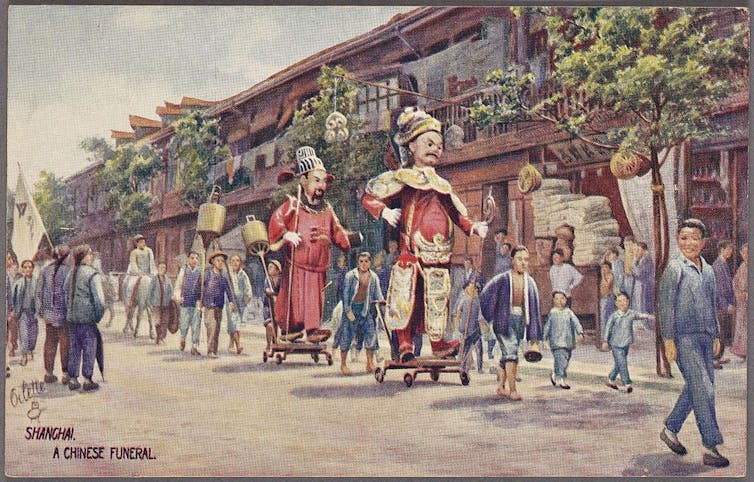
A Chinese funeral. Scan by NYPL, via Wikimedia Commons

According to the early Confucians, this acknowledgment suggested how to deal with the death of those close to us. To grieve was to honor your parent or another person who died and to commit to following their way of life .

Even if their way of life involved flaws, Confucius notes that individuals were still duty-bound to follow their way while doing their best to eliminate the flaws. In Analects 4.18, Confucius says:
“In serving your parents, you may lightly remonstrate [if your parents stray from the virtuous way]. But even if your parents are intent on not following your advice, you should still remain respectful and not turn away from them.”

Developing an understanding of grief

So how do the seemingly contrasting Daoist and Confucian approaches to grief apply to us today?
From my perspective, both views are helpful. Zhuangzi does not eliminate grief, but offers a way out of it. The Daoist response could help people find peace of mind by cultivating the ability to see the death of loved ones from a broader perspective.

The Confucian response could challenge assumptions that devalue grief. It offers us a way to find meaning in our grief. It reveals our communal influences, tests our commitments and focuses us on the ways in which we represent and carry on those who influenced us and came before us.

The ConversationUltimately, both philosophers help us understand that enduring grief is a necessary part of the process of becoming a fully thriving person. It is not something we should look to eliminate, but rather something we should appreciate or even be thankful for.

Alexus McLeod, Associate Professor of Philosophy and Asian/Asian American Studies, University of Connecticut
This article was originally published on The Conversation.

Why media freedom remains fragile in South Africa


File 20171018 32345 18kfusq.jpg?ixlib=rb 1.1
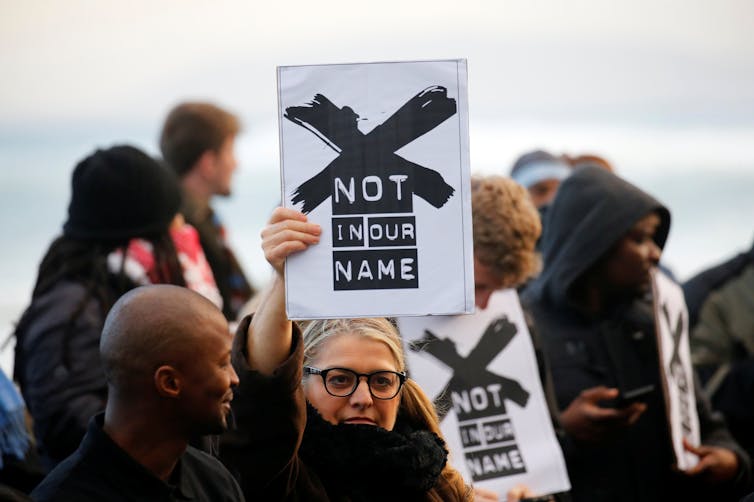
Demonstrators protest against the decision by the South African Broadcasting Corporation to stop airing violent protest scenes. Reuters/Mike Hutchings

Four decades after the Black Wednesday crackdown on the media and the black consciousness movement, South Africa is a different country. Freedom of expression is guaranteed in the constitution and a slew of institutions and laws support the guarantee. At the same time, powerful groups continue to seek ways to limit and undermine journalism.

On October 19, 1977, two South African newspapers - World and Weekend World - and a church journal - Pro Veritate - were closed, journalists were banned and detained and some 18 organisations of the black consciousness movement were banned. Since then, the country’s journalists have marked the day as Media Freedom Day.

The 1977 crackdown went further than even the apartheid cabinet of the time had decided: cabinet minutes from the day before, laboriously written in longhand in leather-covered volumes held in the national archives, record the decision that the World newspaper “be suspended for a week” and that the editor Percy Qoboza and others be detained. The Weekend World is not mentioned.

In fact, both papers were banned permanently. There are other differences: the list of organisations actually closed is much longer than was decided by Prime Minister BJ Vorster’s cabinet.

One can speculate about the reasons for the difference between decision and implementation – perhaps the powerful apartheid police simply thought they knew better than their political bosses.
Black Wednesday remains a particularly brutal act of repression in a long line of attempts to silence critical media voices. There have been many victims, before and since.

What’s clear is that the battle for media freedom in South Africa isn’t over. Attacks on journalists continue – whether in the form of physical intimidation or through the threat of new legal measures that seek to restrict the media’s ability to do its job. And the online world has opened up new frontiers that need defending.

Targeting journalists

Journalism is under attack from a number of quarters.
A number of laws and bills contain problematical provisions. The board of the World Association of Newspapers and News Publishers, who met in Durban in June, highlighted concerns with bills on cybersecurity, hate crimes and films and publications as infringing on media freedom.

Then there’s the Protection of State Information Bill (generally called the
Secrecy Bill, whose problematical provisions include an overly broad definition of the national interest and which would severely restrict the freedom to report. The bill was passed in 2013 but is still awaiting signature on President Jacob Zuma’s desk.

There also appears to be a concerted move to reopen the debate around a Media Appeals Tribunal through a parliamentary inquiry, which would subject the media to regulation by Parliament.
Also, this year has seen attempts to intimidate and threaten journalists, most notably by Black First Land First (BLF) and other proxies in what has become known as the state capture project. This has involved attempts by powerful individuals and groups to shape South Africa’s political and economic landscape through corrupt relationships and deals to benefit their own private interests. After BLF’s protest at the home of former Business Day editor Peter Bruce in June turned violent, the South African National Editors Forum obtained a court interdict against the organisation and its leader Andile Mngxitama. As the forum’s chairperson Mahlatse Gallens pointed out in her response to the court ruling:
They have specifically targeted journalists that have done in-depth reporting on allegations of corruption and state capture. We will not be deterred.
These kinds of attacks attest to the strength and importance of journalism in present-day South Africa. From exposes on the Nkandla scandal to the Gupta emails, which detailed the extent of state capture, journalistic investigations have set the public agenda. Government ministers have been forced to account and international corporations have been ruined following exposure of their complicity.

When around 1000 of the world’s investigative journalists gather for the Global Investigative Journalism Conference at Wits University in a few weeks – the first time the event is held in Africa - the South African experience will be of considerable interest.

Media freedom in a changed era

Attacks and threats to media freedom are a mark of the importance of journalism, but the effects are felt by the citizenry at large. As the Council of Europe pointed out in a paper on protecting journalists, interference with media freedom
is simultaneously an interference with the public’s right to receive information or ideas.
The constitutionally guaranteed right to free expression is mainly about citizens’ right to be informed; journalists hold it in trust for the broader public. Journalism and its organisations have not always been successful in making that point clear.

Seen in that light, the media freedom discussion needs to broaden out and take into account developments which do not amount to direct attempts to harass journalists, but damage their ability to do this important work in other ways.

The long-standing business model of journalistic media is in terminal decline as audiences move to online and social media. Legacy media companies are under intense financial pressure and staffing levels in newsrooms keep dropping. Investment in the time and effort to do journalism of quality is way down.

At the same time, the growth of online platforms has led to an explosion of available information. In many senses, this has been positive, but it has also opened the door to abuse. The campaign in support of state capture involved the extensive use of social media for cyber-bullying and to create the illusion of a groundswell of opinion that does not exist.

The use of information as a weapon is not new - propaganda is as old as the hills, and South African political and factional campaigns have often made use of leaks as a form of warfare. But we seem to be entering a new phase where it becomes harder and harder to distinguish real exposes from the false kind. Some journalists and media outlets, in some cases liberally supported by public funding, are allowing themselves to be used for factional ends.

Trust is journalism’s most valuable asset. In an era of fake news, that trust is harmed not only by what the media themselves may do, but by what is done by pedlars of misinformation, who are often hard to distinguish from professional journalists.

The ConversationA loss of trust may in the long run cause more harm to journalism than the repressive tactics of past decades.
Franz Krüger, Adjunct Professor of Journalism and Director of the Wits Radio Academy, University of the Witwatersrand
This article was originally published on The Conversation.
Saturday, November 11, 2017

The Egg: This Short Story Is The Most Powerful Thing You Will Ever Read

 
The Egg by Andy Wier is a beautiful short story about death and life. It is written plainly, touching on the value and purpose of the human condition.
A fictional tale, it features a conversation between a recently deceased 'you' and a person that introduces himself as 'God'. The dialogue is very relaxed and sincere. The conversation explains and reviews basic global precepts about the meaning of life and what happens when you die.
The conversation plays out like two friends in front of a coffee shop. Its steady pace, and concise language bring a constant flow from idea to idea. I don't want to spoil any of the nuances and revelations, but I can tell you some of the aspects covered. Which religion was the 'right' religion, is there a heaven or hell, what is the purpose of life, why create humans and the connection between our maker and us are revealed.
 
This story personally fits my weird, personal mash-ups of belief eriely well. It was really exciting to see so many ideas I mull in my head on a daily basis, so perfectly summed up in an adorable and well organized dialogue. It turns out a handful of my friends had read the story as well. The story became a platform for us to probe eachother's beliefs and ideas in a way that helped us relate to ouir distinctive truths and perception.
The story is under one thousand words, maybe a five to ten minute read. Its message is universal, not disrespecting or belittling any philosophy or religion. I strongly recommend it, not only in a recreational sense but in a way to expand your awareness of the universe's potential.
Andy Weir has been writing science fiction on his website since the mid 1980's. The Egg was his first widely recognized published story. It has been translated into over thirty languages and even has a short film tailored after it by Sam Meacock, starring Harrison Lee and Philip Hope. Another published work of his that gained a lot of attention was his novel The Martian, which was adapted into the 2015 blockbuster featuring Matt Damon. You can read his collected works here.
 

The Egg – Andy Weir

You were on your way home when you died.
It was a car accident. Nothing particularly remarkable, but fatal nonetheless. You left behind a wife and two children. It was a painless death. The EMTs tried their best to save you, but to no avail. Your body was so utterly shattered you were better off, trust me.
And that's when you met me.
"What… what happened?" You asked. "Where am I?"
"You died," I said, matter-of-factly. No point in mincing words.
"There was a… a truck and it was skidding…"
"Yup," I said.
"I… I died?"
"Yup. But don't feel bad about it. Everyone dies," I said.
You looked around. There was nothingness. Just you and me. "What is this place?" You asked. "Is this the afterlife?"
"More or less," I said.
"Are you god?" You asked.
"Yup," I replied. "I'm God."
"My kids… my wife," you said.
"What about them?"
"Will they be all right?"
"That's what I like to see," I said. "You just died and your main concern is for your family. That's good stuff right there."
You looked at me with fascination. To you, I didn't look like God. I just looked like some man. Or possibly a woman. Some vague authority figure, maybe. More of a grammar school teacher than the almighty.
"Don't worry," I said. "They'll be fine. Your kids will remember you as perfect in every way. They didn't have time to grow contempt for you. Your wife will cry on the outside, but will be secretly relieved. To be fair, your marriage was falling apart. If it's any consolation, she'll feel very guilty for feeling relieved."
"Oh," you said. "So what happens now? Do I go to heaven or hell or something?"
"Neither," I said. "You'll be reincarnated."
"Ah," you said. "So the Hindus were right,"
"All religions are right in their own way," I said. "Walk with me."
You followed along as we strode through the void. "Where are we going?"
"Nowhere in particular," I said. "It's just nice to walk while we talk."
"So what's the point, then?" You asked. "When I get reborn, I'll just be a blank slate, right? A baby. So all my experiences and everything I did in this life won't matter."
"Not so!" I said. "You have within you all the knowledge and experiences of all your past lives. You just don't remember them right now."
I stopped walking and took you by the shoulders. "Your soul is more magnificent, beautiful, and gigantic than you can possibly imagine. A human mind can only contain a tiny fraction of what you are. It's like sticking your finger in a glass of water to see if it's hot or cold. You put a tiny part of yourself into the vessel, and when you bring it back out, you've gained all the experiences it had.
"You've been in a human for the last 48 years, so you haven't stretched out yet and felt the rest of your immense consciousness. If we hung out here for long enough, you'd start remembering everything. But there's no point to doing that between each life."
"How many times have I been reincarnated, then?"
"Oh lots. Lots and lots. An in to lots of different lives." I said. "This time around, you'll be a Chinese peasant girl in 540 AD."
"Wait, what?" You stammered. "You're sending me back in time?"
"Well, I guess technically. Time, as you know it, only exists in your universe. Things are different where I come from."
"Where you come from?" You said.
"Oh sure," I explained "I come from somewhere. Somewhere else. And there are others like me. I know you'll want to know what it's like there, but honestly you wouldn't understand."
"Oh," you said, a little let down. "But wait. If I get reincarnated to other places in time, I could have interacted with myself at some point."
"Sure. Happens all the time. And with both lives only aware of their own lifespan you don't even know it's happening."
"So what's the point of it all?"
"Seriously?" I asked. "Seriously? You're asking me for the meaning of life? Isn't that a little stereotypical?"
"Well it's a reasonable question," you persisted.
I looked you in the eye. "The meaning of life, the reason I made this whole universe, is for you to mature."
"You mean mankind? You want us to mature?"
"No, just you. I made this whole universe for you. With each new life you grow and mature and become a larger and greater intellect."
"Just me? What about everyone else?"
"There is no one else," I said. "In this universe, there's just you and me."
You stared blankly at me. "But all the people on earth…"
"All you. Different incarnations of you."
"Wait. I'm everyone!?"
"Now you're getting it," I said, with a congratulatory slap on the back.
"I'm every human being who ever lived?"
"Or who will ever live, yes."
"I'm Abraham Lincoln?"
"And you're John Wilkes Booth, too," I added.
"I'm Hitler?" You said, appalled.
"And you're the millions he killed."
"I'm Jesus?"
"And you're everyone who followed him."
You fell silent.
"Every time you victimized someone," I said, "you were victimizing yourself. Every act of kindness you've done, you've done to yourself. Every happy and sad moment ever experienced by any human was, or will be, experienced by you."
You thought for a long time.
"Why?" You asked me. "Why do all this?"
"Because someday, you will become like me. Because that's what you are. You're one of my kind. You're my child."
"Whoa," you said, incredulous. "You mean I'm a god?"
"No. Not yet. You're a fetus. You're still growing. Once you've lived every human life throughout all time, you will have grown enough to be born."
"So the whole universe," you said, "it's just…"
"An egg." I answered. "Now it's time for you to move on to your next life."
And I sent you on your way.


source

Friday, November 10, 2017

3 things every believer needs to do before Christ comes back


The Lord Jesus Christ is coming back real soon, at a time we don't really know. What we do know is that He's coming back and while He hasn't returned yet, we can still do something that would make Him happy.
With that, I would like to encourage all of us who are longing for His return to make the most of our stay here by enjoying our earthly lives in doing His will. To help you with that, here are some things you should not miss out on doing before Christ comes back.
1) Preach the Gospel to everyone you know
This is so exciting. As we preach the Gospel and make disciples of Christ, we get to become His lips, hands and feet for those who don't know Him yet. And as we do that, He goes with us too!
"Go therefore and make disciples of all nations, baptizing them in the name of the Father and of the Son and of the Holy Spirit, teaching them to observe all things I have commanded you. And remember, I am with you always, even to the end of the age." Amen." (Matthew 28:19-20)

2) Co-labor with Christ in the work of salvation
Jesus promised that as we go and preach the Gospel to every creature, we will get to see signs and wonders. These signs are proof that He is alive and is with us as we go and do what He said according to Matthew 28 (see above). When we obey Him, the signs show that we are co-laboring with Him in bringing the Good News to all.
"He said to them, "Go into all the world, and preach the gospel to every creature. He who believes and is baptized will be saved. But he who does not believe will be condemned. These signs will accompany those who believe: In My name they will cast out demons; they will speak with new tongues; they will take up serpents; if they drink any deadly thing, it will not hurt them; they will lay hands on the sick, and they will recover."" (Mark 16:15-18)
3) Love your fellow believers in Christ
Lastly, we should grow in our love for fellow believers. The Lord Jesus said according to John 13:34-35,
"A new commandment I give to you, that you love one another, even as I have loved you, that you also love one another. By this all men will know that you are My disciples, if you have love for one another."
Our lives are indeed short, but it will be very significant if we show love for God and the people He loves. Because we love Him, we also love our fellow believers – and the love that we have for each other reveals God to those who don't know Him.
Be eager for His return!
Friends, I urge you, let's all be eager to meet Christ when He returns. Let's do all that He commanded us to do so that when He comes back, we'll make Him really happy.