Let me share some thoughts with you. Let me be a source of encouragement and support. May you never forget your dreams and remember miracles happen every day. Let us laugh, have fun, and inspire one another.
(Family Features) A holiday season filled with gatherings calls for simple recipes that make baking for family and friends easy and enjoyable.
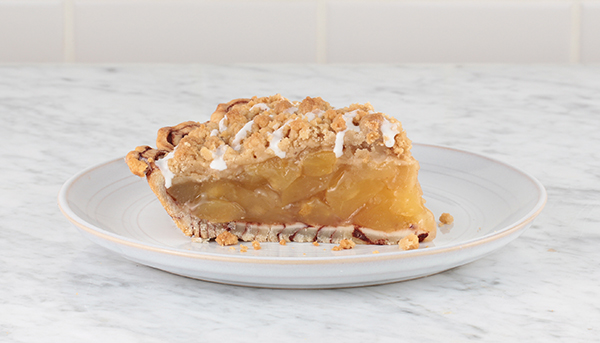
Traditions are often enjoyed more around the holidays and some classic flavors are must-haves for seasonal parties and dinners. Individually portioned desserts are ideal for entertaining, and these smooth, creamy cheesecakes with vivid holiday color are a perfect single serving that is sure to brighten any dessert table. Or put a festive twist on apple pie with a cinnamon roll-inspired crust.
Each of these desserts features quick and easy preparation, and the delicious flavors of Lucky Leaf Fruit Fillings, which use high-quality fruit and contain no high-fructose corn syrup, for great tasting desserts every time. An array of popular flavors like apple, blueberry, cherry and strawberry make it possible to prepare your favorite holiday desserts in minutes.
Find more inspiration for this season’s holiday baking at luckyleaf.com.
Mini Marbled Cherry Cheesecakes
18 chocolate cookies with white filling
2 packages (8 ounces each) cream cheese, softened
1/3 cup sugar
2 eggs
1 teaspoon vanilla
1 can (21 ounces) Lucky Leaf Premium Cherry Fruit Filling, divided
Heat oven to 350° F. Line muffin tins with 18 paper liners.
Place one chocolate cookie in bottom of each paper liner.
In mixing bowl, beat cream cheese, sugar, eggs and vanilla until light and fluffy. Fold in half of fruit filling. Fill each muffin liner about three-fourths full with mixture.
Bake 20-25 minutes, or until done. Cool. Top each cheesecake with spoonful of remaining fruit filling.
Cinnamon Apple Pie
1 refrigerated pie crust
1 tablespoon butter, melted
2 teaspoons ground cinnamon
2 cans (21 ounces each) Lucky Leaf Premium Apple Fruit Filling
1 stick (8 tablespoons) butter, softened
1 cup flour
1 cup light brown sugar
1/2 cup powdered sugar, plus additional (optional)
1/4 teaspoon vanilla
1/4 teaspoon cinnamon
2 teaspoons milk, plus additional (optional)
Heat oven to 400° F.
On lightly floured surface, unroll pie crust. Brush with melted butter and sprinkle evenly with cinnamon. Roll up tightly and slice into 1/2-inch rounds, like miniature cinnamon rolls.
Press miniature cinnamon rolls evenly into bottom and sides of 9-inch pie plate, making sure there are no spaces between rolls. Pour fruit filling on top of crust.
In large bowl, using pastry blender, combine stick of butter, flour and brown sugar, until crumbly. Sprinkle over apple filling.
Bake pie until top and crust are golden brown and filling is bubbling, about 40-45 minutes (cover top and crust with foil, if necessary, to prevent from getting too dark). Remove from oven and allow to cool.
In small bowl, whisk together powdered sugar, vanilla, cinnamon and milk to form icing. Add more sugar or milk, if necessary, to reach desired consistency. Drizzle icing over cooled pie.
If you are ready to move into the New Paradigm, if you choose
to participate in The Great Transformation-moving out of concern for the
personal self and joining forces with the Legions of Light currently engaged in
elevating an entire Planet into a Higher Realm of being- your life will begin
to change in ways both joyful and profound.
As you consciously work on elevating your own frequency-in
the name of Service, for the Well-being of All-you receive the first benefits
of the intention of your dedication. For the higher the frequency of your
energy body, the greater the synchronicity in your field, and the more ease and
grace in your life.
The more you choose to move beyond the personal into the
Universal, the Oneness, the more aligned you become and the more de-Light-ful
your experience.
The higher your frequency, the more Light you carry; the more
Light you carry, the more effect you have on those around you-elevating the
frequency of your environment and the community in which you reside or the
arenas in which you move. As everything gets better for everyone, it naturally
gets better for you.
Realize you are not alone in this work-but part of a great
wave of Consciousness that is focused on and influencing the Planet, elevating
and transforming the very fabric of reality.
Be not distracted by the shenanigans of various actors in the
play-but play your part with dedicated focus and watch the changes that arise
before you eyes-they are happening, now, everywhere.
The appearance of Time & Space are mutable, not fixed.
What you call 'miracles' are simply manifestations of intention at a higher
level of Consciousness and child's play for Masters who can manipulate energy
at will.
But this is a collective endeavor, and if you would be
part of it you must take part in it-else your reality will
remain chaotic and distressful.
Just choose. Step on board. You are supported in ways you
cannot even imagine.
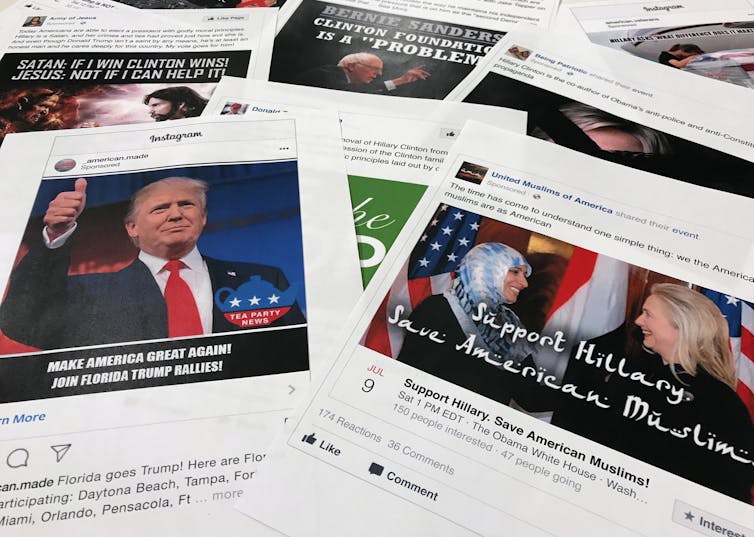
Some of the Facebook and Instagram ads used in 2016 election released by members of the U.S. House Intelligence committee.
AP Photo/Jon Elswick
Recent revelations about how Russian agents inserted ads on Facebook, in an attempt to influence the 2016 election, present a troubling question: Is Facebook bad for democracy?
As a scholar of the social and political implications of technology, I believe that the problem is not about Facebook alone, but much larger: Social media is actively undermining some of the social conditions that have historically made democratic nation states possible.
I understand that’s a huge claim, and I don’t expect anyone to believe it right away. But, considering that nearly half of all eligible voters received Russian-sponsored fake news on Facebook, it’s an argument that needs to be on the table.
How we create a shared reality
Let’s start with two concepts: an “imagined community” and a “filter bubble.”
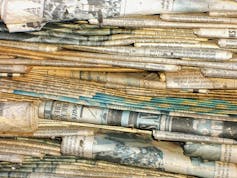
The late political scientist Benedict Anderson famously argued that the modern nation-state is best understood as an “imagined community” partly enabled by the rise of mass media such as newspapers. What Anderson meant is that the sense of cohesion that citizens of modern nations felt with one another – the degree to which they could be considered part of a national community – was one that was both artificial and facilitated by mass media.
Mass media is one way to create a shared community.Dave Crosby, CC BY-SA
Of course there are many things that enable nation-states like the U.S. to hold together. We all learn (more or less) the same national history in school, for example. Still, the average lobster fisherman in Maine, for example, doesn’t actually have that much in common with the average schoolteacher in South Dakota. But, the mass media contribute toward helping them view themselves as part of something larger: that is, the “nation.”
Democratic polities depend on this shared sense of commonality. It enables what we call “national” policies – an idea that citizens see their interests aligned on some issues. Legal scholar Cass Sunsteinexplains this idea by taking us back to the time when there were only three broadcast news outlets and they all said more or less the same thing. As Sunstein says, we have historically depended on these “general interest intermediaries” to frame and articulate our sense of shared reality.
Filter bubbles
The term “filter bubble” emerged in a 2010 book by activist Eli Pariser to characterize an internet phenomenon.
Legal scholar Lawrence Lessig and Sunstein too had identified this phenomenon of group isolation on the internet in the late 1990s. Inside a filter bubble, individuals basically receive only the kinds of information that they have either preselected, or, more ominously, that third parties have decided they want to hear.
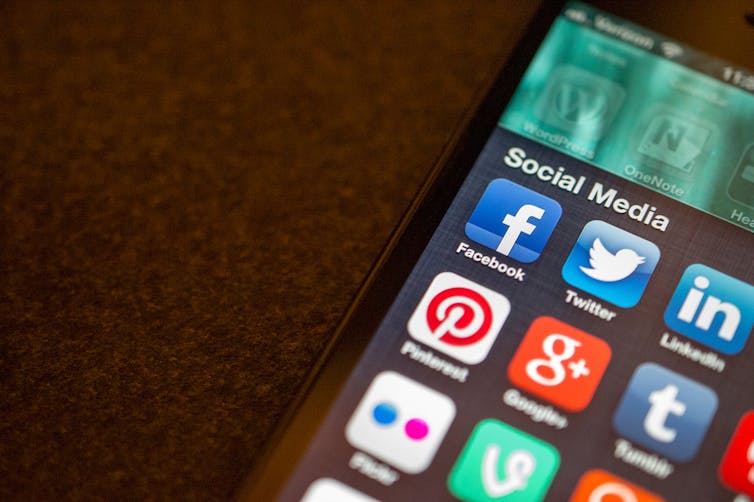
The targeted advertising behind Facebook’s newsfeed helps to create such filter bubbles. Advertising on Facebook works by determining its user’s interests, based on data it collects from their browsing, likes and so on. This is a very sophisticated operation.
Facebook does not disclose its own algorithms. However, research led by psychologist and data scientist at Stanford University Michael Kosinskidemonstrated that automated analysis of people’s Facebook likes was able to identify their demographic information and basic political beliefs. Such targeting can also apparently be extremely precise. There is evidence, for example, that anti-Clinton ads from Russia were able to micro-target specific voters in Michigan.
Is Facebook creating filter bubbles?sitthiphong/Shutterstock.com
The problem is that inside a filter bubble, you never receive any news that you do not agree with. This poses two problems: First, there is never any independent verification of that news. Individuals who want independent confirmation will have to actively seek it out.
Second, psychologists have known for a long time about “confirmation bias,” the tendency of people to seek out only information they agree with. Confirmation bias also limits people’s ability to question information that confirms or upholds their beliefs.
Not only that, research at Yale University’s Cultural Cognition Project strongly suggests that people are inclined to interpret new evidence in light of beliefs associated with their social groups. This can tend to polarize those groups.
All of this means that if you are inclined to dislike President Donald Trump, any negative information on him is likely to further strengthen that belief. Conversely, you are likely to discredit or ignore pro-Trump information.
It is this pair of features of filter bubbles – preselection and confirmation bias – that fake news exploits with precision.
Creating polarized groups?
These features are also hardwired into the business model of social media like Facebook, which is predicated precisely on the idea that one can create a group of “friends” with whom one shares information. This group is largely insular, separated from other groups.
The software very carefully curates the transfer of information across these social networks and tries very hard to be the primary portal through which its users – about 2 billion of them – access the internet.
Facebook depends on advertising for its revenue, and that advertising can be readily exploited: A recent ProPublica investigation shows how easy it was to target Facebook ads to “Jew Haters.” More generally, the site also wants to keep users online, and it knows that it is able to manipulate the emotions of its users – who are happiest when they see things they agree with.
Is social media creating more polarization?Chinnapong/ Shutterstock.com
As the Washington Post documents, it is precisely these features that were exploited by Russian ads. As a writer at Wired observed in an ominously prescient commentary immediately after the election, he never saw a pro-Trump post that had been shared over 1.5 million times – and neither did any of his liberal friends. They saw only liberal-leaning news on their social media feeds.
In this environment, a recent Pew Research Center survey should not come as a surprise. The survey shows that the American electorate is both deeply divided on partisan grounds, even on fundamental political issues, and is becoming more so.
All of this combines to mean that the world of social media tends to create small, deeply polarized groups of individuals who will tend to believe everything they hear, no matter how divorced from reality. The filter bubble sets us up to be vulnerable to polarizing fake news and to become more insular.
The end of the imagined community?
At this point, two-thirds of Americans get at least some of their news from social media outlets. This means that two-thirds of Americans get at least some of their news from highly curated and personalized black-box algorithms.
Facebook remains, by a significant margin, the most prevalent source of fake news. Not unlike forced, false confessions of witchcraft in the Middle Ages, these stories get repeated often enough that they could appear legitimate.
What we are witnessing, in other words, is the potential collapse of a significant part of the imagined community that is the American polity. Although the U.S. is also divided demographically and there are sharp demographic differences between regions within the country, partisan differences are dwarfing other divisions
in society.
This is a recent trend: In the mid-1990s, partisan divisions were similar in size to demographic divisions. For example, then and now, women and men would be about the same modest distance apart on political questions, such as whether government should do more to help the poor. In the 1990s, this was also true for Democrats and Republicans. In other words, partisan divisions were no better than demographic factors at predicting people’s political views. Today, if you want to know someone’s political views, you would first want to find out their partisan affiliation.
The reality of social media
Jason Howie, CC BY
To be sure, it would be overly simplistic to lay all of this at the feet of social media. Certainly the structure of the American political system, which tends to polarize the political parties in primary elections, plays a major role. And it is true that plenty of us also still get news from other sources, outside of our Facebook filter bubbles.
But, I would argue that Facebook and social media offer an additional layer: Not only do they tend to create filter bubbles on their own, they offer a rich environment for those who want to increase polarization to do so.
Communities share and create social realities. In its current role, social media risks abetting a social reality where differing groups could disagree not only about what to do, but about what reality is. Gordon Hull, Associate Professor of Philosophy, Director of Center for Professional and Applied Ethics, University of North Carolina – Charlotte
This article was originally published on The Conversation.
God is in the business of using men and women to carry out His plans and fulfil His purposes. The Bible tells us that God used men and women of all sorts of personalities, educational attainments, skills, and professions to fulfil His purposes, all of them being part of His grand plan for salvation. And God is still in the business of using men and women to do His will on earth.
Mere People
Many of us want to be like these men and women of faith in the Bible. Some of us honour them too much, in fact so much that we already sin by idolising them. Yet one thing that many of us forget is that no matter what they have done for God, no matter how much He has used them, they are mere people just like us: flawed, imperfect, and with a lot of room for improvement.
This brings me to what I want to share to you, dear reader. All men and women of faith aren't perfect. They're flawed, yet God used them. If God can use them, He can use you, too. Do you want God to use you to fulfil His purposes? If you do, you're in good company, regardless of who you are.
In Good Company
To encourage you to allow God to use you, here are some people in the Bible – flawed and imperfect men – who allowed God to use them in spite of their flaws.
1. Paul
We read in the book of Acts how Saul met Christ, got transformed into Paul, and became an apostle to many churches in different areas around the world. Yet we also know that Paul was at first a Christian-killer who was relentless in his persecution of those who followed Christ. Later on, he would become the man who would say,
"Imitate me, just as I also imitate Christ." (1 Corinthians 11:1)
2. Peter
Peter is a great example to many of us of a man who is rash and impulsive. Peter was very impulsive, so much so that he slashed the ear off of Malchus, a servant of the Jewish High Priest Caiaphas who participated in the arrest of Jesus (see John 18:10). Later, this act of passion was overturned after he denied the very same man he was protecting earlier. He denied Christ thrice (see Luke 22:54-62).
Yet later we also read that Christ spoke to him, and he reaffirmed his love for the Saviour (see John 21:14-16). Later on, we read that in just one of his preachings, 3,000 men got saved (see Acts: 2:14-42). How's that for a turnaround?
3. Moses
All of us know Moses. Some of us even picture him as a man with a long beard and gray to white hair. The Bible portrays him, however, as a man who was very strong and skilful, enough to kill an Egyptian (see Exodus 2:11-15).
After murdering the said Egyptian, Moses ran away and became a shepherd in Midian, where he apparently learned how to become a speaker, although a poor one, failing in his attempt to what he believed was God's will (see Exodus 4:10-17; 6:30). Yet God used him just the same, in a way far more powerful than he could have expected: God used him to deliver the whole nation of Israel from slavery.






 Communities share and create social realities. In its current role, social media risks abetting a social reality where differing groups could disagree not only about what to do, but about what reality is.