Let me share some thoughts with you. Let me be a source of encouragement and support. May you never forget your dreams and remember miracles happen every day. Let us laugh, have fun, and inspire one another.
Recall that last time you had something “go down the wrong pipe”?
You spent the next several minutes coughing, choking and feeling like
something bad was in your throat.
It may seem strange to say this, but count yourself lucky.
Your brain was making you do the right things to keep what you drank
or ate out of your lungs. The path for air to enter our lungs, the
larynx (or voice box), is very close to the upper esophageal sphincter,
the entry point for food and liquids to our esophagus. This close
anatomical relationship of these two entry points means the brain must
coordinate breathing, eating and drinking to ensure the lungs get only
air and the esophagus gets only food or liquids. This coordination
happens unconsciously, so we never really think about it until we get
food or liquid in our airway.
As it turns out, millions of people with brain diseases, including
those with Alzheimer’s, Parkinson’s, Lou Gehrig’s disease, stroke,
multiple sclerosis and traumatic brain injury, have impaired swallowing.
As a result, they are unable to protect their lungs in the way that a
healthy person can.
The result is that millions of brain disease patients are at risk for
inhaling food and saliva into the lungs, leading to death by pneumonia
or even choking.
Detecting and treating impaired swallowing is important, particularly
as the nation’s nearly 70 million baby boomers continue to age.
Impaired swallowing is associated with many conditions of the elderly,
and it is often severely underreported. Clinicians may not detect it or
may see it as a side effect of another condition.
As a neuroscientist who has studied brain diseases, I know of no
pharmaceutical companies that have drug discovery programs aimed at
restoring weakened swallow and cough. And yet, it’s a major problem.
Hard to swallow, easy to choke
An important part of swallowing is complete closure of the larynx
while food is moving through the throat. Disordered swallowing, or
dysphagia, limits the ability of the muscles in the mouth and throat to
move liquid or food into and through the esophagus and on to the
stomach.
This inability to protect the airways and lungs increases the risk of pneumonia or choking.
In addition, many people with brain disorders experience reduced
coughing, or a weakened ability to activate breathing muscles to
generate airflows that eject material from the lungs. Weakened cough is
caused by problems with nerves in our lungs that detect foreign material
or with the brain driving the respiratory muscles.
Disordered swallowing can also be caused by problems with nerves in
the neck. For example, people who have had cancer of the head or neck
often undergo extensive surgery to remove the diseased tissue. This
process can inadvertently damage nerves that are important for
swallowing.
Sometimes, the swallowing impairment, rather than the primary brain
disease, actually leads to death. When swallowing is impaired, it is
more likely that material will enter the lungs and trachea during eating
or drinking. This is known as aspiration. Aspirated food or drink
“seeds” the lungs with material that is coated with pathogens from the
mouth. These pathogens are not normally present in the lungs and can
cause chronic inflammation and serious bouts of pneumonia.
When a weak cough is a bad sign
In patients with acute stroke, severe swallow and cough impairments
occur at the same time. Our research has shown that the risk of
aspiration due to swallow impairment can be predicted by weakened cough
in patients with stroke or Parkinson’s disease. These findings indicate that brain diseases can lead to multiple impairments in how we protect our airways.
Another way of thinking about this problem is that the nervous system
has many tools, or reflexes, that it uses to perform certain tasks.
Each reflex has a specific function, and the brain coordinates the time
of occurrence of each to optimize the result.
For example, a cough can eject material out of the airways into the
throat and out of the mouth. Swallows frequently occur just after coughs
to move material that was deposited into the throat into the esophagus
and then the stomach. The result is that lungs were cleared by coughing,
and swallowing moved any remaining material out of the throat to
prevent aspiration.
Nearly half of residents of long-term care facilities vulnerable to pneumonia
Patient in a care facility. Via Shutterstock.From www.shutterstock.com
Simultaneous impairments of cough and swallow lead to high aspiration
risk. This high risk is due to seeding of the lower airways with
harmful pathogens that increase the risk of pneumonia. Mortality rates
of aspiration pneumonia have been reported of over 60 percent, leading
to a US$4.4 billion medical burden from hospitalized patients alone in 1997. Aspiration pneumonia costs as much as $17,000 per hospital admission. Further, this type of pneumonia can occur in as many as half of long-term care residents.
When members of our research team talk to their friends about airway
protection and its consequences, everyone seems to have a story. Most
center around an older relative who had a brain disorder and the
difficulties this person had eating. Often their relative choked when
eating or had to eat special thick foods. These are signs of impaired
swallow, cough and aspiration.
Speech pathologists specialize in diagnosing and treating swallowing
disorders. They often recommend thick foods that are easier to swallow
and less likely to penetrate the airways during swallowing. This
clinical approach is the most well-accepted.
Some companies market devices that apply a weak electrical current to
the neck to improve swallowing. The long-term benefit of these devices
is controversial. Further, these therapies have not been shown to enhance a weakened cough reflex.
There are no drugs for the treatment of impaired swallow or cough. It
appears that the pharmaceutical industry has not yet recognized the
importance of prevention of aspiration in patients with neurological
disease in disease outcome.
A team in Japan has promoted a comprehensive protocol using sensory
stimuli such as menthol and capsaicin, the pungent ingredient in red
peppers, to help elderly people who have serious impairments in swallowing. Their preliminary results show impressive improvements in reducing aspiration pneumonias in these patients.
There is a promising approach based on strengthening breathing
muscles that has been shown to improve swallow and cough function in
patients with Parkinson’s disease and stroke.
This approach is called “expiratory muscle strength training,” and it
is easy for health care professionals and most patients to perform. The
extent to which this method can prevent pneumonia in at-risk patients is
unknown at this time.
In short, while there are some promising approaches, there are no
widely accepted therapies for restoring weakened swallow and cough in
patients at significant risk of aspiration. Continued research on the
fundamental neurological mechanisms of coughing and swallowing will
provide a foundation for new therapies to reduce the occurrence and
severity of aspiration pneumonia.
This article was published on The Conversation
Whenever I’m driving around my hometown, I always know I’ll get a
chuckle while passing by a church in our community that’s notorious for
their hilariously clever signs.
Most of us think of houses of worship as strictly business, but
plenty of them are clearly capable of exercising their funny bone, as
you’ll see in the creative church signs below that folks spotted in
their neck of the woods.
It’s always nice to see that on top of their weekly services and acts of kindness for their neighbors,
there are those who can also embrace their sense of humor. After all,
it’s that much easier to convince someone to come inside if they’ve
already got a smile on their face!
Does your church get silly with their signs? Or do you have one in your town you know will always give you a giggle?
Jess Catcher
Springtime is here, and with it, an influx of sunshine, nests and baby
birds. But peppered among the warmer weather is the occasional nasty
storm, which can potentially knock baby birds from their nests. The
question is, how do you best help a stranded baby bird? While it might
be counter-intuitive to leave them on the ground, depending on the
baby’s age, doing so might best the best course of action.
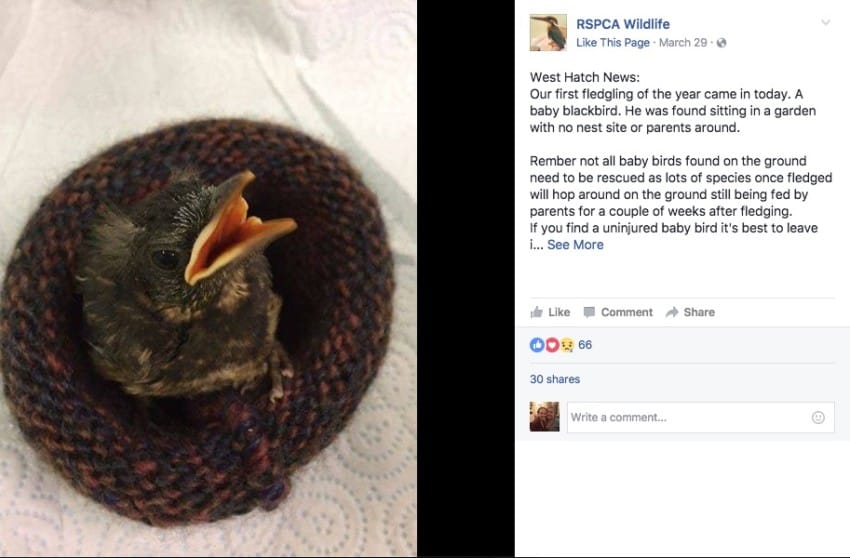
The reason some baby birds are on the ground might have nothing to do with a storm at all.
According to RSPCA Wildlife,
not all baby birds found on the ground need to be rescued. A lot of
bird species, once fledged, will hop around on the ground still being
fed by parents for a couple of weeks. Being so, the site asserts that if
you find an uninjured baby bird, it’s best to leave it alone and watch
it from afar for at least 30 minutes. In that time you will likely see a parent bird come to feed it.
RSPCA,
as well as many other wildlife rehabilitation centers, receive many
baby birds each year from well-meaning members of the public. The birds
they bring in often would have had a better chance of survival had they
been left alone in the wild.
As such, raising wild birds in captivity should always be a last resort,
the criteria for which is when a baby bird is known to be injured or
orphaned. Although it may seem the safer route to raise babies in
captivity, birds raised without the advantage of learning from their
parents have only a small chance of survival when released. Unless you
have the necessary experience, do not attempt to raise a wild baby bird
yourself.
Hatchlings
and nestlings, however, may need your help getting back into the nest.
Contrary to popular belief, the smell of your hands on a baby bird will
not cause a parent to abandon it—as it is, birds have a poor sense of
smell. But how do you tell if a baby bird needs your help getting into a
nest? It’s all in the age:
Three stages of a baby bird:
• Hatchling (usually 0-3 days old)
Its eyes aren’t yet opened. It may have bits of down on its body. It’s not ready to leave the nest.
• Nestling (usually 3-13 days old)
Its eyes are open, and its wing feathers may look like tubes because
they’ve yet to break through their protective sheaths. This baby is also
not ready to leave the nest.
• Fledgling (13-14 days old or older)
This
baby has full feathers. Its wings and tail may be short, and it may not
be great at flying, but it can walk, hop, or flutter. It has left the
nest, though its parents may be nearby. You don’t need to worry about
getting this little guy back to the nest. However, to ensure the baby’s
continued safety, you should make sure your cats, dogs and curious
children are kept indoors.
It’s important to note that some birds nest on the ground.
The baby’s nest might have also dropped to the ground, in which case
you can return the baby and the nest to the tree. However, what do you
do if you find a hatchling or nestling and there is no nest in sight?
You can create a makeshift nest. Put the baby or babies inside of it,
and secure it up in a tree. If the baby is injured or you’re still not
sure what to do, contact your local wildlife rehabilitation center.
The Kim regime in North Korea, which has imprisoned, tortured and
even killed thousands of Christians, is terrified of the Gospel, Sen.
James Lankford, R-Okla., told North Korean freedom activists gathered on
Capitol Hill Wednesday.
As North Korea continues to rank as the top persecutor of Christians
in the world, Lankford and other GOP congressmen spoke during
International Christian Concern's 2017 Capitol Hill advocacy day, which
this year focused solely on the human rights abuses that have occurred
under the Kim regime.
Lankford,
the co-chair of the Congressional Prayer Caucus, approached the podium
carrying his Congress members' Bible study Bible.
"It's amazing to me that ... I walked up holding this [Bible],"
Lankford said. "If I did the same thing speaking in North Korea, this
would give me a hard time. It would be longer if I handed it to you."
Although North Korea has some state-run front churches designed to
have people think that religion is allowed in the communist country, the
practice and worship of real Christianity and other real religions is
illegal in North Korea.
The thousands of Christians who participate in the underground house
church movement and Christians who evangelize run the risk of being
arrested and thrown into labor camps and tortured along
with other people of faith, political enemies of the Kim regime and
those who advocate for freedom. Hundreds of thousands of prisoners have
died since the Kim regime came to power in 1948.
"I'm astounded by that. I am astounded by that as a Christian myself.
But I am astounded by that because [sharing the Gospel] attracts the
fear of Kim Jong Un and that regime," Lankford said. "I think about the
words that are in this book and how terrified they are of this book. I
think about some of the things that it says."
Lankford continued by citing the passage of Matthew 22:37-40.
"The regime is terrified of statements like this, where Jesus said to
them all, 'You shall love the Lord, your God, with all your heart, with
all your soul and with all your mind. This is the great and foremost
commandment. The second is like it, You shall love your neighbor as
yourself. On these two commandments depend the whole law and the
prophets,'" Lankford said. "The Kim regime is terrified of that
statement. It's just a simple statement but here is what [God] demands —
to be able to love God and to be able to love your neighbor."
He also cited 1 Timothy 2: "Paul writes to Timothy and he says to
him, 'I encourage that prayers, entreaties, petitions and thanksgiving
be made on behalf of all men — for kings and all those in authority,
that we may live tranquil and quiet lives in all godliness and in
dignity. This is good and acceptable in the sight of God our Savior.'"
Lankford summarized that "our first calling" of the Gospel is to be
able to love our neighbor," and "to love God." He added that the calling
from Paul tells people to "show respect and live quiet and dignified
lives."
"That is the subversive text that the regime is terrified of and that is astounding to me," he added.
In a panel discussion later in the day, Greg Scarlatoiu, an expert on
the human rights abuses in North Korea who has led in the publication
of at least 24 reports and books on the subject, offered his explanation
for why the Kim regime fears Christianity.
Scarlatoiu, who is also the executive director of the Committee for
Human Rights in North Korea, said that one of the largest reasons why
the Kim regime has a disdain for Christianity is because of its threat
to the regime's ability to control information.
"North Korea today is a post-communist, post industrial, kleptocratic
dynasty that holds an absolute monopoly over political power at home.
This is not a criminal kleptocratic cartel, this is an absolute
monopoly. There are no competitors inside the country," he said. "The
only competitor is, on the one hand, Christianity. And on the other
hand, free, prosperous, democratic Republic of Korea [South Korea]."
"[Christianity] offers an alternative set of beliefs, an alternative
way of life, a way of life that does not tolerate tyranny," he
continued. "The North Korean regime fears Christianity because it offers
a venue for the exchange of ideas. Remember, this regime has maintained
its power through information control, through an absolute overwhelming
level of coercion, control, surveillance and punishment that is
executed by 270,000 agents in three eternal security agencies — a vast
network of informers."
Open Doors USA has ranked North Korea as the No. 1 worst country in
the world when it comes to the persecution of Christians for 16 years in
a row on its World Watch List.
"For those of us in government, it is our responsibility to press everywhere we can," Lankford said.
He suggested that Western governments should place travel
restrictions on North Korean officials. He added that banks should be
threatened with loss of U.S. business if they do business with North
Korea. Additionally, he thinks there should be a ban on the sale of
luxury goods to North Korean officials.
"While we are limited in the things that we can do, we should do all
that we can do to be able to apply pressure to the leadership of North
Korea until they have opened up one of the most basic human dignities —
the right to be able to believe in your heart and to be able to pursue
God," Lankford stated.