Let me share some thoughts with you. Let me be a source of encouragement and support. May you never forget your dreams and remember miracles happen every day. Let us laugh, have fun, and inspire one another.
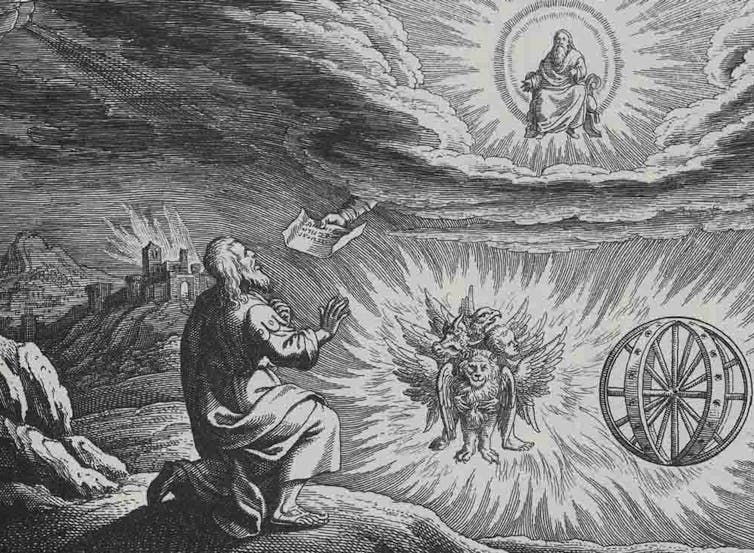
The biblical book of Ezekiel describes a vision of the divine that medieval philosophers understood as revealing the connection between religion and science.
By Matthaeus Merian (1593-1650), CC BY-NC
Faced with a range of serious patient reactions to the COVID-19 disease, doctors and nurses have sometimes struggled to find viable treatment options. But when we examine faith-based responses to the virus, spiritual guidance has proved even more elusive.
Religious figures such as Pope Francis have composed prayers for protection from coronavirus. But the idea of prayer as a vital part of any response to COVID-19 might feel inappropriate or even irresponsible to some in a world that often views medicine and religion as polar opposites – one turning to science, the other to God.
As a social historian of the medieval Islamic world, I think and write about the role of religion in daily life. Looking at how people thought about science and religion in the past can inform the contemporary world’s approach to COVID-19.
Fragment from Cairo Geniza held at Cambridge shows handwritten letter from Moses Maimonides. It was discovered in late 19th century.Culture Club/Getty Images
During the time of the jurist and philosopher Moses Maimonides (1138-1204), who led the Jewish community of Egypt, Fusṭāṭ (Old Cairo) faced a plague so daunting in 1201 that the city’s Jewish population never returned to its former glory.
In “A Mediterranean Society,” Geniza researcher S.D. Goitein describes Maimonides’ reaction to the plague: “Whatever the philosophers and theologians of that time might have said about man’s ability to influence God’s decisions by his deeds, the heart believed that they could be efficacious, that intense and sincere prayer, almsgiving, and fasts could keep catastrophe away.”
But the Jewish community also dealt with disease in other ways, and its holistic response to epidemics reveals a partnership – not a conflict – between science and religion.
Science and religion
In the medieval period, thinkers like Maimonides combined the study of science and religion. As Maimonides explains in his philosophical masterwork “The Guide to the Perplexed,” he believed that studying physics was a necessary precursor to metaphysics. Rather than seeing religion and science as inimical to one another, he saw them as mutually supportive.
Indeed, scholars of religious texts complemented their studies with science-centered writings. Maimonides’ Islamic contemporary, Ibn Rushd (1126-1198), is a perfect example. Though an important philosopher and religious thinker, Ibn Rushd also made meaningful contributions to medicine, including suggesting the existence of what would later come to be called Parkinson’s disease.
But it was not only elite scholars who saw religion and science as complementary. In “A Mediterranean Society,” Goitein says that “even the simplest Geniza person was a member of that hellenized Middle Eastern-Mediterranean society which believed in the power of science.” He adds: “Illness was conceived as a natural phenomenon and, therefore, had to be treated with the means provided by nature.”
Tending to one’s inner life
Science and religion, therefore, were both integral to the soul of the Geniza person. There was no sense that these two pillars of thought challenged one another. By tending to their inner lives through rituals that helped them deal with the sadness and trepidation, and their bodies through the tools of medicine available to them, the Geniza people took a holistic approach to epidemics.
For them, following the medical advice of Maimonides or Ibn Rushd was an essential part of their response to plague. But while hunkered down in their homes, they also looked to the spiritual advice of these thinkers, and others, to care for their souls. Those of us experiencing stress, solitude and uncertainty amid the coronavirus pandemic could learn from the medieval world that our inner lives demand attention too.
Across the United States, prisons and jails have become hot spots for COVID-19. Governments at the state and federal level are being pressed to release inmates before the end of their sentence in order to minimize the spread of the disease.
So far more than 100,000 of them have been infected with the coronavirus, and at least 802 inmates and several correctional officers have died.
New Jersey’s correctional facilities have been hit particularly hard. With 29 deaths for every 100,000 inmates, they have the highest COVID-19-related death rate in the nation.
In response, New Jersey has already released more than 1,000 inmates, and Gov. Phil Murphy on April 10, 2020 authorized a case-by-case review of prisoners who are at greater risk. Additionally, the state legislature is considering a bill to authorize release of about 20% of its prison population.
As a scholar who has studied penal policy in the U.S., it is clear that the coronavirus requires Americans to think hard about what is unjust and disproportionate punishment. It is a question that ethicists have tried to tackle for millennia, but has been given added urgency during the pandemic.
Overcrowding, infections and deaths
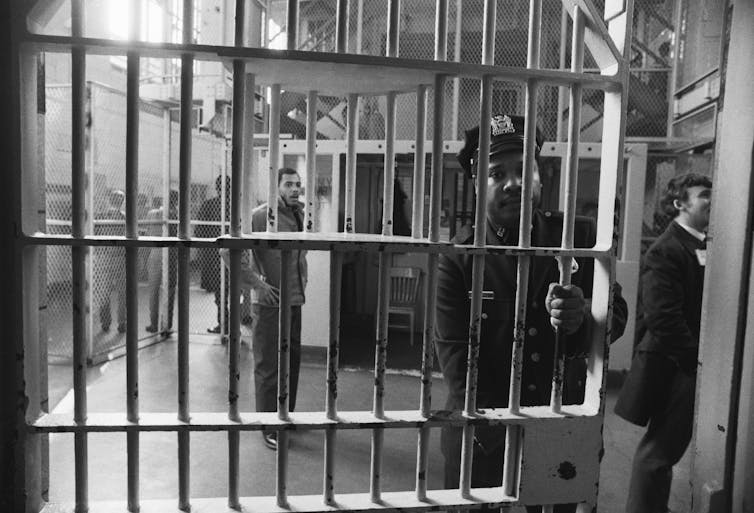
Social distancing is impossible in correctional facilities and, as a result, so is COVID-19 prevention.
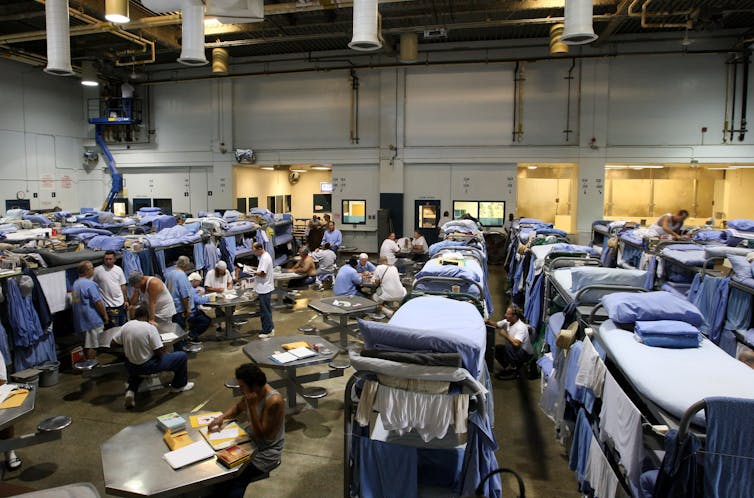
In California, for example, where 109,000 prisoners are housed in facilities with a maximum capacity of 85,000, the infection rate in June for the state’s jails and prisons was about 40 per 1,000 inmates – more than seven times the rate for the state’s population as a whole.
In New York City’s jails, it was was more than 7%, compared to just over 2% for the city’s population.
Inmates fear for their lives. One California prisoner, who is serving an eight-year sentence for causing injury while driving drunk, told the Los Angeles Times: “I don’t deserve a death sentence.”
Overcrowding in prisons: Inmates at the Mule Creek State Prison in a gymnasium that was modified to house prisoners in Ione, California.Justin Sullivan/Getty Images
Justice in punishment
Philosophers since Aristotle have debated what justice in punishment requires. For him, punishment is governed by the requirements of what he called “corrective justice.” By this he meant that when someone is injured, the offender should be punished by inflicting comparable harm.
Aristotle‘s idea that punishment is a deserved and proportional response to an offense provides a building block for retributive theories of punishment, which embrace some form of “an eye for an eye” as a way to do justice.
Those theories insist, as 18th-century philosopher Immanuel Kant noted, that punishment “can never be inflicted merely as a means to promote some other good for the criminal himself or for civil society. It must always be inflicted upon him because he has committed a crime.” In other words, just punishment must give people what they deserve, nothing less and nothing more.
Thus, Kant suggested that the amount of punishment should be governed by a principle of proportionality.
Many contemporary theorists of punishment embrace this idea. As legal scholar Bernard Harcourt recently said, punishment “should be proportional to the amount of harm caused by the offender.”
Prison conditions
To determine whether the risk of being exposed in prison to sickness or death from COVID-19 is disproportionate punishment requires paying attention to prison conditions. One question to ask is whether the harsh conditions of life behind bars are part of a criminal’s punishment or merely a collateral consequence of their sentence.
Throughout most of American history, a criminal sentence was thought to be the full measure of the punishment inflicted – jail and prison conditions, as bad as they might be, were not regarded as part of the punishment.
In 1992, Supreme Court Justice Clarence Thomas observed, in a case brought by an inmate who had been beaten by a guard, that the prohibition on cruel punishment found in the Constitution’s Eighth Amendment did not apply to any “deprivations” or “hardships” during incarceration.
Two years later, Thomas reiterated his view that the overcrowding, disease or violence which are often part of confinement “are not punishment in any recognized sense of the term.”
But Thomas’ view has not prevailed.
In a series of recent cases, the United States Supreme Court has held that what happens in jails and prisons is in fact part of an inmate’s punishment and must be considered in deciding whether their treatment is just.
As Justice Lewis Powell said in a 1981 case challenging prison overcrowding, such conditions are part of the punishment and are “subject to scrutiny under the Eighth Amendment standards.”
Those conditions “must not,” he said, “involve the wanton and unnecessary infliction of pain, nor may they be grossly disproportionate to the severity of the crime warranting imprisonment.”
In 2011, the Supreme Court reaffirmed the view that jail and prison conditions were very much part of the punishment. The court upheld a lower court order directing the state of California to reduce the size of its prison population so as to reduce overcrowding and provide better medical treatment for inmates.
In the coming weeks, courts will be handling a number of pandemic-related cases involving prisoners, and legislatures will be considering proposals to let large numbers of inmates leave confinement.
As they do so, it is important for them to acknowledge that when the government puts someone behind bars and deprives them of the capacity to provide for their own care and protection it has, what law professor Sharon Dolovichcalls “an affirmative obligation,” a duty to act to protect them from harm.
Judges and legislators will need to consider both whether being exposed to COVID-19 in prison is a disproportionate and unjust punishment and also how to discharge the government’s responsibilities to the incarcerated.
Doing so should, I believe, lead them to release as many inmates as possible from the dangers to which COVID-19 is exposing them every day.
Austin Sarat, Associate Provost and Associate Dean of the Faculty and Cromwell Professor of Jurisprudence and Political Science, Amherst College
This article is republished from The Conversation under a Creative Commons license.
Note from Editor of The Conversation US: This is a revised version of the original piece. We have done so to make explicit the author’s expertise with regard to the subject of this article. We have also incorporated important context that was missing in the original version.
The question of whether a god exists is heating up in the 21st century. According to a Pew survey, the percent of Americans having no religious affiliation reached 23 percent in 2014. Among such “nones,” 33 percent said that they do not believe in God – an 11 percent increase since only 2007.
Such trends have ironically been taking place even as, I would argue, the probability for the existence of a supernatural god have been rising. In my 2015 book, “God? Very Probably: Five Rational Ways to Think about the Question of a God,” I look at physics, the philosophy of human consciousness, evolutionary biology, mathematics, the history of religion and theology to explore whether such a god exists. I should say that I am trained originally as an economist, but have been working at the intersection of economics, environmentalism and theology since the 1990s.
Laws of math
In 1960 the Princeton physicist – and subsequent Nobel Prize winner – Eugene Wigner raised a fundamental question: Why did the natural world always – so far as we know – obey laws of mathematics?
As argued by scholars such as Philip Davis and Reuben Hersh, mathematics exists independent of physical reality. It is the job of mathematicians to discover the realities of this separate world of mathematical laws and concepts. Physicists then put the mathematics to use according to the rules of prediction and confirmed observation of the scientific method.
But modern mathematics generally is formulated before any natural observations are made, and many mathematical laws today have no known existing physical analogues.
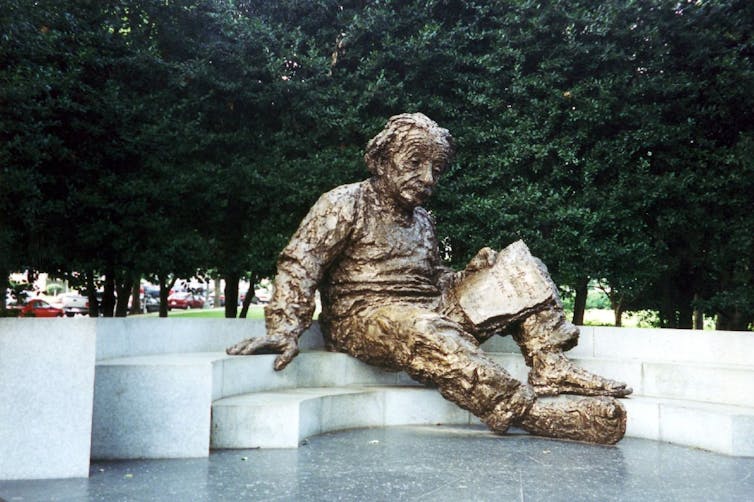
Einstein Memorial, National Academy of Sciences, Washington, D.C.Wally Gobetz, CC BY-ND
Einstein’s 1915 general theory of relativity, for example, was based on theoretical mathematics developed 50 years earlier by the great German mathematician Bernhard Riemann that did not have any known practical applications at the time of its intellectual creation.
In some cases the physicist also discovers the mathematics. Isaac Newton was considered among the greatest mathematicians as well as physicists of the 17th century. Other physicists sought his help in finding a mathematics that would predict the workings of the solar system. He found it in the mathematical law of gravity, based in part on his discovery of calculus.
At the time, however, many people initially resisted Newton’s conclusions because they seemed to be “occult.” How could two distant objects in the solar system be drawn toward one another, acting according to a precise mathematical law? Indeed, Newton made strenuous efforts over his lifetime to find a natural explanation, but in the end he could say only that it is the will of God.
Despite the many other enormous advances of modern physics, little has changed in this regard. As Wigner wrote, “the enormous usefulness of mathematics in the natural sciences is something bordering on the mysterious and there is no rational explanation for it.”
In other words, as I argue in my book, it takes the existence of some kind of a god to make the mathematical underpinnings of the universe comprehensible.
Math and other worlds
In 2004 the great British physicist Roger Penrose put forward a vision of a universe composed of three independently existing worlds – mathematics, the material world and human consciousness. As Penrose acknowledged, it was a complete puzzle to him how the three interacted with one another outside the ability of any scientific or other conventionally rational model.
How can physical atoms and molecules, for example, create something that exists in a separate domain that has no physical existence: human consciousness?
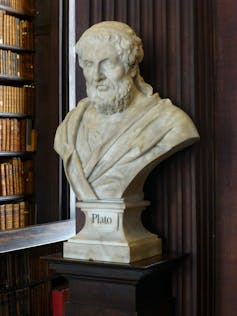
This mystery is the same one that existed in the Greek worldview of Plato, who believed that abstract ideas (above all mathematical) first existed outside any physical reality. The material world that we experience as part of our human existence is an imperfect reflection of these prior formal ideals. As the scholar of ancient Greek philosophy, Ian Mueller, writes in “Mathematics And The Divine,” the realm of such ideals is that of God.
Indeed, in 2014 the MIT physicist Max Tegmark argues in “Our Mathematical Universe” that mathematics is the fundamental world reality that drives the universe. As I would say, mathematics is operating in a god-like fashion.
The mystery of human consciousness
The workings of human consciousness are similarly miraculous. Like the laws of mathematics, consciousness has no physical presence in the world; the images and thoughts in our consciousness have no measurable dimensions.
Yet, our nonphysical thoughts somehow mysteriously guide the actions of our physical human bodies. This is no more scientifically explicable than the mysterious ability of nonphysical mathematical constructions to determine the workings of a separate physical world.
Until recently, the scientifically unfathomable quality of human consciousness inhibited the very scholarly discussion of the subject. Since the 1970s, however, it has become a leading area of inquiry among philosophers.
Recognizing that he could not reconcile his own scientific materialism with the existence of a nonphysical world of human consciousness, a leading atheist, Daniel Dennett, in 1991 took the radical step of denying that consciousness even exists.
Finding this altogether implausible, as most people do, another leading philosopher, Thomas Nagel, wrote in 2012 that, given the scientifically inexplicable – the “intractable” – character of human consciousness, “we will have to leave [scientific] materialism behind” as a complete basis for understanding the world of human existence.
As an atheist, Nagel does not offer religious belief as an alternative, but I would argue that the supernatural character of the workings of human consciousness adds grounds for raising the probability of the existence of a supernatural god.
Evolution and faith
Evolution is a contentious subject in American public life. According to Pew, 98 percent of scientists connected to the American Association for the Advancement of Science “believe humans evolved over time” while only a minority of Americans “fully accept evolution through natural selection.”
As I say in my book, I should emphasize that I am not questioning the reality of natural biological evolution. What is interesting to me, however, are the fierce arguments that have taken place between professional evolutionary biologists. A number of developments in evolutionary theory have challengedtraditional Darwinist – and later neo-Darwinist – views that emphasize random genetic mutations and gradual evolutionary selection by the process of survival of the fittest.
From the 1970s onwards, the Harvard evolutionary biologist Stephen Jay Gould created controversy by positing a different view, “punctuated equilibrium,” to the slow and gradual evolution of species as theorized by Darwin.
In 2011, the University of Chicago evolutionary biologist James Shapiro argued that, remarkably enough, many micro-evolutionary processes worked as though guided by a purposeful “sentience” of the evolving plant and animal organisms themselves. “The capacity of living organisms to alter their own heredity is undeniable,” he wrote. “Our current ideas about evolution have to incorporate this basic fact of life.”
A number of scientists, such as Francis Collins, director of the U.S. National Institutes of Health, “see no conflict between believing in God and accepting the contemporary theory of evolution,” as the American Association for the Advancement of Science points out.
For my part, the most recent developments in evolutionary biology have increased the probability of a god.
Miraculous ideas at the same time?
For the past 10,000 years at a minimum, the most important changes in human existence have been driven by cultural developments occurring in the realm of human ideas.
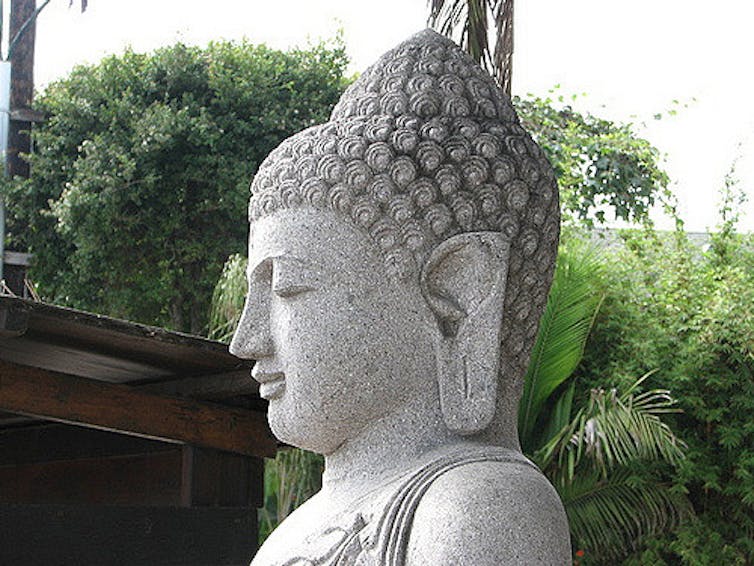
In the Axial Age (commonly dated from 800 to 200 B.C.), world-transforming ideas such as Buddhism, Confucianism, the philosophies of Plato and Aristotle, and the Hebrew Old Testament almost miraculously appeared at about the same time in India, China, ancient Greece and among the Jews in the Middle East, groups having little interaction with one another.
Many world-transforming ideas, such as Buddhism, appeared in the world around the same time.Karyn Christner, CC BY
The development of the scientific method in the 17th century in Europe and its modern further advances have had at least as great a set of world-transforming consequences. There have been many historical theories, but none capable, I would argue, of explaining as fundamentally transformational a set of events as the rise of the modern world. It was a revolution in human thought, operating outside any explanations grounded in scientific materialism, that drove the process.
That all these astonishing things happened within the conscious workings of human minds, functioning outside physical reality, offers further rational evidence, in my view, for the conclusion that human beings may well be made “in the image of [a] God.”
Different forms of worship
In his commencement address to Kenyon College in 2005, the American novelist and essayist David Foster Wallace said that: “Everybody worships. The only choice we get is what to worship.”
In several of my books, I have explored how Marxism and other such “economic religions” were characteristic of much of the modern age. So Christianity, I would argue, did not disappear as much as it reappeared in many such disguised forms of “secular religion.”
That the Christian essence, as arose out of Judaism, showed such great staying power amidst the extraordinary political, economic, intellectual and other radical changes of the modern age is another reason I offer for thinking that the existence of a god is very probable.
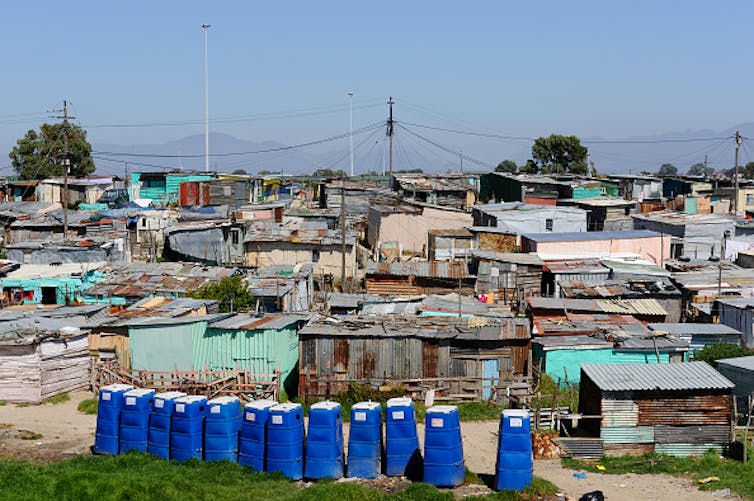
The township of Khayelitsha in Cape Town. South Africa has adopted First World COVID-19 responses for Third World reality.
COVID-19 infections are rising sharply in South Africa – and Latin America. This is fitting: South Africa resembles the countries of South America more than those of its home continent.
It has become common to point out that COVID-19 has highlighted South Africa’s inequalities. It is less common, but just as important, to recognise that inequality shapes how the country is governed, ensuring that, while South Africa is located in Africa, those who govern it may be closer to their counterparts in Latin America.
The first reason South Africa has been unable to stem the tide of infections is that its strategy always assumed a severe epidemic was inevitable. It is hard to fight anything if you assume you are bound to lose. This followed advice from South Africa’s medical scientists, almost all of whom embrace this view despite the fact that scientists in other parts of the world have helped to prevent great damage.
Why is this? Possibly because their points of comparison on the pandemic were not Asia and parts of Africa where infections were curbed, but the rich countries of the global North, many of which were overwhelmed. They also probably assumed that while some countries might be able to prevent a severe outbreak, South Africa could not.
If so, this would reveal a common way of thinking in South Africa: the belief that the country must compare itself to the rich countries of the North – but that it will never match up.
Capacity problems
This pessimism is born of the view that South Africa’s government has very limited capacity. The failure to curb COVID-19 does show glaring capacity gaps. But the problem is not, as critics usually assume, a lack of technical know-how. It is, rather, a particular view of the world and the difficult relationship between those who govern and the governed.
Despite appearing to give up before the fight began, South Africa could have contained COVID-19 had it done what its government said it would do: create an effective testing and tracing programme which would identify people with the virus, trace their contacts and isolate them if they were infected.
In May, doctors complained that it took on average a week to receive COVID-19 test results for outpatients and three to four days for patients in hospitals. Other doctors reported cases in which it took weeks to receive results. At the end of May, Gauteng, the country’s economic hub, was waiting for test results for over 20,000 people.
Testing can contain COVID-19 only if results are received speedily so that the contacts of infected people can be traced. The laboratory backlog meant that testing and tracing could not work no matter how many tests were conducted and how many health workers were hired.
This seems to be an obvious technical failure. Some test results were, according to doctors, lost, which seems to show that the lab was simply not up to the task. But the real problem may be that the government put far too much faith in a high-tech laboratory which was, because too much was expected of it, simply overwhelmed (hence the lost results).
By contrast, Senegal, a far poorer country, knowing that it had no laboratory service that could have coped, developed a test which cost only $1 and produced results very quickly.
South African President Cyril Ramaphosa.
So, South Africa believed it had capacity which it lacked. It also assumed that a laboratory which operated like those in rich countries was the most effective way to test for COVID-19. And so, unlike Senegal, it failed to come up with a solution fitted to its needs. Again, the desire to be like the North made it impossible to contain the virus.
Elitist approach
The second problem is that the behaviours which are needed to stem COVID-19 are very difficult for most South Africans – those who live in the formerly blacks-only urban townships and in shack settlements. Overcrowding makes physical distancing very hard, clean water may not be available for hand washing and people are forced to travel in full minibus taxis.
The government could have overcome these problems if it had chosen to work with people in these areas to find ways to protect themselves. But it did not try – it relied on instructing people to do things they clearly could not do.
To South Africa’s elite, of which the government is now a part, people in low-income townships lack sophistication and maturity: poverty is confused with inability. And so there is no point in working with them.
The problem here is the government’s lack of political capacity, its inability to form a relationship with voters which would enable them to work together against a common threat.
Why is South Africa governed this way? Unlike other sub-Saharan African countries and like several Latin American countries, South Africa is both “First World” and “Third World”. A significant section of its people lives like, and measure themselves by the standards of, the affluent in North America and Western Europe.
This is why it has facilities other African countries lack and why it insists on relying on them.
People who live in “First World” conditions also find it much easier to lobby politicians. That is why the government’s claim that it would be guided only by the science of COVID-19 collapsed as lobby groups persuaded it to open activities which allowed the virus to spread.
But most people live in the same conditions as the poor of the “Third World”. Facilities designed for the “First World” one-third of the population cannot meet the needs of the other two-thirds. The elite’s deep admiration for the “First World” ensures that the government always wants to rely on what works only for the one-third because only this is “respectable”.
The issue is not that many South Africans are wealthy and live well – so do elites in other African countries. It is that the country is divided into two worlds. An entire economy and social system serves one-third of the people and excludes the rest from its benefits. This shapes attitudes as well as who gets what. The government may be elected by people outside the charmed circle but it is a product of it, hence its response to COVID-19.
Exceptionalism
Another consequence, common to South Africa and much of Latin America, is that those who live in “First World” conditions tend to see those who don’t as people who have not attained their exalted standards: they must be told what to do and controlled if they do not listen. Working with the majority to fight the virus isn’t possible when they are seen as “backward” embarrassments.
Many South Africans like to think the country is unique in sub-Saharan Africa. Its contrasts of wealth and poverty certainly are one of a kind. Its response to COVID-19 shows how much this prevents the government from doing what it needs to do.